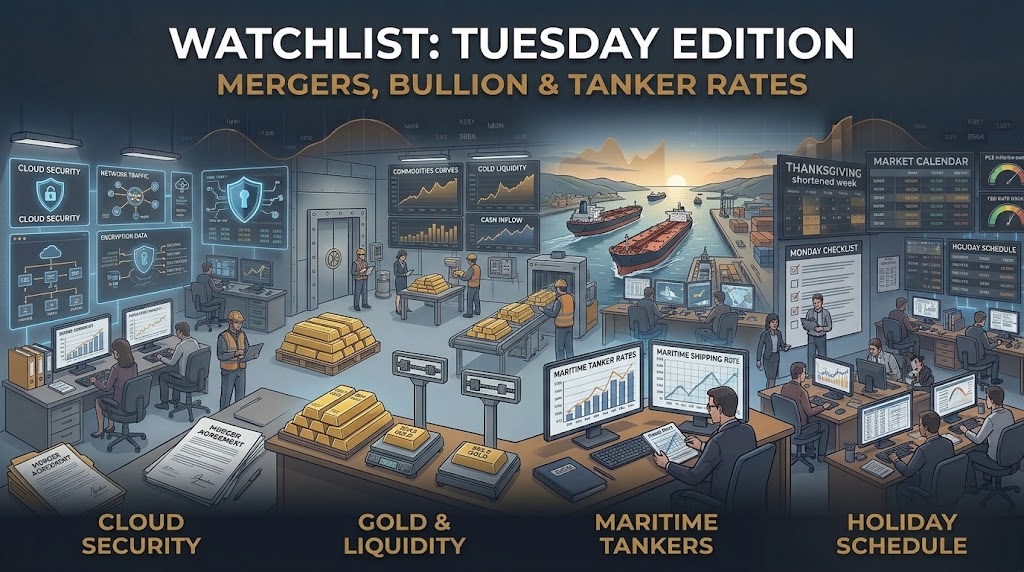
Morning Watchlist: Tuesday Edition
A quick note from Behind the Markets
It's a short holiday week, and it started with a hangover.
Last week, the S&P 500 fell seven days in a row, its longest losing streak since February 2020. On Friday alone it lost 3.7%, the Nasdaq lost 5.3%, and Nvidia lost 13.8%. By the close, the S&P 500 and the Dow were both in a correction, more than 10% below their record highs.
On Monday morning, before the open, futures pointed sharply higher. We went to press before the bell, so how Monday finished is yours to check, not ours to guess.
Here's what we keep coming back to. In a stampede, people don't sell what's broken. They sell what's easy to sell. Three stories this morning. Three pairings. Let's get into it.
1) The Biggest Deal in Cybersecurity
On Monday, CrowdStrike agreed to buy Zscaler in an all-stock deal worth about $43.9 billion. Zscaler holders get 1.135 CrowdStrike shares for each share they own, about $260 a share based on Friday's close. That's a 34% premium.
CrowdStrike protects laptops and servers. Zscaler protects the network traffic between them. Together, they expect to start with more than $10 billion in annual recurring revenue. CEO George Kurtz's exact words: "Security used to be about keeping the adversary out. Today, safety is required to let AI in."
The market's first reaction was mixed. Before the open, Zscaler jumped about 13% to 18%, still well short of the offer. CrowdStrike fell about 8%.
Now look at the timeline. The deal isn't expected to close until the second half of CrowdStrike's fiscal 2028, which runs from roughly August 2027 to January 2028. That's the better part of a year in which every Zscaler customer has a contract up for renewal and a new owner they didn't choose.
Big mergers create a long, awkward limbo. Limbo is when customers shop around.
The pairing: Netskope (NTSK) — Watch
Netskope sells the same kind of cloud network security Zscaler does, and competes with it head-to-head. With Zscaler folding into CrowdStrike, Netskope becomes the largest pure-play independent left in that corner of the market.
Think about what happens when two big airlines merge. For a year or so, nobody knows which loyalty program survives or which routes get cut. The third carrier at the airport doesn't have to do anything clever. It just has to be there when frustrated travelers check other fares.
Netskope's business is growing fast. Its last reported quarter, ended July 31st, showed revenue up 29% to $221 million, and it guided the next quarter to $227 to $229 million. The stock closed Friday at $23.93, roughly triple its March low.
So why Watch and not Buy? Price, and profits. At about $9.8 billion in market value, Netskope trades near 11 times its current annual sales run-rate, by our math. It still loses money: its net loss last year was $679 million. And the stock already sits above Wall Street's average price target of about $23.
Our entrance is the December earnings report. If revenue growth holds near 30% and management talks about winning Zscaler customers, move it up your list. The risk, plainly: CrowdStrike and Palo Alto Networks both sell "one platform for everything," and if big customers buy the bundle, the independent gets squeezed rather than helped.
2) Gold Got Used as an ATM
Gold had its worst week in eight months. It fell about 9% and touched a 14-month low near $3,516 an ounce on Friday. In January, it hit a record of $5,515.
That's down more than a third from the top.
Two forces did it. The Fed: traders see a December rate hike as close to certain, and Fed Governor Lisa Cook said rates still aren't high enough for current inflation. Higher rates make a metal that pays no interest less attractive. And the AI selloff, which triggered margin calls. When investors need cash fast, they sell what they can sell quickly. Chris Weston of Pepperstone put it perfectly: "Gold has become a source of liquidity rather than a destination for safety."
The miners got dragged along. On Friday, the VanEck Gold Miners ETF traded near its 52-week low, about 40% below its high.
The pairing: Newmont (NEM) — Buy
Newmont is the world's largest gold miner. On Friday morning, it traded around $98, down about 16% in a month.
Picture a pawn shop during a panic. People bring in their gold watches first. Not because the watches stopped working, but because gold is the one thing the shop will always take for cash. When the panic passes, the watch is worth exactly what it was before.
Wall Street still expects Newmont to earn about $9.28 a share this year and $9.85 next year. At $98, that's about 10 times next year's earnings. The S&P 500, even after its slide, sits near 18 times by Goldman Sachs' count. The biggest gold miner on Earth, priced like gold's best days are over.
And gold's bounce on Monday morning, about 2% to roughly $3,600, is a reminder of how fast forced sellers can disappear.
The risks, plainly. Analysts have cut Newmont's fourth-quarter earnings estimate about 14% over 90 days, and they'll cut more if gold keeps falling. Some strategists see $3,200 as the next stop. A string of Fed hikes into 2027 would keep pressure on the metal. If gold breaks well below $3,500 and stays there, the earnings math changes and we're wrong.
3) The Ships Got Hit. The Stocks Got Sold.
Here's a strange split. Near the Strait of Hormuz, attacks on tankers are getting worse, not better. On Saturday, two tankers were hit by projectiles off Khasab, Oman. Attacks in October and November have been higher than in any month since the war with Iran began in late February.
Yet oil keeps falling. Brent crude is down about 20% in November. And tanker stocks have given back nearly half their wartime gains on talk of sanctions relief and a possible deal.
The head of the International Energy Agency, Fatih Birol, isn't buying the peace story. His words: "I don't see any credible pathway back to the situation that existed in February 2026."
The pairing: Teekay Tankers (TNK) — Buy
Teekay Tankers owns a fleet of mid-sized crude and product tankers, mostly Suezmaxes and Aframaxes, and most of them work in the spot market, where rates are set voyage by voyage.
Think of a moving company during an evacuation. The roads are dangerous, so fewer trucks drive them, and the ones that do name their price.
Here's the price. In the third quarter, Teekay's Suezmaxes earned about $106,000 a day. For the fourth quarter, with 63% of their days already booked, they're earning $272,000 a day. Aframaxes went from about $68,000 to $208,000. The CEO says the company is positioned for its best quarter and best year ever.
The stock closed Friday at $85.42, about 21% below its high. That's a market value near $3 billion, and the company holds about $1.4 billion in cash and short-term investments, with no debt reported. Nearly half the price tag is cash. And in the first nine months of the year, Teekay earned about $14 a share in adjusted profit. You're paying about six times nine months of earnings, before the record quarter arrives.
The honest risk is peace. A real deal that reopens Hormuz would drain those rates fast, and a spot fleet feels it within weeks. If shipping lanes normalize and rates fall back toward last year's levels, the call is wrong.
Before You Go
That's the watchlist. A $44 billion merger that leaves an independent rival in the middle of a long limbo. A gold miner sold because gold was easy to sell. And a tanker company priced for peace while its ships earn wartime rates.
One theme connects them: in a stampede, the crowd sells what it can, not what it should.
Your calendar: Best Buy and Burlington, both on our Watch list, reported this morning before the open, and our entrances are already written down. Symbotic, our Monday Watch, reported Monday night after we went to press. Dell reports after the close. On Wednesday morning, Deere and the PCE inflation report land together. Markets close Thursday for Thanksgiving.
Found this helpful? Share it with others.
Written by Behind The Markets