Morning Watchlist: Friday Edition
A quick note from Behind the Markets
It's Friday. And for the first time in its 33-year history, Nvidia has a chief executive who isn't Jensen Huang.
On Wednesday night, Nvidia's board went behind closed doors to decide whether to remove him. On Thursday morning, before the opening bell, the board announced that Huang had resigned, effective immediately. Chief Financial Officer Colette Kress is now interim CEO. The shares fell about 10% in premarket trading.
Here's the good news: our pairing doesn't depend on who gets the job next.
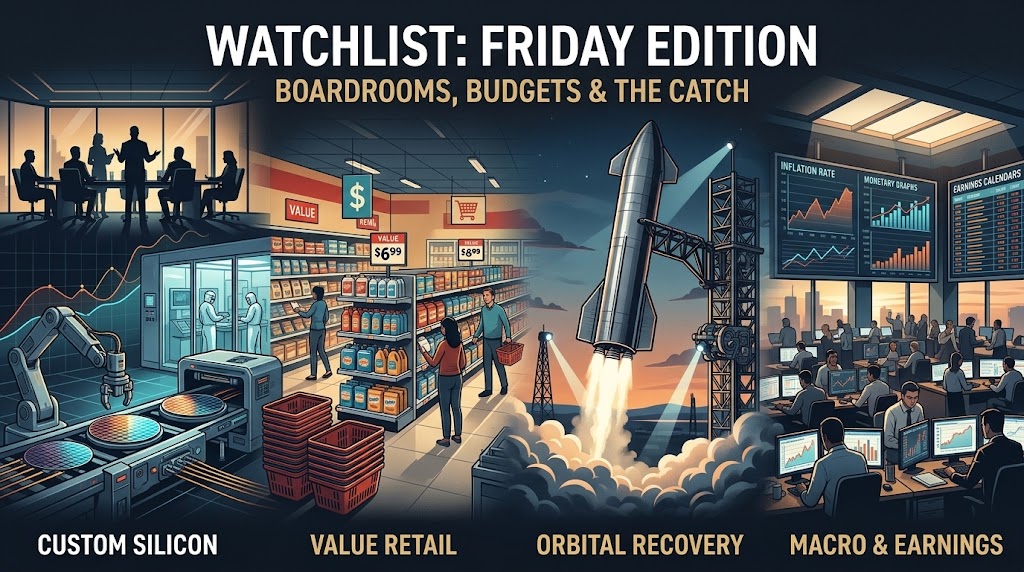
A founder out of the chair. A consumer quietly changing addresses. And, this evening, a company trying to catch a rocket out of the sky. Three stories this morning. Three pairings.
Let's get into it.
1. The Most Expensive Chair in Silicon Valley
A quick recap for anyone just joining. On Sunday, Huang admitted in a memo to employees that he had been unfaithful to his wife — with an executive at a major Nvidia customer whom U.S. intelligence suspects of working for Beijing. On Wednesday it got worse: The New York Times reported a second relationship, this one with Kimberly Powell, the Nvidia executive who runs its healthcare business and reports directly to him. By evening, The Wall Street Journal reported the board was preparing to remove him, Reuters confirmed it, and the directors convened. The stock closed Wednesday at $173.73 and fell more than 8% in after-hours trading. Elon Musk suggested he'd hire him. Thursday morning, Huang resigned rather than wait for the vote, and the stock was down about 10% before the market opened.
Strip away the soap opera and one market fact remains. Nvidia ran on one man — roughly 60 direct reports and no announced successor, which is why the board's first move was to hand the keys to its CFO on an interim basis. For three years, everyone building AI has lived with a single point of failure they preferred not to think about. On Thursday, it failed.
When the only grocery store in town has a fire, every family plants a garden.
In chips, the garden is custom silicon — processors a big cloud company designs for its own workloads instead of buying off the rack. (Nvidia sells brilliant off-the-rack suits, at full price. A custom chip is a suit cut to measure.) And the tailor the giants keep hiring is Marvell.
The pairing: Marvell Technology (MRVL) — Buy
In June, at the Computex conference, one of the most famous CEOs in technology called Marvell "the next trillion-dollar company." That CEO was Jensen Huang — as of Thursday, Nvidia's former CEO. He backed the words with money: Nvidia invested $2 billion in Marvell and made it a partner on its NVLink platform. In August, Google signed Marvell to build chips for its TPU ecosystem.
Since Huang said it, the stock has nearly been cut in half — from a record near $316 to about $169. Not because of him. On November 2, Marvell agreed to buy Lumentum — the company whose lasers and optics connect AI data centers — in a $115 billion all-stock deal. All-stock means paying with your own shares: Marvell's share count grows about 49%, Bank of America and TD Cowen downgraded, and the stock lost more than a third of its value before bouncing nearly 12% on Wednesday. Revenue, meanwhile, is growing about 30% a year.
Here's the detail we keep coming back to. When Google signed on in August, it negotiated warrants — the right to buy 59 million Marvell shares at $206.58. The market is offering you the same stock at about $169. The average analyst target sits near $315.
The honest risks: 49% more shares is real dilution, the Lumentum deal needs Chinese regulatory approval and isn't expected to close until 2028, and if AI construction slows, the custom-chip order book slows with it. But notice what's happening beneath the headlines. The crowd spent the week arguing about one man. The customers are quietly buying insurance against needing him.
2) The Shopper Changed Addresses
While the AI trade watched a boardroom, the American consumer filed a quieter report. On Wednesday, the CNBC/NRF Retail Monitor put October retail sales up just 0.2% — $561.7 billion, the slowest monthly pace in nearly a year. Core sales rose 3.4% from a year earlier, which sounds fine until you remember Tuesday's hot CPI: much of that growth is prices, not purchases. Credit-card balances sit at records.
So is the consumer dead? Look closer at the 0.2%. Spending didn't stop. It's being rationed.
A tight month doesn't cancel the shopping list. It changes the address at the top of it.
We know where that migration ends, because the destination already told us. Last quarter, Dollar General grew same-store sales 3.5% with customer traffic up 2% — and CEO Todd Vasos described "strong trade-in across middle- and high-income" shoppers, even as he called the chain's core customers "financially constrained." Translation: wealthier households are walking into dollar stores, by necessity, in numbers the company itself finds striking.
The pairing: Dollar General (DG) — Buy
Dollar General sells the weekly basics — more than 80% of sales are consumables like food and household staples, the last things any budget cuts. At about $137, the stock costs roughly 17 times next year's expected earnings. The S&P 500: 21 times. It still sits about 13% below its 52-week high, and JPMorgan recently raised its target to $178.
A ledger note: we first flagged Dollar General on September 25th, at about $120, when McDonald's warned about its low-income customer. It's up roughly 14% since, and we're re-upping rather than discovering — because October's data says the migration is accelerating into the holidays, and the December 3 earnings report is where it should show up as new faces at the register.
The risks, plainly: the FTC and 20 states sued in late October, alleging shoppers are charged more at the register than the shelf price — an ugly suit for a business built on price trust. And if its core customer slides from strained to broke, traffic eventually goes with them.
3) The $1.9 Trillion Catch
This evening, if the weather and the paperwork cooperate, SpaceX will attempt something no one has ever done.
Starship Flight 15 is targeted for a launch window opening at 5:45 Eastern tonight. The giant booster comes back to the launch tower about six and a half minutes after liftoff — SpaceX has caught it three times before. The new part is the ship on top: it deploys 26 Starlink satellites, spends about 22 hours in orbit, then returns Saturday afternoon for its own tower catch. Catch both, and it's the first full recovery of an orbital launch system in history. Musk's own October framing: not guaranteed, but "more likely than not."
We'll be watching like everyone else. We just won't be buying tickets at this price.
The pairing: SpaceX (SPCX) — Watch
At about $141 — down 37% from its post-IPO high of $225.64 — SpaceX still carries a market value near $1.9 trillion, about 33 times its annualized revenue. And here's what the fireworks hide: the rocket business is just 12% of that revenue — $1.8 billion of $14.6 billion last quarter. Roughly half the company is AI computing; a third is Starlink.
Buying the stock tonight for the catch is buying the whole mall because you like the food court.
Markets price a spectacle by the next open, then spend years deciding whether they were right. What moves this up our list: the ship caught and then actually reflown — the step that collapses the cost of reaching orbit — or a price that pays you fairly for the 88% of the company that isn't the rocket. The risks of the trade either way: a scrub or a failure costs time and money, and 33 times sales is a hard number to defend in a world where the ten-year Treasury pays five.
Before You Go
That's the watchlist. A founder left the chair — and the tailor the whole industry hires is on sale. The shopper changed addresses — and the register at the end of the migration reports December 3. And tonight, they try to catch the rocket.
Three notes for your weekend radar. Cisco and Applied Materials reported after Thursday's close — after we went to press — so grade Cisco against the margin bar we set Thursday, and let AMAT grade the equipment aisle where our Lam Research and FormFactor positions sit. October PPI landed at 8:30 this morning, half an hour before this note — the last big inflation print before the Fed's December 8–9 meeting. And if the ship flies tonight, the catch attempt comes Saturday afternoon.
Found this helpful? Share it with others.
Written by Behind The markets