Dear Reader,
Everybody's been asking me what I think about Jensen being back at Nvidia.
What I think is that he probably shouldn't have been pushed out as quickly.
What I think is that it makes us look very sloppy.
Our administration looked very sloppy.
He gets approval from the Commerce Department to sell to Megaspeed.
Then Treasury goes off and says it's a national security risk.
It just seems like the left hand of the Trump administration doesn't know what the right hand is doing.
I suspect there's bigger stuff going on here than any of us know about.
The China Playbook
Remember when Trump went after China with 125% tariffs?
The administration was saying, "We're going to make them buckle."
Then real quick, China said, "Well, you're not going to get rare earths."
The CEOs of the automakers weren't allowed to say anything in public.
But in the industry rags they were saying, "We can't get rare earths. Our production lines are going to stop. We're going to stop making Ford cars."
And then the Trump administration just blinked.
I suspect there's a deal behind the scenes where we get rare earths in exchange for giving them chips.
I expect there's some kind of hustle going on here that none of us are aware of.
But no matter what, you just feel like it's amateur hour up there.
It's just so sloppy.
It's really, really sad.
Look Where Nobody Else Is Looking
One of the habits I picked up as an investor early in my life is this.
When everybody's looking at one thing, I like to look somewhere else.
It's like one of those spy movies, like the Bourne Identity.
He creates a distraction and sets a bomb off in a car.
Everybody runs over there to look, and he steals the jewelry and makes his getaway on the other side.
I'm a big fan of distractions, because they're great opportunities to make money or to learn really interesting new things.
So when something has everybody's attention fixed, I look around at everywhere else people are not looking.
I've developed that discipline over 35 years.
What Happened While Everyone Watched Jensen
If you looked last week, while everybody was talking about Jensen, something else happened.
On Thursday, the Senate passed a data center law with bipartisan support.
It's called the Bipartisan American Affordability and Jobs Act.
God, these people come up with the dumbest names.
Here's what it does.
Data centers pay for the grid costs they create, instead of passing them on to you.
It passed 62 to 33.
It requires federal regulators to change how transmission costs are split, so utilities charge data centers for their share of the existing grid, plus the extra costs of serving them.
Why wasn't this passed before the election?
Trump tried to pass it, but the Democrats wanted to run on it.
They knew it was a good wedge issue.
Very smart wedge issue.
So they ran on it.
But as soon as they won, everybody passed it, because nobody really wants to litigate this.
It's Kabuki theater.
You always have to remember, as an investor, to separate policy from politics.
Politics is what you say to everybody else in public.
Policy is what you do in Washington.
Nobody has an interest in stopping data centers en masse.
I mean, come on.
Let's be realistic.
That hysteria is just not real.
It's silly, really, for anybody who studies Washington and the market.
The Two-Month Window
Here's a side note for the history buffs.
One of the great things our founders set up is a gap between when an old Congress finishes and a new Congress gets sworn in.
It's about two months, and it's really special.
Look at the great pieces of legislation passed in that window and you'll be amazed.
Everybody who lost the election can now just vote their conscience.
Lincoln passed the amendment ending slavery during that period.
It's one of those rare times when people in Washington can actually vote their conscience.
You get a lot of great things from that little window that most people don't even consider.
The Senate passed this one.
It goes to the House, where it will very likely pass, and Trump will sign it.
That's the baseline expectation.
What It Means for Investors
This law standardizes how data centers get built.
That's very important nationally.
You want states to have some control, but you also want a guaranteed rule across the land.
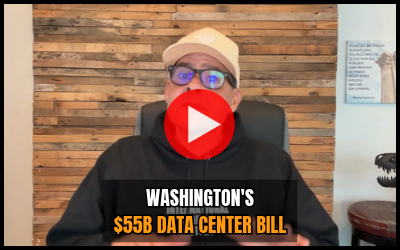
The consulting firm Grid Strategies estimates it will shift $55 billion in grid costs onto data centers over ten years.
That's good for regular people, who have been absorbing these costs.
Everybody says, "I don't care if there's a data center here. I just don't want to see my electric bill go up 10% because of it."
Now think about what $5.5 billion a year in extra cost does.
The weaker financial players, like some of the weaker NeoClouds, are going to have more difficulty paying for it.
Their margins get squeezed.
It lends itself to stronger companies being able to afford the increase, and to the argument that the weaker data centers are going to die.
And when you raise the cost of something, you can only do less of it.
If there were 20 new data centers planned for next year, maybe now there are 15.
So it slows the pace down, which is part of why you've seen the sell-off.
It also makes capital more expensive.
But the bigger picture is that it slows things down, which we've talked about here, and makes the whole build-out a heck of a lot more sustainable over time.
So while everybody was talking about Jensen Huang, this happened.
Everyone was watching Jensen.
But the real story is the power story.
Every data center needs it, and now they'll pay for it.
Find out who profits from the power change here>>>
And another big, exciting thing happened with robotics, with ChatGPT.
I'll be talking to you about it in the next day or two.
It's a real game changer in AI and robotics, and I look forward to it.
That's all I have for you today.
Have a wonderful day.
I'll see you tomorrow with a Thanksgiving note.
Take care.
“The Buck Stops Here,”
Found this helpful? Share it with others.
Written by Dylan Jovine