Dear Reader,
This is Dylan Jovine with Behind the Markets.
Happy Friday.
Today is Friday, July 31st.
TGIF, and the last day of the month.
I want to ask the question everybody’s asking right now.
Is the AI trade over?
My answer is clearly no.
But as I said yesterday, Wall Street hasn’t settled on a new story yet.
And without a master narrative carrying the torch, these stocks are going to stay choppy.
What’s Actually Happening
AI infrastructure stocks have gotten hammered over the past thirty days.
The stocks that were receiving all that capital spending — the ones that went absolutely bonkers — have been crushed.
I’m very grateful that before I left on vacation, we closed a lot of those positions.
We still have a few left — Amkor, ARM — where we sold half for profits and still hold the remainder.
But here’s how I see the recent decline.
This is a positioning issue, not a fundamentals issue.
Short-term investors rotating out.
Fast money chasing the next thing.
The underlying story hasn’t changed.
I still expect AI compute demand to significantly outpace supply for years to come.
There is no doubt about that in my mind.
The big build-out narrative is still firmly in place.
Just look at the Mag Seven earnings.
This is happening.
The Token Maxing Problem
A smart friend of mine raised a good point recently.
He said companies are starting to put a clamp on token maxing.
Token maxing is when a company tells its employees: use as much AI as you want, don’t worry about the cost, just figure it out.
Tokens are the units AI models charge for their services.
And they’re expensive.
A lot of companies are pulling back on that.
It’s a fair concern.
But here’s the context that matters.
AI penetration across companies is still under 10%.
This has enormous room to grow.
If you look at this as a chart over time, the long-term trend is unmistakably up.
But zoom in and there are going to be a lot of little dips along the way.
That’s the nature of building out infrastructure at this scale and pace.
The Numbers That Matter
Here’s what the CapEx projections look like from the five largest US hyperscalers.
2026: $800 billion.
2027: $1.2 trillion.
2028: $1.4 trillion.
That money has to go somewhere.
And a lot of it flows through the kinds of companies we’ve been talking about on this channel for years.
Five Areas I’m Watching Right Now
Given the recent pullback, here are the five areas I think look really good right now.
First, AI infrastructure bottlenecks.
Companies that help address labor shortages, shorten time to power, and expand electricity supply.
Fuel cell providers, turbine manufacturers, energy storage companies, power developers, data center REITs.
These stand to benefit enormously from what’s coming.
Second, the compute manufacturing ecosystem.
Semiconductor producers and packaging companies like Amkor.
As the value of intelligence rises and supply remains constrained, these names look very, very good right now.
And this is where I want to spend an extra minute with you, because it’s the corner of the market I’m most excited about right now.
Everybody watches NVIDIA.
Almost nobody watches the companies NVIDIA cannot function without.
There’s one firm in particular I’ve been pounding the table on.
NVIDIA’s newest superchip — the one Jensen Huang says is twenty times more powerful than its predecessor — is built on this company’s designs.
Not manufactured by them. Built on their architecture.
NVIDIA locked in a twenty-year supply agreement with them. Twenty years, in an industry where the technology turns over every few months.
They actually tried to buy the company outright. The FTC blocked it — because Google, Apple, Qualcomm and Amazon all objected to NVIDIA having that much control over the architecture.
Think about what that tells you about the asset.
And here’s the part that really gets my attention.
While the fast money has been dumping AI names over the past thirty days, the most sophisticated institutional investors on the planet have been quietly buying this one — Ken Griffin at Citadel, Izzy Englander at Millennium, Druckenmiller, Renaissance.
NVIDIA itself owns roughly two million shares.
And after this pullback, it is still cheap. I do not think it stays that way for long.
I put the entire story together in a full briefing — what the company does, why NVIDIA can’t replace it, and how to position before the next announcement.
Third, certain leading Chinese AI solution providers.
I’ll be honest — I’m watching these carefully.
They look mispriced to me.
But the Trump administration could decide to block them from entering this market entirely.
We’ll see how that plays out.
Fourth, energy security assets.
Businesses that support reliable energy supply and storage are critical to AI infrastructure development and to the hyperscalers themselves.
This is a theme I keep coming back to.
Fifth, large-cap hyperscalers themselves.
Companies with the scale to generate attractive returns on AI CapEx.
Microsoft’s earnings showed exactly how this works.
The cloud business grew.
The AI investments are starting to pay off.
These stocks sold off before the latest AI infrastructure decline.
Now they’re even cheaper.
They look very interesting here.
The Bottom Line
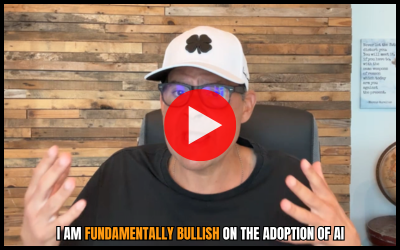
I am fundamentally bullish on the improvement of AI capabilities.
I am fundamentally bullish on the adoption of AI and the capital spending that comes with it.
The recent pullback in AI infrastructure stocks has created some genuinely attractive entry points.
Amkor in particular looks great to me right now.
We sold some of these names for nice gains over the past four to six weeks.
Now that they’ve been crushed well below our selling price, we may be recommending getting back into some of them very soon.
Stay tuned.
Have a wonderful weekend.
God bless you.
I’ll see you Monday.
“The Buck Stops Here,”

Found this helpful? Share it with others.
Written by Dylan Jovine