Key Points
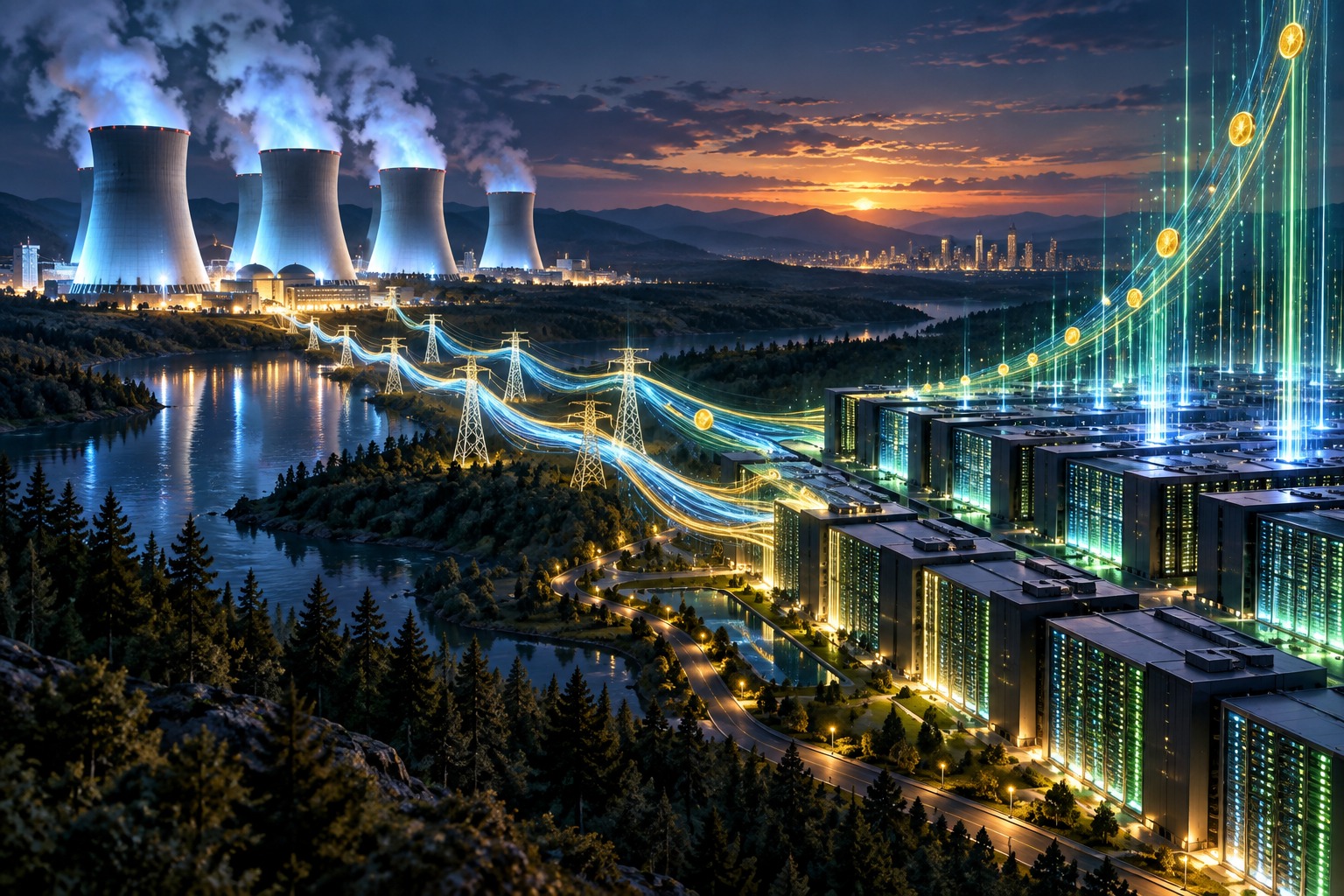
Google contracted for 3,590 megawatts of power from Constellation Energy, including 890 megawatts of new nuclear capacity under a 20-year deal. Constellation will invest more than $4.3 billion to deliver it.
Constellation shares jumped 12% to $300.40 Tuesday, one of the biggest gains in the S&P 500, a week after it signed a separate 20-year nuclear deal with Amazon.
Vistra rose 10.8% after the Energy Department offered up to $4.2 billion in loans to expand its nuclear plants.
Marvell forecast $70 billion to $90 billion in revenue for fiscal 2031, far above Wall Street's $47 billion estimate.
The S&P 500 closed at its first record high since August, and the Nasdaq set its second straight closing record.
The AI race has a dirty secret: the chips are the easy part.
Big Tech can order more Nvidia processors. It can't order the electricity to run them overnight. In the Mid-Atlantic and Midwest, data center demand is outrunning supply.
On Tuesday, Google made its move to lock up the power before someone else does.
The Deal
Google contracted for 3,590 megawatts of power from Constellation Energy, the largest operator of nuclear plants in the U.S. All of it sits in PJM Interconnection, the country's largest power grid, which serves more than 65 million people across 13 states and Washington, D.C.
The deal has two parts:
New nuclear power: a 20-year agreement for 890 megawatts from upgrades at 11 existing reactors in Illinois, Pennsylvania and New Jersey. That's about the output of one large reactor, enough to power more than 600,000 homes. The first upgraded plant is expected to deliver power in 2028.
Existing power: a separate 15-year agreement for 2,700 megawatts from Constellation's current PJM fleet.
Constellation will invest more than $4.3 billion in the upgrades. That's more than it spent on capital projects in any of the last three years.
Why the Stock Ripped
Constellation shares jumped as much as 15% and closed 12% higher at $300.40. It was the second Big Tech deal in a week. On Sept. 30, Constellation signed a 20-year agreement with Amazon that adds 190 megawatts of new capacity at its Calvert Cliffs plant in Maryland.
The rally fixed only part of a rough year. Constellation soared about 58% in 2025 on the AI power trade. Then in January, the White House and Mid-Atlantic governors unveiled a plan that would cap what existing PJM plants can charge, and the stock dropped nearly 10% that morning. Even after Tuesday's jump, shares are still down for 2026.
Tuesday's deals point to an answer for that problem. Instead of waiting for power prices to rise, Constellation is signing long contracts that pay for new capacity. Upgrading reactors that already exist, known as uprates, is faster and cheaper than building new plants.
There is a catch. Only about a quarter of the megawatts Google contracted is new nuclear power. PJM is also still finalizing its rule requiring data centers to "bring your own power."
The Power Trade Came Back
Constellation wasn't alone. Vistra rose 10.8% to $160.50 after the Energy Department offered a conditional loan commitment of up to $4.2 billion to upgrade its nuclear plants in Pennsylvania and Ohio.
AI infrastructure stocks rallied too. Marvell climbed 5.8% to $287.01 after it told investors it expects $70 billion to $90 billion in revenue in fiscal 2031. Analysts polled by FactSet were expecting about $47 billion. Ciena surged 13.9% to $443.65 and Nebius rose 7.4% to $249.87.
Not every AI stock joined in. Seagate fell 9.2% to $805.63 and Western Digital dropped 6.9% to $411.04 after a Bloomberg report that Seagate and Toshiba are competing to buy TDK's magnetic-head business. That followed last week's news that Toshiba plans to nearly double its hard drive output.
Elsewhere, Option Care Health soared 32.7% to $31.00 after agreeing to a $32.05-a-share buyout from Clayton Dubilier & Rice and McKesson, a 37% premium. Lamb Weston rose 7.5% to $47.91 after its quarterly earnings of 75 cents a share beat the 59-cent estimate.
The broader market followed the AI trade higher. The S&P 500 rose 0.6% to 7,818.93, its first record close since August and its fourth straight gain. The Nasdaq added 0.4% to a record 27,599.79, and the Dow gained 0.5% to 51,521.28.
Bonds Got a Breather
The 10-year Treasury yield eased to 5.28% from 5.31% on Monday, backing off its highest level in 24 years. The two-year yield slipped to 4.80%. Demand at the government's $58 billion three-year note auction was mixed, and the notes sold at a 4.932% yield, the highest since May 2006.
Oil ended roughly flat. U.S. crude settled at $89.44 a barrel and Brent at $100.58, as a planned G7 release of emergency reserves offset worries about attacks on Saudi oil sites.
Traders still see about a 79% chance the Fed holds rates at its Oct. 27-28 meeting, though a December hike remains largely priced in. That's a big shift from late September, before last week's weak jobs report knocked out the Fed's case for an October hike.
What Lands Next
Wednesday: Constellation Brands, the maker of Modelo and Corona, reported after Tuesday's close. Adjusted earnings of $3.74 a share beat the $3.55 estimate, and sales rose 6% to $2.63 billion. It reaffirmed its full-year adjusted profit outlook, and the stock fell about 4.5% after hours. Management hosts its call at 8 a.m. ET. Minutes from the Fed's September meeting arrive at 2 p.m. ET, and the Treasury sells $39 billion in 10-year notes.
Thursday: PepsiCo reports before the opening bell, with analysts expecting about $2.30 a share.
Friday: Delta Air Lines kicks off airline earnings.
Next week: The big banks start reporting Oct. 13, and September CPI lands Oct. 14. Analysts expect S&P 500 earnings to grow more than 30% from a year ago this quarter, according to LSEG.
For two years, investors chased the companies that make AI chips. On Tuesday, Google showed what may be scarcer: the power to run them.
This article is for informational and educational purposes only and does not constitute investment advice or a recommendation to buy or sell any security.
Found this helpful? Share it with others.