Dear Reader,
Today is September 11th.
Twenty-five years ago I found myself running down the street in lower Manhattan as the Twin Towers came down.
We remember those people.
We remember the lost.
And we remember the lessons.
Today I want to talk about something else entirely.
SpaceX is on a suicide mission.
They are being paid by NASA to destroy the International Space Station.
How You Destroy a 430-Ton Space Station
The ISS — that 430 metric ton monstrosity that has been the backdrop of every end-of-the-world movie I watched growing up — is coming down.
Here's how it happens.
SpaceX is sending a modified Dragon rocket up to connect to the ISS autonomously.
Then over a year and a half, through a series of very gradual maneuvers — a slow dance in orbit — it lowers the station into a progressively lower Earth orbit.
Once the station is low enough, the Dragon fires up its 46 engines for up to an hour.
That drives the ISS through the thickest, most dangerous layers of the atmosphere at a precisely calculated angle.
The idea is for heat — not force — to tear it apart.
As the station plunges through the atmosphere, it hits temperatures around 3,000 degrees Fahrenheit.
Solar panels, modules, trusses — heat breaks them apart.
Whatever survives the burn lands in the ocean.
Specifically, what they call the space graveyard — a designated area in the South Pacific.
Any metal too dense or heat-resistant to fully burn up goes straight there.
Intentionally.
What This Tells You About SpaceX
Think about what's actually happening here.
This is steered by autopilot.
A rocket connects autonomously to the International Space Station, performs a year and a half of complicated orbital maneuvers, and then drags a 430-ton structure through the atmosphere at precisely the right angle to burn it up and drop what's left into a target zone in the South Pacific.
I'm having trouble getting emails out some mornings.
This guy has built a self-driving rocket.
We talk a lot about self-driving cars.
If Elon can drag the ISS out of orbit through eighteen months of automated maneuvers and deposit the remains in the South Pacific, he can probably teach a Tesla to navigate a parking lot.
It tells you something important about the level of technical capability SpaceX has built — and why they keep winning contracts that nobody else can touch.
The Opportunity Behind the Destruction
But here's the investment angle I want to leave you with.
We need a space station up there.
The ISS has been critical for research, for science, for maintaining American presence in space.
And China has built its own.
The Moon is now being discussed openly as the ultimate high ground in the next phase of geopolitical competition — because from the Moon, you can knock out enemy satellites.
We are militarizing space.
That's not speculation anymore.
It's official policy.
Which means whoever builds America's next space station is building something that is part research platform, part military asset, and part geopolitical statement.
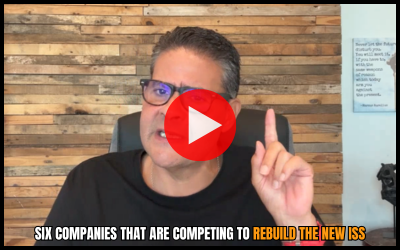
Six companies are currently competing for that contract.
And NASA isn't building it — they're going to rent it.
At as much as a billion dollars a year.
The Part I Find More Interesting
Now, I could spend the next month trying to handicap which of those six wins.
I've been doing this thirty-five years, and I'll tell you honestly — I don't know.
Nobody does yet.
But here's the thing I keep coming back to.
All six of them have to buy from the same short list of suppliers.
Every one of those stations — and the private platforms going up alongside them — needs the same hardware, built to the same tolerances, by the same handful of firms that have already proven they can put something in orbit and keep it working.
And it isn't just space stations driving that order book anymore.
The reason I've spent the past year on this is that the AI buildout has run out of room on the ground.
Power, cooling, land — all of it is constrained down here, and all of it is free up there.
NVIDIA's chief executive calls it "the next frontier for the AI infrastructure boom."
The U.S. Chamber of Commerce says it's on track to become a trillion-dollar industry.
Musk, Bezos and NVIDIA are all now moving in the same direction at the same time.
Which brings me to the only part of this that actually matters to your money.
You don't have to pick the winner.
It doesn't matter which company builds America's next space station, and it doesn't matter which billionaire wins the race above it.
The supplier gets paid either way.
That is the rarest thing you can find as an investor — a way to be right about a trend without having to be right about the company.
I've put the whole thing together, including the name and the ticker, in a new report I'm calling "SpaceX's Hidden Supplier: The Firm Powering the Orbital AI Boom."
This is one of the most interesting investment stories I've seen in a long time.
I'd get through it before November 4th, for reasons that will be obvious when you read it.
Have a wonderful weekend.
I'll see you tomorrow.
"The Buck Stops Here,"

Found this helpful? Share it with others.
Written by Dylan Jovine