Morning Watchlist: Tuesday Edition
A quick note from Behind the Markets
It's Tuesday — the loudest morning on the fall earnings calendar, with four of the biggest banks reporting before the bell. We set that table on Sunday, and Goldman Sachs takes the first exam of our October 2nd Buy around your second cup of coffee.
So this morning we're looking everywhere else, at three quieter verdicts the tape handed down while the bond market took Monday off: a tower landlord got its best day in eighteen years on a tenant that hasn't signed a lease, Washington licensed Russian diesel to fight the price of fuel, and the first hurricane of the season — the latest first in more than a century — finally showed up.
Three stories this morning. Three pairings. Let's get into it.
1) The Market Bought the Landlord a Tenant
On Monday we bought the toll road the market was selling: Verizon, marked down with roughly $39 billion of combined carrier value after SpaceX's $8 billion spectrum purchase. Friday finished that grading — AT&T fell 9.8%, its worst day since 2000.
But the same report card had a column of A's. If Starlink Mobile is going to be a real fourth carrier, somebody has to hang its radios. Crown Castle jumped 15.6% to $79.64 — its best single day in eighteen years — with American Tower up about 8% and SBA Communications close to 7%. The logic is sound as far as it goes: low-band spectrum gets signals indoors, but city-grade coverage still means equipment on thousands of towers. Bernstein pegs a standalone SpaceX network at $50 to $130 billion — and most of that money walks through a tower landlord's lobby.
Here's the problem. The market just bought the building because a billionaire bought land in the neighborhood. The lease is unsigned. Bernstein said the quiet part too: buying spectrum is not a commitment to build. And the towers have seen this movie — Dish was the last promised fourth carrier, and when it went dark the tower companies were left pressing roughly $7.6 billion in unpaid lease claims in its bankruptcy, Crown Castle's the largest.
The pairing: Crown Castle (CCI) — Watch
Crown Castle is the pure-play way to own the idea: it sold its fiber and small-cell businesses in May, so it's all towers now, with a $4.25 dividend yielding about 5.3%. The stock printed a 52-week low of $65.65 on October 5th — this rally started from the clearance rack, and even after Friday it sits well below where it began the year. Twenty-three analysts lean Buy with an average target near $94.
So why Watch? Because we don't pay a 15.6% same-day premium for a hope. The entrance: SpaceX actually signing tower agreements, or the pop fading back toward the low $70s, or the October 21st report making the case on rent that already exists. The kill: a Dish rerun — spectrum warehoused, nothing built — while a 5.3% dividend argues with a 5.3% Treasury.
2) Washington Found a New Diesel Supplier. It's Moscow.
On Monday, writing about Valero, we said a spread built on war premiums can deflate by committee or by peace treaty. Friday evening, the committee convened.
President Trump announced that Vladimir Putin agreed to supply diesel to U.S. and global markets — over 300,000 tons immediately, 500,000 tons in November, a path the White House says reaches 4.8 million tons — and the Treasury issued a general license making Russian-diesel imports legal on the spot. Diesel futures fell about 4%. Count the campaign now: the G7's 100-million-barrel reserve release, a dyed-diesel executive order, refiners summoned to Washington, and now Russian imports. With retail diesel at $6.28 a gallon five weeks before the midterms, shrinking the refining spread is official policy, four programs deep.
Be honest about the other side: analyst Tom Kloza notes Ukrainian drones have crippled roughly half of Russia's refining and says the volumes "don't add up to much," and six senators from both parties demanded the deal be reversed. The barrels may never sail. But policy risk doesn't need to succeed to compress a multiple. It just needs to keep trying.
The pairing: PBF Energy (PBF) — Sell
For readers who own it, after one of the great runs of 2026. A pure refiner is a ticket scalper working the gap between crude going in and diesel coming out — the shortage is the business. PBF, a smaller independent whose earnings swing hardest with that spread, has more than tripled off its 52-week low of $25.62; last quarter it earned $6.22 a share against the $4.12 Wall Street expected. Nobody's calling the machine broken.
We're selling the spread's political ceiling. The stock fell 5.7% Friday to $84.27 as the deal hit the tape, and the average analyst target — about $79.62 — now sits below the price, with the consensus at Hold. The forward multiple under 3 isn't a bargain signal; it's the market saying it doesn't believe next year's estimates, because a cheap multiple on peak commodity earnings is the oldest trap in the book. We named the entrance on best-in-class Valero on Monday rather than chase it; the same discipline says take the scalper's profit when the stadium starts handing out tickets at the gate. Wrong if: Russia never delivers, inventories stay at record seasonal lows, and the war keeps the spread at records — then October 29th is another blowout and holders left the last inning early.
3) The Storm Finally Showed Up. The Season Mostly Didn't.
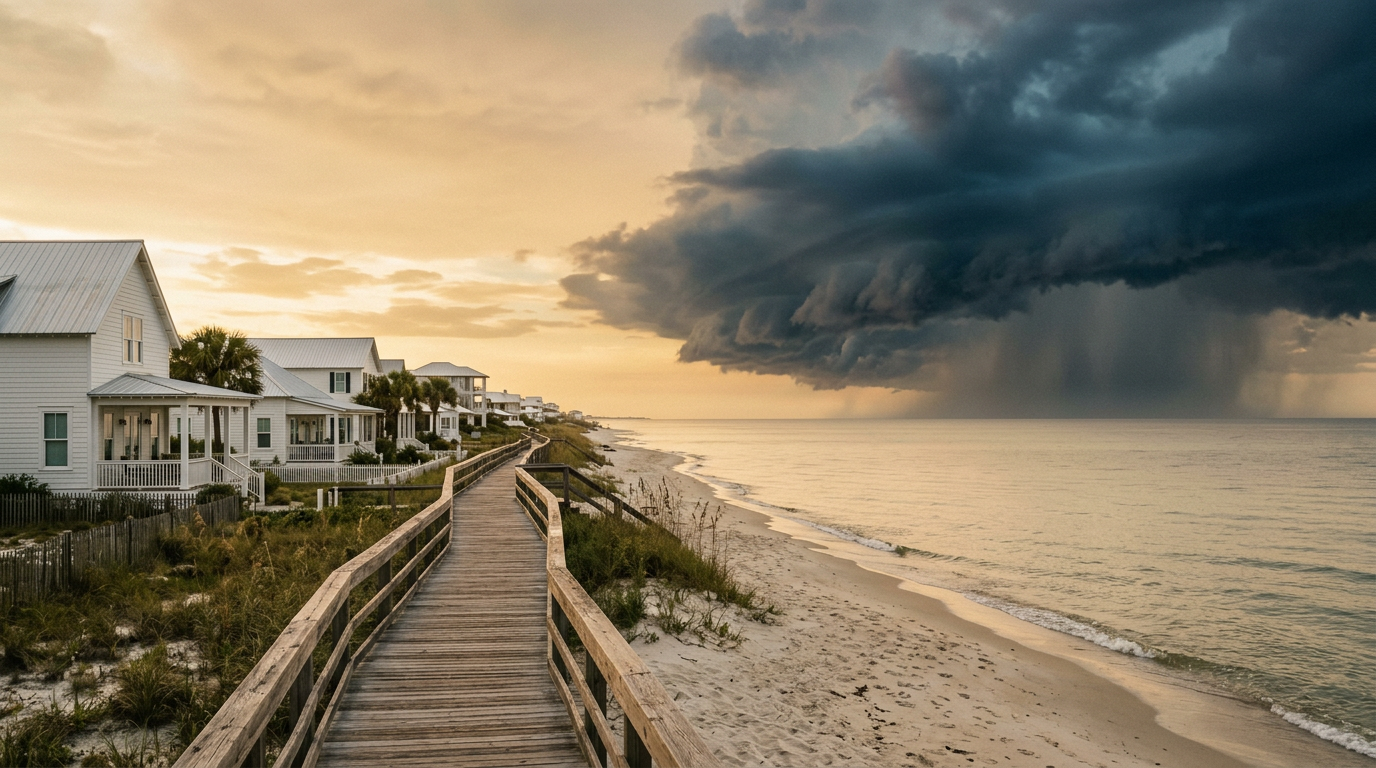
Late Friday night, Hurricane Isaias came ashore near Destin, Florida as a Category 2 — the first hurricane of the entire Atlantic season, and the latest first hurricane in more than a century. It was deadly and disruptive: four people killed, over 300,000 customers dark in Alabama, nearly two-thirds of Gulf oil production paused, two refineries offline.
For the insurance industry, though, the math landed softly. Gallagher Re pegs insured losses in the low-to-mid single-digit billions, and brokers called the event unlikely to move the market. Now step back: Isaias is the first U.S. hurricane landfall since 2024, arriving in October of a historically quiet year. Reinsurers — the insurance companies' insurance companies — priced this whole year assuming the usual parade of storms. A reinsurer runs the neighborhood's storm fund: everybody pays in every spring, and in a year the storms mostly skip town, the fund keeps the money.
The pairing: RenaissanceRe (RNR) — Buy
RenaissanceRe is one of the world's premier catastrophe reinsurers, and the quiet is sitting in its numbers: a 72.8% combined ratio last quarter — meaning about 73 cents of claims and costs per premium dollar, with the rest kept — a 20% operating return on equity, book value per share up 24.8% in a year, and $350 million of its own stock repurchased in a single quarter. At Friday's close of $331.38, the $13.8 billion company trades at about 7.7 times next year's expected earnings (the trailing 5.7 is flattered by a calm year — use the forward number). The S&P 500: 21 times.
The honest flags: we are not early — the stock sits about 3% below its high — and the consensus of eighteen analysts is a Hold, with a $347 average target, a shrug at a 20% ROE. The season runs through November 30th, and one late monster rewrites the year; that's the business. But the real risk is the success itself: quiet years soften prices, and RenaissanceRe's catastrophe premiums already fell about 14% last quarter on rate reductions. The kill is margin compression at the January renewals, not a storm. (Housekeeping: Assurant, our September 9th Buy, carried hurricane season as its named risk — a sub-$5-billion Isaias is a bill, not a disaster.)
Before You Go
That's the watchlist. A landlord gifted a 15.6% day by an unsigned lease, a scalper's spread that just became a campaign issue, and a storm fund that kept most of a season's premiums. One theme, as always: the market prices the headline in hours — the cash register rings for quarters — and the best opportunities stand one step behind the headline.
Your calendar: the banks and UnitedHealth report this morning, the September inflation report lands Wednesday, TSMC reports Thursday, and Crown Castle itself reports October 21st — the same day as Knight-Swift's entrance exam and First American's earnings.
Found this helpful? Share it with others.
Written by Behind the Markets