Dear Reader,
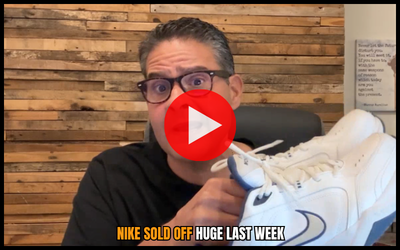
Nike sold off big last week as earnings continued to collapse.
And I want to talk about why — because it offers one of the most valuable business lessons I've seen play out in real time in years.
Yesterday we talked about durable competitive advantages.
Nike just showed you what happens when you voluntarily destroy one.
The Setup
Nike has long had challenges in China, where local competitors have genuinely learned to make good sneakers.
They also stopped innovating on product and leaned too hard on retro Jordans.
But the mistake that truly gutted this company was a strategic decision made in June 2020.
Right in the middle of COVID, the CEO launched what he called the Consumer Direct Acceleration strategy.
The logic was straightforward.
Consumers are buying everything online now.
Why share margin with retailers when we can sell directly?
Cut out the middleman and keep all the money.
Classic thinking.
Except for one thing.
A little patience would have been worth a fortune.
What Actually Happened
Nike cut off Amazon, DSW, Urban Outfitters, Dick's Sporting Goods, Big 5, Dunham Sports, Olympia Sports.
They pulled apparel from Macy's.
And Foot Locker — their single biggest retail partner, who at the time represented 75% of their sales — wasn't formally cut, but Nike told them their allocations were dropping 60%.
Nike essentially broke up with Foot Locker.
So what did Foot Locker do?
They had all this empty shelf space and bills to pay.
They went out and signed exclusive deals with Reebok, Adidas, New Balance, Puma, Crocs.
New Balance and Crocs saw their sales jump 50%.
May all of your enemies make mistakes this generous.
Those companies must have thought it was a gift from God.
Infinite shelf space at the biggest sneaker retailer in America, handed to them for free.
The Discovery Problem
Here's the part most people don't talk about.
When you're an old man like me, you don't need to discover new shoes.
I buy the same ugly old man shoes every couple of years.
I don't go to the mall.
I don't care.
But my kids go to the mall.
Young people go to the mall.
That's how they discover what to wear.
That's how sneakers become cultural.
Nike blew apart that discovery process.
They kept the uncool old men like me.
They lost their future customers.
Revenue fell from $51 billion in 2024 to $46 billion in 2025.
A 10% decline.
The steepest single-year drop in at least two decades.
Worse than the financial crisis.
Worse than COVID.
And the direct-to-consumer revenue that was supposed to replace all of
that?
It never held.
Turns out people still want to feel a shoe before they buy it.
Young people included.
The Slow Rebuilding
Nike finally brought back Elliot Hill — their former president, out of retirement — to replace the prior CEO in October 2024.
And not surprisingly, his entire strategy is centered on rebuilding the wholesale relationships they destroyed.
They've crawled back to Macy's. Back to DSW. Back to Amazon.
They're trying to rebuild the Foot Locker relationship — though now they negotiate with Dick's, which bought Foot Locker outright, meaning Nike faces one mega-gatekeeper with 3,100 stores instead of two separate partners.
The spurned lovers don't exactly come running back.
Now what Nike has to do is offer retailers better terms than their competitors — essentially pay more per sneaker, even at a loss, just to get the shelf space back.
But Adidas, New Balance, and the others have scale now too.
This is going to be a war for shelf space.
The Lesson
Nike's moat was never just the swoosh.
It was the distribution channel.
The shelf space.
The discovery surface.
That was the durable competitive advantage.
And one CEO gave it away in a snapshot moment during COVID, convinced the world had permanently changed.
It hadn't.
When you're analyzing a business — any business — this is what you're watching for.
Not just whether a competitive advantage exists today.
But whether management understands what it is.
Because the ones who don't understand what their moat actually is are the most dangerous people in the world to invest alongside.
The Other Side of the Same Coin
Nike handed its moat to its competitors voluntarily.
For the past year I've been researching a company in the exact opposite position — one that can't hand its moat away, because the people who need it have nowhere else to go.
Here's the setup.
Elon Musk built Colossus, the supercomputer his entire AI operation runs on.
And on January 2, 2027, the federal government can pull the plug on it.
I'm not going to sit here and tell you I know how that fight ends.
What I know is the part that actually matters to an investor — and it's the Nike lesson running in reverse.
If that plug gets pulled, Elon has exactly one way out.
One small company.
Not the best option available to him. Not the cheapest.
The only one.
That is what a real moat looks like from the inside.
You aren't competing on price, or product, or marketing budget.
You are the door, and everybody has to walk through you.
Nike had exactly that with Foot Locker — and talked itself into giving it away.
This company has it with the most aggressive spender in technology, and there is nothing his money can do about it.
I put the whole story together for you here>>
Just remember the date, because the clock on this one is not ours to set: January 2, 2027.
Have a wonderful day.
I'll see you tomorrow.
"The Buck Stops Here,"

Found this helpful? Share it with others.
Written by Dylan Jovine