
Dear Reader,
This is Dylan Jovine with Behind the Markets.
Happy Tuesday. Today is Tuesday, May 26th.
We are live with our webinar today at 1 o'clock. Charles and I look forward to seeing you there.
Today I want to explain something that I think will make the company we are discussing today click for you in a completely new way.
A Story From Wall Street in the 1990s
Back when I was working on Wall Street in the nineties, trading technology started to evolve in a way nobody had really anticipated.
Software started appearing that could execute rapid-fire trades at speeds no human trader could match.
The firms using this software were making real money — fast.
They were called the SOES bandits, for those of you who are geeky about this stuff.
The big banks and hedge funds took notice, and they all started building faster software, laying fiber optic cables, doing everything they could to move data faster.
But here is what I remember very clearly.
At a certain point, every firm was using the same fast software.
Every firm was running fiber optic cables.
And that's when something surprising happened.
Distance started to matter.
The closer your servers were physically located to the New York Stock Exchange, the faster your trade got executed.
Fractions of a millisecond.
That was the edge.
The firm that was three blocks from the exchange beat the firm that was ten blocks away — every single time.
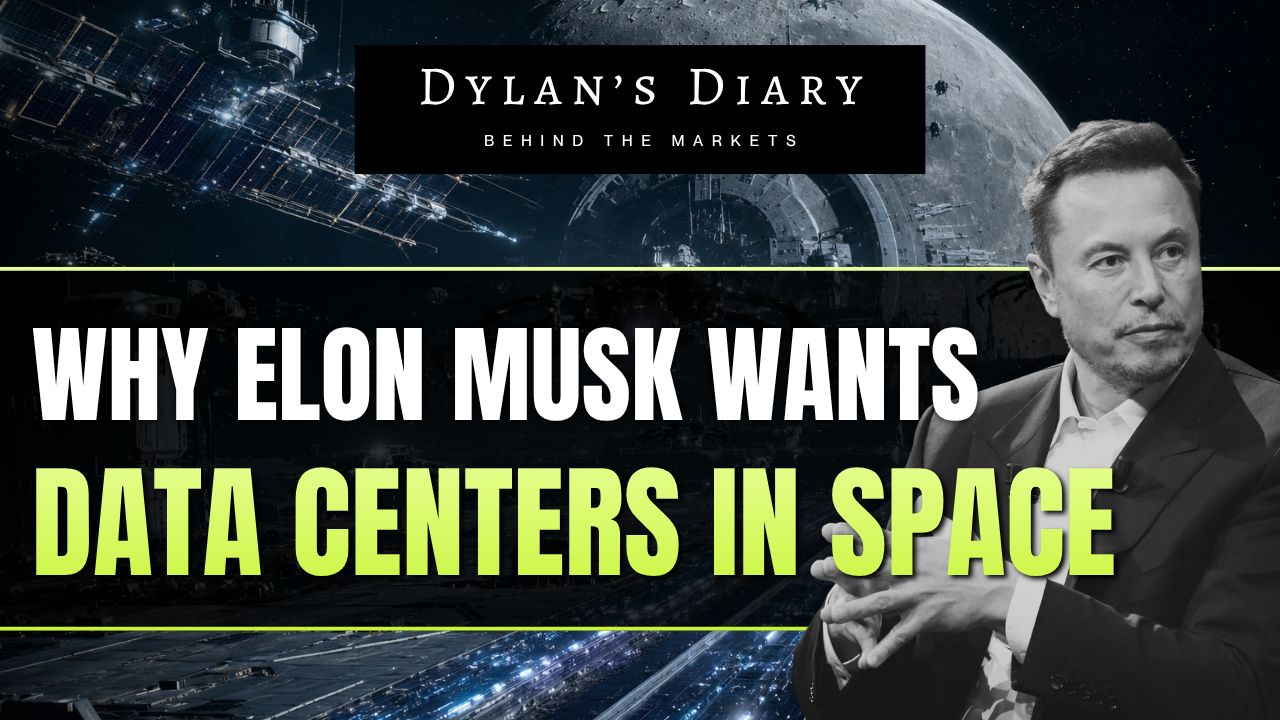
Why Elon Musk Wants Data Centers in Space
Now think about what that means on a modern battlefield.
Last year, Pete Hegseth called Elon Musk into the Pentagon for a meeting.
Very shortly after that meeting, Musk started publicly talking about putting data centers in space.
That is not a coincidence.
Here is the future we are building toward.
Thousands of drones operating in coordinated swarms, pulling data from satellites, making decisions together in real time, identifying and engaging targets at speed.
All of that data has to travel up to space and back down again.
And just like those Wall Street firms in the nineties, the side that moves that data fastest wins.
Space is the ultimate high ground.
If you move the data centers into space — closer to the satellites, closer to the source — you cut the distance the data has to travel.
You make the whole system faster.
In warfare, faster means winning.
The Company We Are Discussing Today
The company we are talking about at 1 o'clock today has built software that compresses and moves satellite data faster.
Think of it as the fiber optic cable of space warfare.
The closer the data center is to the exchange, the faster the trade.
The faster the data moves between satellites and drones, the faster the military can act.
This company is already partnered with Nvidia, Intel, and Viasat — the second largest satellite company in the world.
They have received Department of Defense funding.
Their technology is already being used.
Right tech. Right partners. Right moment.
I hope to see you at 1 o'clock.
I think you are going to enjoy this one.
Anyway, that's all I have for you today.
See you then.
“The Buck Stops Here,”

Found this helpful? Share it with others.
Written by Dylan Jovine