Dear Reader,
This is Dylan Jovine with Behind the Markets.
Happy Friday.
Today is Friday, August 14th.
TGIF.
Today I want to talk about something very old-fashioned.
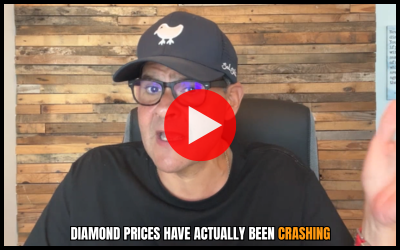
A buddy of mine has a son who wants to propose to his sweetheart.
He asked me if I follow the diamond market and what kind of leverage his son might have when negotiating.
I hadn't looked at diamonds in a couple of years.
Jewelry is of no real interest to me.
But I looked into it — and I learned something I didn't know.
Something that could save your kids or grandkids $5,000 to $10,000 when the time comes.
What Has Happened to Diamond Prices
Diamond prices have crashed about 60% in the past five years.
In 2022, a natural one-carat diamond cost $10,000 to $11,000.
Today, in 2026, that same diamond costs roughly $4,200.
That is an extraordinary collapse in price.
And lab-grown diamonds — which are chemically identical to natural stones — have fallen even further.
Wholesale prices on lab-grown diamonds are down 80% to 90%.
They've fallen so far that wholesale rates are now approaching the basic cost of production.
There is almost no margin left at the wholesale level.
Why Is This Happening?
A few reasons.
First, lab-grown competition.
Man-made diamonds are chemically identical to natural stones but cost a fraction of the price.
They've pulled billions of dollars away from mined diamonds.
Second, China flooded the market.
China got into the lab-grown diamond business and did exactly what China always does — flooded the world with cheap supply.
Third, buyer habits have changed.
Millennials and Gen Z simply don't place the same value on luxury diamonds that our generation did.
They'd rather have a bigger stone, a better trip, or a different experience altogether.
The De Beers marketing machine that shaped our generation's thinking about diamonds doesn't have the same grip on younger buyers.
And by the way — this is exactly why Anglo American has been desperately trying to sell its 85% stake in De Beers for years.
Nobody wants to touch it.
Where Does the Opportunity Land?
Naturally, when I see carnage like this, I look for opportunity.
I looked at lab-grown diamond companies — Adamas One, symbol JEWL, and Brilliant Earth, BRLT.
Both are trading around a dollar a share with thin volume.
Basically dead on arrival.
I didn't dig in further.
The one company that's actually holding up well is Signet Jewelers.
They beat forecasts.
Stock is trading around $92, $3 billion market cap, modest yield.
Looks fairly valued — not cheap, not a screaming buy.
But what Signet tells you is something important.
In the war between producers, wholesalers, and retailers, the balance of power has shifted to the retailer.
Signet can buy diamonds cheap — mined or lab-grown — mark them up about 20%, and sell them to consumers who still want the ring.
The retailer is winning this round.
The Bigger Pattern
This reminds me of what happened with razors.
I used to own Procter & Gamble, which owned Gillette.
What a business — cheap to make, raise prices above inflation every couple of years with a new blade.
Then Walmart got so powerful that they started dictating terms to suppliers.
"You'll sell us razors at $3 a pop if you want to be in our stores."
Procter & Gamble's response?
Buy Gillette.
Bulk up.
Push back.
That's the nature of how these industries evolve.
What I suspect you'll see in the diamond business is the same thing — massive consolidation among the lab producers after this carnage plays out.
Eventually one big behemoth emerges from the rubble.
Then it starts exerting pressure on the Signets of the world who are capturing the economic value today.
But we're still many innings away from that.
In the meantime, if your son or grandson is shopping for a ring — now is a very good time to buy a diamond.
But I want to leave you with the real lesson here, because it isn't about diamonds.
It's about what happens when the people who control a resource lose control of the supply.
De Beers spent the better part of a century telling us what a diamond was worth.
Then the supply changed.
And the story stopped working.
Anglo American can't even find someone to take the business off their hands.
I've been watching that same setup build in a market many times the size of diamonds.
Energy.
There's a valley in Utah where a drilling crew just cracked open the fuel source Big Oil spent fifty years trying to bury.
Not a laboratory. Not a computer model. A drilling crew.
The Department of Energy is now behind the most ambitious drilling initiative since the program that launched the shale revolution.
And the checks have already been signed — by Google, by Berkshire Hathaway, and by the Pentagon.
When those three are early to the same thing, I pay attention.
One company sits at the center of it.
It starts August 18th — next Tuesday.
I put the whole story together here.
Have a wonderful weekend.
I'll see you Monday.
"The Buck Stops Here,"

P.S. URGENT: Fellow Investor, Please View ASAP I recently released a report on a secret story big oil has desperately been trying to cover up. One that could lead to gains of 1000% or more for early investors.
The catalyst is coming... but the smart money is already moving and I want to make sure you see this before the biggest opportunities are gone.
This report will only take a moment of your time, but it could have a dramatic impact on your personal wealth.
Found this helpful? Share it with others.
Written by Dylan Jovine