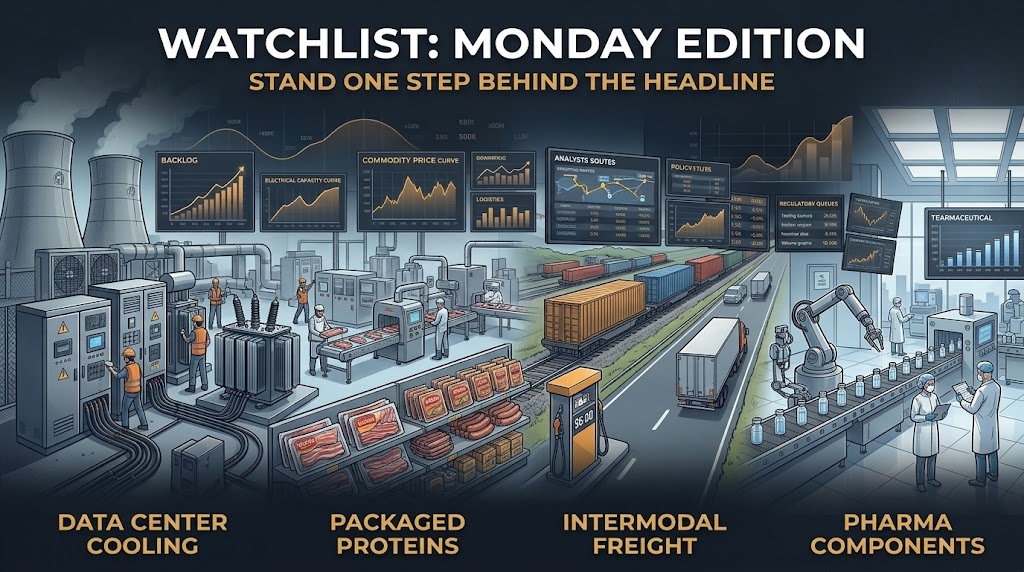
Morning Watchlist: Monday Edition
A quick note from Behind the Markets
It's the start of another week. And somebody may have spent the weekend deciding whether to buy one of our stocks.
Late Thursday, Bloomberg reported that Samsung is in active talks to acquire Modine Manufacturing — the Wisconsin radiator maker we've flagged twice in these pages. By Friday morning, the stock had jumped more than 30% before the opening bell. Nothing was signed when we went to press, so this morning you may know how the story ends. We don't.
Here's what we do know: when one house on the block gets a full-price offer, the whole block gets re-appraised. Four stories this morning. Four pairings.
Let's get into it.
1) Somebody Knocked at the Radiator Factory
First, the ledger note. We flagged Modine on September 2nd, and again on October 30th at about $136.51 after its spin-off left it a pure cooling company. Earlier this month it sat near $123 — about 10% below that flag — because data-center margins kept arriving late. Friday morning's pop changes the scoreboard, not the discipline: we don't chase a 30% rumor gap in a stock we already own. If a deal prints, holders get paid; if the talks die, the November 18th investor day is still the margin exam. Still Buy, on the business, not the rumor.
The bigger story is what Samsung just said about the whole aisle. It surveyed the picks and shovels of AI — chips, servers, software — and decided the thing worth paying up for is the equipment that keeps the building from overheating.
So who else is on that block?
The pairing: SPX Technologies (SPXC) — Buy
SPX builds the industrial-scale cooling equipment — cooling towers and HVAC systems — that data centers can't run without. Market cap: about $7.5 billion. Last quarter, revenue grew 20.5% and its HVAC backlog crossed $1.1 billion for the first time, up 69% from a year earlier, with data-center capacity built for roughly $1.1 billion of annual revenue.
And yet the stock traded near $150 on Tuesday — down about 40% from its 52-week high — at roughly 18 times next year's expected earnings. The S&P 500: about 21 times. The average analyst target sits near $242, and a director bought shares twice this month, around $164 and again around $141 — more than $600,000 of his own money, into the decline.
Why the markdown? Last quarter's HVAC margin slipped on labor and input costs, and management trimmed the top of its profit guidance — growing fast, inefficiently. More than 90% of its data-center work hangs on a handful of hyperscaler customers, and if the Samsung talks collapse, the street's new appraisal can sag with them. We'd rather own the house next door than bid on the one with the crowd on the lawn.
2) The Butcher's Exam Is This Morning
Before the market opens this morning, Tyson Foods reports earnings. Wall Street expects about 65 cents a share, down from $1.15 a year ago, and the company has already warned that its beef business could lose as much as $775 million this fiscal year.
Why? The U.S. cattle herd is the smallest it has been since 1951 — about 86 million head — and ground beef has spent the year at records, north of $6.70 a pound.
Everyone will grade the beef pain this morning. We'd rather stand at the other end of the meat case. While cattle are the scarcest in 75 years, hogs are plentiful and hog prices have been falling — and the shopper staring at $7 ground beef has been sliding her hand two feet to the left, toward bacon, sausage, and hot dogs.
The pairing: Smithfield Foods (SFD) — Buy
Smithfield is America's largest pork company, back on the Nasdaq since early 2025. Its fresh-pork segment lost $89 million last quarter — that's the headline, and why the stock sits near its 52-week low. But its biggest business, packaged meats — the branded bacon and hot-dog aisle, where it just added Nathan's Famous — posted its second-best third-quarter profit on record, with margins rising. It's the smokehouse in a pig glut: cheap hogs are a crisis for the farmer selling them — and a raw-material discount for the brand smoking them into bacon that never went on sale.
At $18.98 as of Thursday's close, the stock trades near 8 times trailing earnings. The S&P 500: about 21. The $1.25 annual dividend works out to a yield north of 6.5%, on a balance sheet levered at just half a turn of EBITDA. The risks, plainly: management cut full-year guidance in late October because fresh-pork spreads are genuinely broken; a permit for its South Dakota plant got reversed; and its Hong Kong-listed parent, WH Group, still owns the overwhelming majority of the shares — a thin float where minority holders ride shotgun.
3) The Inflation Report Was Mostly a Fuel Bill
Friday morning, before we went to press, the October producer price index landed: up 0.3% on the month, a touch cooler than expected — but up 6.5% from a year ago, the largest annual gain since November 2022. One driver keeps showing up in the guts of it: the cost of moving things. LPL's economist flagged transportation as the engine behind core producer inflation running near 5%.
You can see it at the truck stop, where diesel has held above $6 a gallon — up roughly 50% in a year — and in FedEx's 30.5% fuel surcharge. And a freight train carries a ton of cargo three to four times as far as a truck on the same gallon of diesel. When fuel is cheap, nobody cares. At $6 diesel, the railroad stops being old-fashioned and starts being arithmetic.
The pairing: CSX (CSX) — Watch
CSX, the big eastern railroad, just reported record quarterly revenue of $4.02 billion, up 12%, with intermodal volume — truck trailers and containers riding on flatcars — up 7% to an all-time record on exactly these truck-to-rail conversions. Management raised its full-year outlook.
So why Watch and not Buy? Price, mostly: at about $52 as of Friday morning, the stock has run 7% in a month and trades near 29 times trailing earnings — roughly double the rail group's usual teens. Everyone just discovered the train, and the ticket window noticed. And one honest wrinkle: management said about half of its revenue growth came from fuel surcharges — and surcharges cut both ways. If diesel rolls over, half the growth story rolls over with it. What moves this up our list: a pullback that puts the ticket on sale, or a winter quarter proving the converted freight stays on the rails even as fuel eases.
4) Lilly Poured a $3.5 Billion Foundation
On Thursday, while the market stared at a resignation, Eli Lilly broke ground in Pennsylvania's Lehigh Valley on a $3.5 billion plant to make next-generation obesity medicines — its tenth new U.S. site since 2020.
Picture what a factory like that produces: injector pens, millions upon millions of them. And whoever's name is on the pen, nearly every injectable drug needs the same tiny components — the rubber stoppers, plungers, and seals that keep the medicine sterile and the dose exact.
The pairing: West Pharmaceutical Services (WST) — Watch
West makes those components, and it sits inside most injectable medicines on the market. It's the cork maker in a wine boom — nobody toasts the cork, but no bottle ships without one. Business is accelerating: in late October it reported revenue up 8.7% to $874.5 million, earnings of $2.66 a share against the $2.20 expected — a 21% beat — and raised its full-year guidance.
So why Watch and not Buy? You already know the answer. At about $413, the stock costs roughly 44 times this year's guided earnings. The S&P 500: about 21. A wonderful business at a full-price ticket. The honest risks: drugmakers are still working down component stockpiles, a European plant is short of trained staff for the next year or so, and if obesity pills displace injections faster than expected, fewer pens need fewer stoppers. Our entrance: a pullback toward the mid-$300s, or another guidance raise that makes today's price tomorrow's discount.
Before You Go
That's the watchlist. A knock at the radiator factory re-appraised the cooling aisle. The butcher takes his exam this morning while the smokehouse sits on sale. An inflation report that was mostly a fuel bill, and a $3.5 billion hole in Pennsylvania that fills up with rubber stoppers. The theme never changes: stand one step behind the headline, and don't pay full fare to get there.
Found this helpful? Share it with others.
Written by Behind The Markets