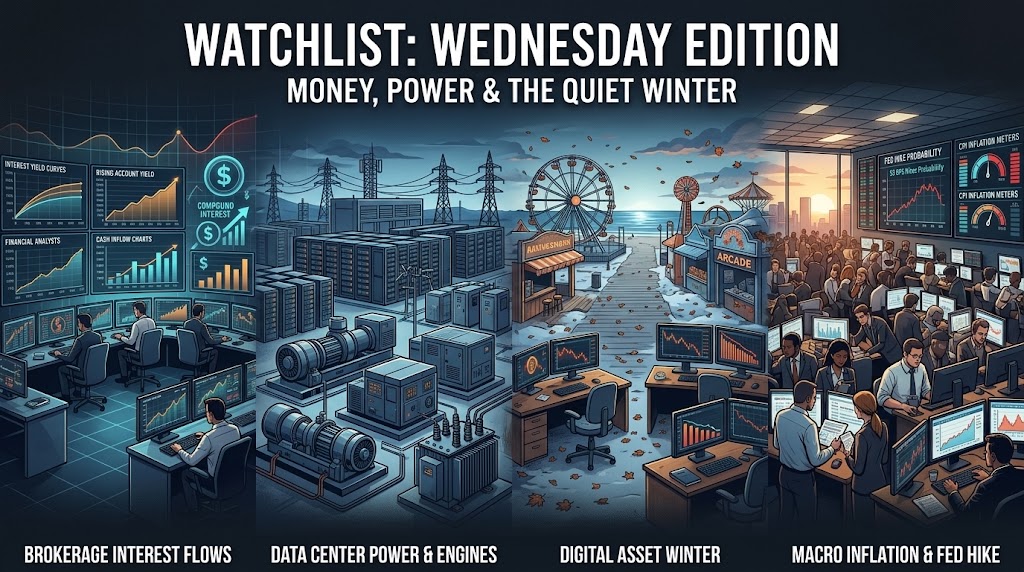
Morning Watchlist: Wednesday Edition
A quick note from Behind the Markets
It's Wednesday — Veterans Day. The stock market is open today; the bond market is closed. Which is ironic, because Tuesday morning the bond market got the most important number of its month — and now has to sit with it for a day.
A hot inflation print and a word nobody has said seriously since 2022. An AI lab that just bought itself a power plant. And the quietest bear market in America. Three stories this morning. Three pairings.
Let's get into it.
1) The Number Came In Hot — and "Fifty" Walked In
Tuesday morning, the government said consumer prices rose 0.4% in October. Wall Street expected 0.3%. The core reading — prices with food and energy stripped out, the line the Fed actually watches — rose 0.3% against an expected 0.2%, the second straight month at that pace.
One oddity worth knowing: this report has a blank spot. Last year's government shutdown stopped price collection in October 2025, so there is no official year-over-year figure this time — only the monthly change. A report card with a missing grade, landing at the worst possible moment.
Why the worst? Because of what Fed Governor Christopher Waller said just beforehand: if core inflation ran around 0.3% or higher, his words, a "50 basis point hike in the policy rate should be considered at the December meeting." The Fed's biggest single move since 2022.
Core ran 0.3%.
The market heard it. The two-year Treasury yield — the one that tracks Fed expectations — jumped 14 basis points within the hour, and stock futures turned lower. A December hike was already priced as near-certain. The live question now is its size.
A housekeeping note. On Sunday we said our re-entry in homebuilder M/I Homes hung on this print coming in cold. It didn't. We stay on the bench, as promised — no trade. We already paid the fighting-the-Fed tuition once this year.
But a rate hike isn't bad news for everybody. For one kind of company, it's a raise.
The pairing: Interactive Brokers (IBKR) — Buy
Interactive Brokers is a parking garage for money: millions of customers park cash and securities there, and the garage earns interest on every idle dollar in the building. When the Fed hikes, the city raises the meter rate — and the garage collects it without lifting a finger.
Here's the part we underlined. Last quarter, interest income topped $1.1 billion, up 19% — and it did that while average short-term rates were 63 basis points lower than a year earlier, because customer accounts grew more than 30%. Pre-tax profit margin: 78%. Last month management raised the dividend 71%. That's a garage filling up while the meter rate fell. Now the meter rate is about to go up.
At around $80, the stock sits roughly 20% below its 52-week high and costs about 23 times next year's expected earnings — not the single-digit cheap we usually hunt (the S&P 500 costs 21), but one extra turn for a business compounding accounts at 30% a year with the next rate move pointed straight at its biggest revenue line. The honest risks: the multiple is above the company's own history, insiders have been net sellers, and a true bear market would shrink the margin-loan book that grew 47% last year.
2) The AI Lab That Bought Itself a Power Plant
On Monday, the Financial Times reported that Anthropic — the AI company marching toward the largest IPO ever attempted — agreed to pay $3.4 billion to take over an order for 1.7 gigawatts of Caterpillar gas generators. The order was placed two years ago by a Texas power startup that couldn't finance it to completion. Anthropic didn't buy the startup. It bought its place in line.
That's the tell. 1.7 gigawatts can power more than a million homes. The companies building AI no longer trust the grid to show up on time, so they're buying generation the way shoppers bought toilet paper in March 2020 — not because they want to, but because the shelf is emptying. The same day, SoftBank booked about $3.7 billion of losses on advance payments for U.S. data-center power equipment. Even the losses are about generators now.
Caterpillar jumped 7% Monday, toward $600. Fair enough: its power-generation sales rose 30% last quarter, to $3.4 billion — one AI lab just wrote a check equal to a full quarter of that segment's sales. But the famous store is where the line forms.
Walk one block over.
The pairing: Cummins (CMI) — Buy
Cummins sells from the same aisle: big engines and industrial generator sets, plus battery storage it's already supplying to a large U.S. data-center project. Its power-systems segment grew revenue 15% last quarter with margins jumping to 25.4% from 22.9%, inside a record quarter for the whole company — and management said data-center demand is strong enough that supply constraints delayed some shipments. Translation: they cannot build them fast enough.
So why is the stock down more than a third from its high? Pickup trucks. Cummins makes the diesel engines in America's heavy pickups, buyers are scarce with diesel prices and rates where the war put them, and management trimmed its full-year outlook last week for exactly that reason. The crowd sold the truck news — and marked down the generator business with it, the same week Anthropic told you generators are scarce.
At about $470, Cummins trades near 14 times next year's expected earnings. The S&P 500: 21 times. Recent price targets from Citi, Wells Fargo and Barclays sit between $608 and $675. Two hardware stores on the same street sell generators during a blackout. The crowd lines up at the famous one. The other one has inventory, and a sale sign.
The risk, plainly: trucks are still the bigger business, and the CEO expects pickup weakness to persist through year-end. If data-center spending freezes — the fear that shook the whole AI aisle last week — generator orders eventually slow too.
3) The Quietest Bear Market in America
While everyone argued about inflation, bitcoin slid to its lowest price since August — roughly $75,000 on Monday, down about 40% from its October 2025 peak, with more than $1 billion of leveraged bets liquidated. Tuesday morning's hot CPI knocked it under $74,000.
Here's what makes this bear market strange: nobody is screaming. The crowd didn't panic out of crypto. It just left. You can see the leaving in one statistic: bitcoin has traded at a discount on Coinbase, the main U.S. exchange, for 61 straight days. American buyers — the ones who powered the last boom — aren't showing up to pay full price anymore.
The pairing: Coinbase (COIN) — Sell
If you own Coinbase, we think you're holding a boardwalk arcade in November. Wonderful business in summer. But trading revenue — the summer crowd — fell 44% last quarter, to $590 million. The stock, near $136, is down about two-thirds from its 2025 peak, and history says it falls harder than the coin itself: in the last crypto winter, bitcoin dropped 77% while Coinbase dropped 91%, then needed three and a half years to see its old high again.
And the weather just turned. The crypto market-structure bill failed the Senate 49–50 in September; Democrats then swept both chambers on Election Day, so the rescue isn't coming from Washington. Banks are lobbying to cap the stablecoin rewards that feed one of Coinbase's better revenue lines.
The honest other side: about half of revenue now comes from steadier subscriptions and services, the company produced $1.4 billion of free cash flow over the past year, and its stablecoin interest income tends to rise when rates rise. This is not a company going to zero. It's a deeply cyclical stock priced for a spring nobody can schedule. What would flip us: American buyers returning — watch for that discount to close — or a genuine regulatory thaw. Until one shows up, we'd rather walk the boardwalk than own the arcade.
Before You Go
That's the watchlist. Tuesday repriced three things: money, power, and faith. A hot CPI put a half-point hike on the Fed's table — and a raise in the broker's pocket. An AI lab bought a power plant — while the other generator maker sits on sale. And bitcoin's quiet winter deepened — with the arcade on the boardwalk still priced for summer.
Two items for your checklist. Thursday night, Cisco and Applied Materials grade the tech aisle, where our Lam Research and FormFactor positions sit. And the bond market reopens Thursday morning with a two-year yield that moved; watch where it settles.
Found this helpful? Share it with others.
Written by Behind the Markets