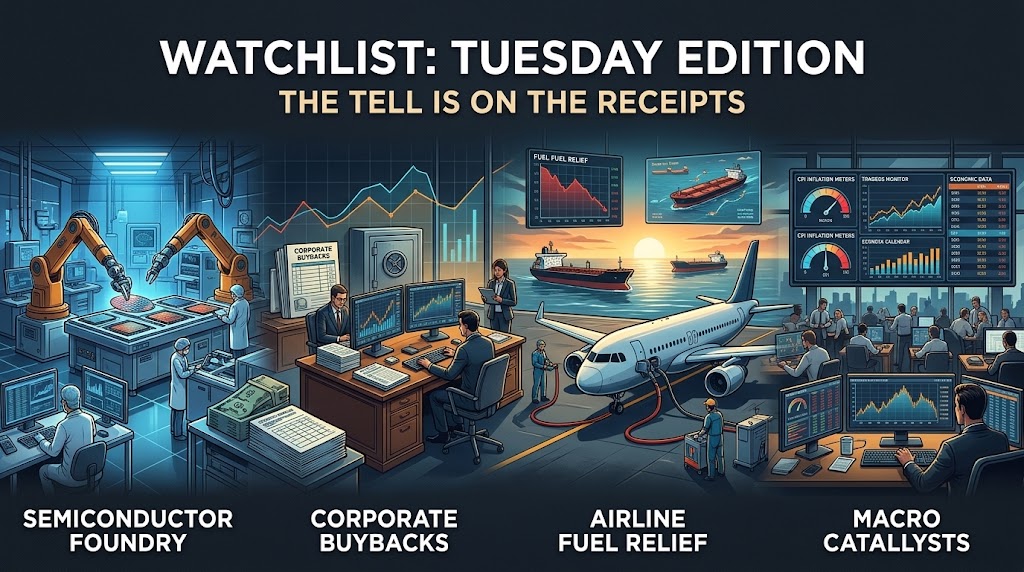
Morning Watchlist: Tuesday Edition
A quick note from Behind the Markets
It's Tuesday. And the biggest story in the market right now isn't a number. It's a confession.
On Sunday, the chief executive of the most important company in the AI trade told his employees he had been unfaithful to his wife. The reason that's a market story — and not a tabloid story — is who the other party allegedly answers to.
A scandal at the top of the AI trade. A Saturday filing from Omaha with a tell buried inside it. A war premium quietly leaking out of a barrel of oil. Three stories this morning. Three pairings.
Let's get into it.
1) The Scandal at the Top of the AI Trade
First, what we actually know.
In October, The New York Times reported that U.S. intelligence suspected Alice Huang — a technology executive at Megaspeed, a major Nvidia customer — of sharing information with Beijing. On Sunday, Nvidia CEO Jensen Huang admitted in an email to employees that the two had an extramarital relationship. His exact words: "I was unfaithful to my wife." The board has opened an independent investigation into whether its own CEO was the target of a foreign intelligence operation; Huang stays in the job, and three House committee chairs want him in a closed-door briefing next Wednesday. In Monday's early trading, the stock fell about 4%, under $180.
Now, what to do with it. Bernstein kept its Outperform rating and $400 target and made the two points that matter. Demand won't change — nobody cancels a GPU order over a CEO's marriage. But the key-person risk is real: Huang runs Nvidia with roughly 60 direct reports and no obvious successor, and a Washington probe is, in Bernstein's words, a "heavy distraction." Nvidia says it has no reason to believe confidential information was compromised, and the espionage claims rest partly on anonymous sources. This could still end as a sad private story and nothing more.
But it lands on an AI trade that was already wobbling. Last Thursday — on no news of its own — Taiwan Semiconductor fell nearly 11% in a day as the whole chip aisle sold off on fears the build-out is slowing. We're not going to referee a scandal. We'd rather ask the question we ask every morning: who gets paid no matter how this ends?
The pairing: Taiwan Semiconductor (TSM) — Buy
Whoever designs the winning AI chip — Nvidia, AMD, Google, Amazon's in-house silicon — TSMC manufactures it. In a pamphlet war, you don't bet on which author wins the argument. You own the printing press.
And the press is running hot. Third-quarter revenue rose 41% to $46.7 billion, gross margin came in above 66%, and the company guided fourth-quarter revenue as high as $54.3 billion. After Thursday's air pocket and a 6% Friday bounce, the stock sits near $375 — still down about 23% from its 52-week high — at roughly 18 times next year's expected earnings. The S&P 500: 21 times. The company that manufactures nearly every advanced AI chip on Earth now costs less than the average American stock.
The honest risks are the famous ones. TSMC operates on an island China claims, and no multiple fully prices that. And if the build-out genuinely slows, the printer sells fewer pages. The checks arrive fast: TSMC posts its October sales this week — a monthly receipt Taiwan requires and few American companies offer — and Applied Materials grades the whole equipment aisle Thursday night.
2) The Tell in the Saturday Filing
While the AI trade argued with itself, the quietest big company in America reported earnings the way it always does: Saturday morning, 8 a.m., no conference call, no guidance, no adjectives.
Berkshire Hathaway's headlines were soft. Operating earnings fell about 6% to $12.7 billion. GEICO's underwriting profit nearly halved, to $982 million, as accidents got more frequent and costlier to fix. And the cash pile — $377 billion in cash and Treasury bills — got written up, once again, as a warning about market prices. One outlet literally called it "a $377 billion warning."
We read a different line in the filing. Berkshire spent $9.6 billion buying back its own stock last quarter — the most of any quarter this year, $14.4 billion year to date, after buying back exactly zero in all of 2025. Berkshire's stated policy is to repurchase shares only when management believes they trade below intrinsic value. Greg Abel has run the company since January, and nobody alive knows what its pieces are worth better than he does.
When the home inspector buys the house, you can stop arguing with the listing.
The pairing: Berkshire Hathaway (BRK.B) — Buy
At about $571, the B shares trade near 1.1 times book value — the company's assets minus its debts; roughly the price of the house without the furniture — and about 14 times earnings, for a collection of railroads, insurers, utilities, and a freshly acquired homebuilder (Taylor Morrison, $6.8 billion in July) that mostly sat out the AI party. That absence suddenly looks like a feature: over the past month, while the S&P 500 fell about 5%, Berkshire rose almost 13%.
So why Buy if the nervous money is already arriving? Because our signal isn't the flows — it's the buyback. The best-informed buyer of Berkshire stock on Earth spent all year accelerating his purchases at prices near these. The honest risks: GEICO's claims inflation is real and industry-wide, a $1.2 trillion compounder compounds politely rather than explosively, and if the AI trade rips higher again, some of the haven money walks right back out. We can live with all three.
3) The War Premium Is Leaking Out of the Barrel
Quietly, the most expensive story of the year is getting cheaper.
The war that began February 28 choked traffic through the Strait of Hormuz — the channel that carried about a fifth of the world's oil and LNG — and drove Brent crude from about $72 to a December contract that expired at $117.64. Now watch the tape. Trump, fresh off his party's midterm defeat, calls new strikes on Iran "highly unlikely" while negotiations progress; Qatar's prime minister was due at the White House Monday; and Bloomberg reported — unconfirmed — that Tehran has eased its demands for reopening the strait.
The price is listening. By Monday morning, Brent had slid into the mid-$90s and WTI toward the high $80s — even though three tankers burned in the strait on Sunday. When a price falls through bad news, that's a premium deflating.
Who paid that premium all year, in cash, every quarter? Airlines. Delta's fuel bill rose 69% last quarter, to $4.35 billion — $3.80 a gallon — and the company cut its full-year earnings guidance from as much as $7.50 a share to $5.10–$5.60, even as its CEO insisted travel demand was holding. The planes were full. The fuel was ruinous.
Think of an airline as a trucking company for people: wages and fuel are nearly the whole cost story, and fuel is the line that moves. The war moved roughly a dollar and a half a share of Delta's earnings into the price of kerosene. Peace, if it holds, is a refund.
The pairing: Delta Air Lines (DAL) — Buy
Delta is the best house on the block — up about 19% this year while United slipped and American fell 17% — and at about $87 it costs roughly 13 times next year's expected earnings. Full disclosure: we are not first through this door. Airlines jumped last Wednesday when oil first cracked — JetBlue rose 14% in a day, Delta 7%. But a one-day pop prices a headline. It doesn't price back the nearly $1.8 billion a quarter the war added to Delta's fuel line if crude keeps walking toward its pre-war $70s. The kill, plainly: the talks collapse. One bad weekend in the Gulf — and Sunday showed the Gulf still has them — puts the premium, and the fuel bill, right back.
Before You Go
That's the watchlist. A scandal at the top of the AI trade — and the printing press that gets paid either way. A soft quarter from Omaha — and the buyback that says what the best-informed buyer thinks it's worth. A deflating war premium — and the airline that's been paying it in cash. One theme: the crowd reads headlines. The tell is on the receipts.
One more thing. The October CPI landed at 8:30 this morning — half an hour before this note, and after we went to press. Grade it with Sunday's playbook: the core line is the one the December 9 decision hangs on, and our M/I Homes entrance hangs with it.
Found this helpful? Share it with others.
Written by Behind The Markets