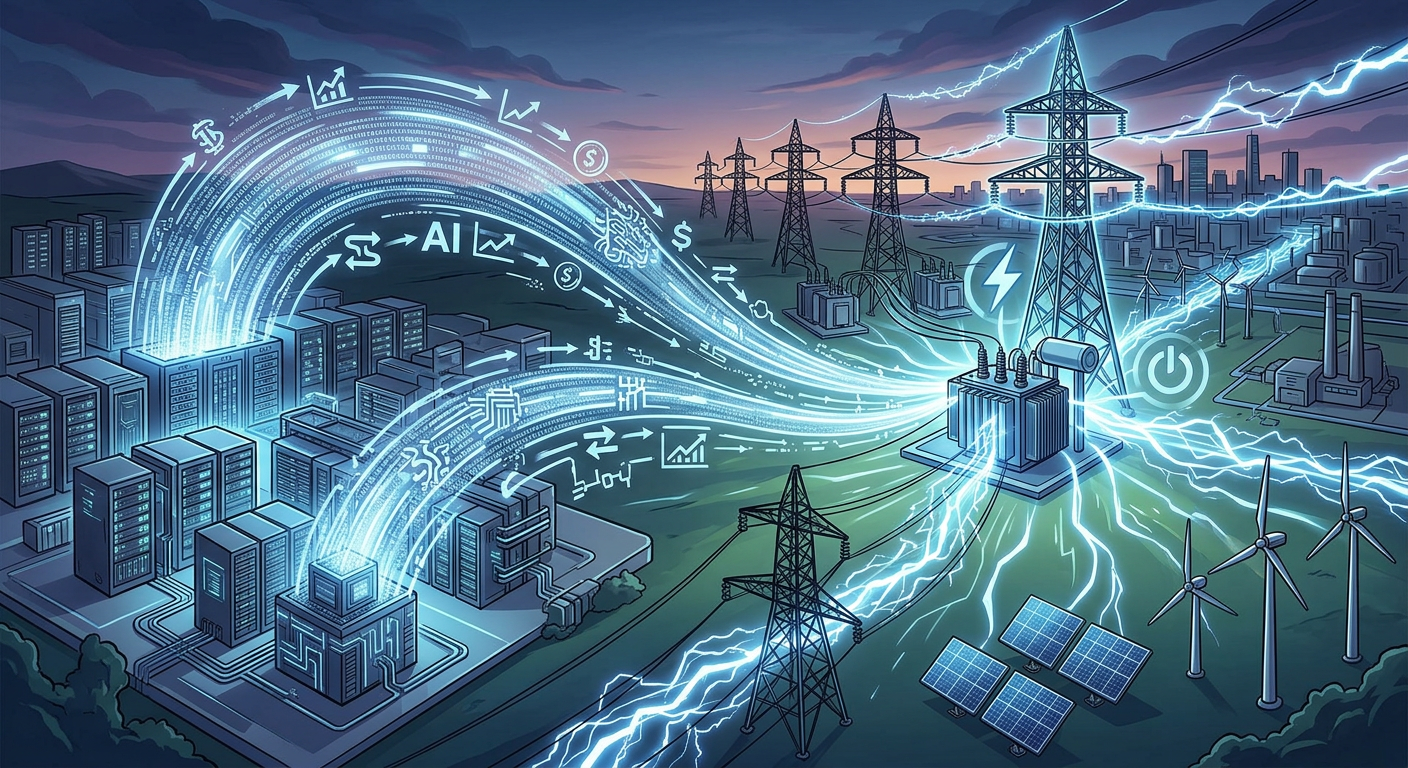
AI Was a Software Story. It's Becoming a Steel-and-Switchgear Story. Trade Accordingly.
A quick note from Behind the Markets
Wall Street loves the cleanest story. "AI is a software margin miracle." "Data centers print money." "Just buy the biggest names and relax."
That story skips the ugly part.
AI is turning into an industrial project — steel, transformers, turbines, cooling, and power contracts. And when the grid is the bottleneck, the winners aren't always the loudest tickers.
One calendar note before we start: the Fed's decision lands at 2 p.m. today, with Chair Warsh at the podium after. Everything below is built around businesses whose order books don't care what he says.
1) The AI Trade Is Morphing Into an Energy-Grid Trade (Whether Wall Street Likes It or Not)
There are two ways to think about AI.
Wall Street's way: it's an earnings call buzzword with a valuation premium.
Reality's way: it's a massive electricity-and-infrastructure buildout — and those projects don't scale smoothly. They hit procurement walls.
The key point for independent investors: power is becoming the limiter. Not "ideas." Not "GPUs." Power.
The framework: when data-center demand accelerates, the first squeeze shows up in interconnection queues and equipment lead times. Then it bleeds into pricing power for firms tied to grid hardware, services, and on-site generation. Eventually, the market realizes "AI capex" isn't just a tech story — it's a multi-year industrial cycle.
Want to see a procurement wall in a single filing? Look at who builds the electrical rooms.
Company: Powell Industries (SYM: POWL)
The custom switchgear and power-control-room specialist — record backlog, a $400 million mega data-center order, zero debt — and a 20% correction that just reopened the door.
Powell has spent 79 years building the equipment that keeps high-voltage electricity flowing safely — integrated power control room substations, electrical houses, arc-resistant switchgear, medium-voltage breakers, and bus duct — originally for refineries and petrochemical plants, now increasingly for the grid's newest gluttons. The numbers tell the section's whole story: new orders nearly doubled year over year to $490 million, backlog hit a record $1.8 billion — up 33% — with $545 million of cash, and, just after the quarter closed, a transformational mega data-center order worth more than $400 million. A single data-center order larger than a third of last year's entire revenue. That's what a procurement wall looks like from the seller's side.
Here's the timing angle: after a monster run, the stock fell roughly 20% in the past week to about $246, most recently closing near $232 — mid-range for its year — while the street stayed constructive: the 4-analyst consensus is a Buy with an average target around $316 — roughly 29% above the recent price — and Roth just raised its target to $333. A correction in a debt-free company with record contracted backlog is the setup.
Now the two-sided truth, and it's loud: the shares still trade at roughly 41 times forward earnings versus about 15 times for the electrical industry, and insiders — including the CEO — have sold roughly $32.5 million of stock over three months with zero purchases. This is a volatile mid-cap whose fortunes swing with project timing, and its next earnings report lands next Tuesday. You're buying the backlog, paying a premium multiple, and riding 10%-weekly-volatility — size for all three. And note the housekeeping: Powell split 3-for-1 in April, so ignore stale quotes in the $500s–$700s.
Bottom line: The next leg of AI isn't just software. It's power. If you're only watching the Nasdaq, you're missing the constraint — and the companies selling into it.
2) The Hidden Risk: AI Capex Can Look Like Growth… Right Until It Looks Like a Balance-Sheet Trap
One reason Wall Street keeps getting cycles wrong is they confuse spending with value.
Data center capex is easy to cheer while demand is rising. But when the buildout is financed with cheap narrative (and expensive debt), the risk is simple: overbuild meets higher-for-longer rates.
The retail-investor checklist that cuts through the hype:
Is capex funded by real free cash flow, or by "adjusted" numbers and new debt?
Are customer commitments contracted, or "pipeline" and "interest"?
Is the company exposed to power price volatility, or locked in with long-term supply?
Now we'll take a look at the most instructive company in America for this checklist — because it passes every single test.
Company: Comfort Systems USA (SYM: FIX)
The mechanical-and-electrical contractor building the AI boom — aces the entire checklist.
Comfort Systems installs the HVAC, cooling, plumbing, and electrical guts of complex facilities — and it has become one of the AI buildout's biggest quiet winners. Run the checklist against its fresh second-quarter report, out this week: contracted commitments? Backlog hit a record $14.1 billion — up $5.9 billion year over year — with technology customers generating 58% of first-half revenues and management reporting no slowdown among major data-center customers. Real cash, not adjusted stories? Over $1 billion in cash with minimal debt, a raised dividend, and ongoing buybacks. Execution? EPS of $12.53 crushed the $10.38 consensus by 21%, revenue of $3.26 billion beat by 11%, and same-store revenues grew 44%. This is what "capex funded by real free cash flow with contracted customers" looks like.
So why isn't this a table-pounding buy? Because the market found it first — spectacularly: the stock has surged over 112% year to date, trading at a forward P/E around 41 versus its industry's high-20s, insiders have been sellers for six months, and fair-value estimates now span an almost comical range — one framework pegs fair value at $1,150, a 42% downside, while bulls carry targets of $2,050–2,350. When smart people disagree by that much, the honest label is: a magnificent business at a debated price. The checklist tells you the business is real. It never tells you the price is safe. Put it on the watchlist, and if the AI-capex jitters that clipped the sector last week turn into a genuine correction, you'll know exactly what you're buying.
Bottom line: AI spending can create fortunes — and landmines. Follow the financing terms, not the headlines — and remember that even a perfect checklist score can't repeal the laws of valuation.
3) Defense Is Learning the Same Lesson as AI: The Constraint Isn't the Platform — It's the Supply Chain
Last week's conversation in defense circles wasn't about one more shiny program. It was about production capacity.
That's the parallel with AI: once demand is real, the entire game becomes throughput. Investors who only chase prime contractors miss the real opportunity set: component suppliers, test equipment, specialty metals, sustainment — and the bullet we've never covered until today: cyber and physical security for critical infrastructure.
Because here's the thing about a world of drone strikes on tankers, sabotaged pipelines, and hardened NATO fuel depots: every port, border, base, and cargo terminal on Earth is being told to inspect more, screen more, and detect more.
Company: OSI Systems (SYM: OSIS)
The security-screening specialist — cargo, vehicle, baggage, radiation detection — with a record backlog and a steady drumbeat of government orders.
OSI Systems builds the machines that see inside things: systems for inspecting luggage, packages, cargo, vehicles, and individuals, plus radiation, explosive, and narcotics detection, under the Rapiscan, AS&E, and Gatekeeper brands, alongside healthcare monitoring and an optoelectronics manufacturing arm. The demand signal — small, steady, relentless: a $19 million North American inspection-systems order, a $15 million cargo-and-vehicle order, a $12 million electronics award, a $10 million non-intrusive-inspection order — week after week. And it's compounding into records: record fiscal third-quarter revenue of $453.2 million with record EPS, a $1.9 billion backlog, a 1.3x book-to-bill, and reiterated full-year guidance of $10.30–$10.55 in non-GAAP EPS — putting the stock, around $210, at roughly 20 times this year's earnings. Even after trimming, the bulls sit well above: Citi at $279 (Buy) and BofA at $300.
The honest disclosures, and this name has spicy ones: OSI has appeared on lists of the most-shorted stocks that carry Strong Buy ratings — meaning a sophisticated crowd is betting against it, historically on questions about government-contract lumpiness and accounting complexity, and you should know that fight exists before joining either side. Insiders have sold $9.5 million of stock in three months with zero purchases. Both bullish covering analysts cut their targets even while keeping Buys. Government orders are chunky and can slip quarters. This is a fresh lane with a real tailwind and a real bear case — the kind of two-sided setup where position size does the risk management.
Bottom line: The 'defense boom' isn't just missiles. It's manufacturing capacity, throughput — and the screening infrastructure a more dangerous world has to buy.
4) Markets Don't Break on Bad News. They Break When Liquidity Gets Religious.
Here's the trap independent investors keep falling into: they think a selloff needs a catastrophic headline.
It doesn't.
In a higher-rate world, markets crack when lenders tighten quietly, refinancing windows shrink, spreads widen — and everyone suddenly starts caring about cash flow again. That's why the "soft landing" story can coexist with nasty under-the-surface damage — until it can't.
The lens for 2 p.m. today: when the Fed statement drops and Warsh speaks, don't ask "hike or hold." Ask whether anything he says reopens the refinancing window — because if it doesn't, the question that rules the second half stays the same: Which businesses can self-fund, and which are just renting time? Notice that every company in today's issue answers it the same way — Powell with $545 million and no debt, Comfort Systems with a billion in cash, OSI funding growth from operations.
Bottom line: When liquidity turns moralistic, weak balance sheets get punished fast — especially in small and mid caps.
Before You Go
The biggest edge retail investors can build isn't a hot take. It's a habit: find the bottleneck before Wall Street starts selling it as a theme.
Today that bottleneck is power — and the grid doesn't care about anyone's narrative. Neither does a $14 billion contracted backlog, a $400 million switchgear order, or a port scanner the government has to buy. Every name above carries the risks I put in plain sight: premium multiples, insider selling, short-seller fights, and one Fed chairman with a microphone at 2 p.m.
Found this helpful? Share it with others.
Written by Behind the Markets