Morning Watchlist: Wednesday Edition
A quick note from Behind the Markets
The third quarter ends at today's closing bell, and it's going out the way it came in — loudly. August PCE inflation prints this morning, right about the time this note lands in your inbox. Micron sits the most-watched exam of the season tonight after the close. Friday's jobs report still referees everything.
But the story we can't stop thinking about landed Monday, with less fanfare than it deserved: a chip company paid $8.2 billion for a startup that teaches machines to understand rooms.
Back in July, we wrote that the fading Mag Seven narrative would need a successor, and that the next ChatGPT moment would probably be the EI moment — embodied intelligence. Robots. On Monday, somebody put $8.2 billion behind that idea.
Three stories this morning. Three pairings. Let's get into it.
1) The Chipmaker is Buying "AI Imagination"
On Monday, AMD agreed to acquire World Labs — the startup founded by Fei-Fei Li, the Stanford professor often called the godmother of AI — in an $8.2 billion all-stock deal. Li becomes AMD's chief scientist.
What AMD bought is not a chatbot. World Labs builds "world models" — AI that understands three-dimensional space and physics, not just text. Its first product, Marble, generates simulated environments used to train robots before they ever touch the real world. Li's own words on the announcement: "Now that we have tangible proof of the possibilities, we want to do everything we can to accelerate the future."
Why does a chipmaker need this? Because the next wave of AI won't live in a chat window. It will live in machines — cars, warehouses, factory arms, humanoids — and an AI that runs a machine has to understand floors, shelves, and gravity. Nvidia has spent years building its robotics platform; AMD just bought its way into the same race, and the market barely blinked. The stock rose about 1% Tuesday morning, toward $615.
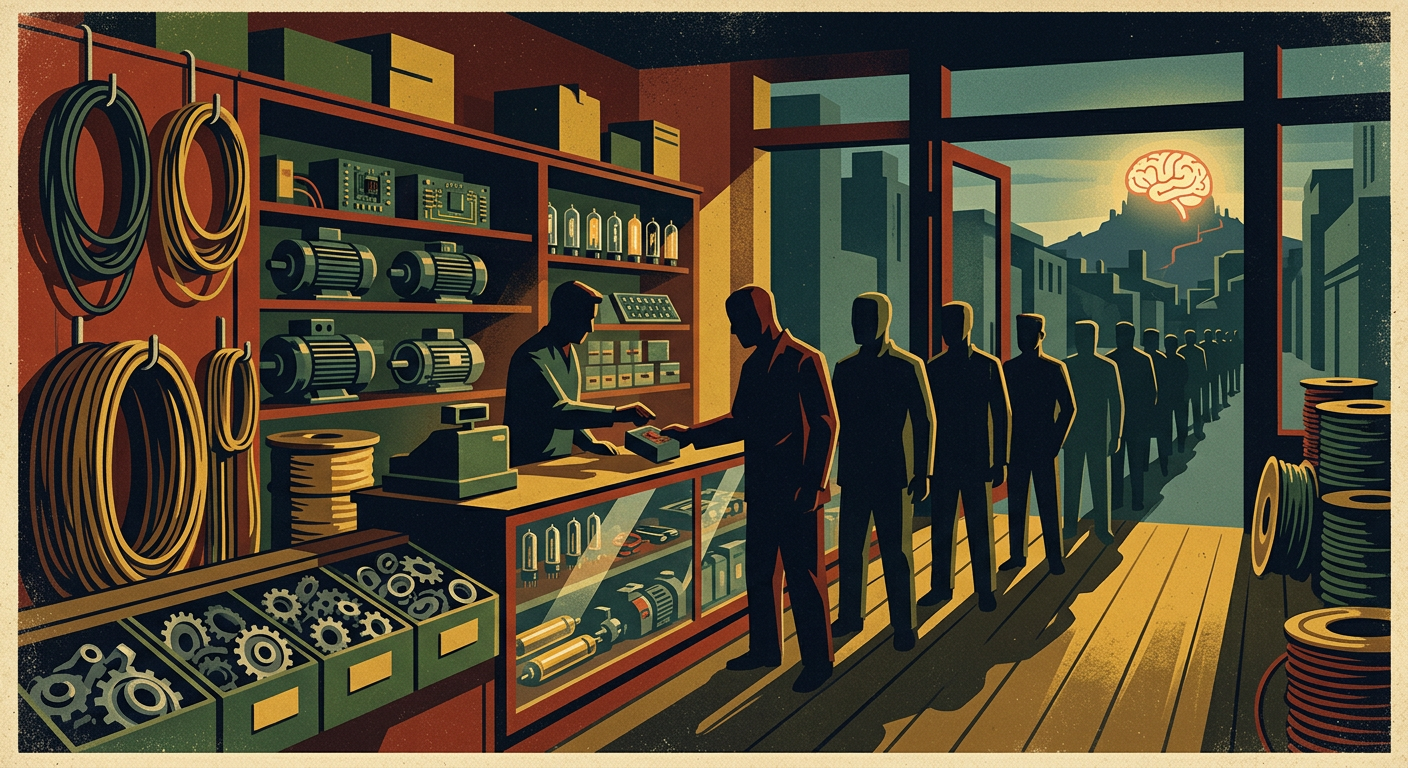
Here's the thing about robot brains, though. The brains get the headlines. The purchase orders go to the body. Put any robot on a workbench and it's mostly motors, gearing, bearings, and precision motion control — muscles, joints, and tendons. Whoever wins the intelligence race, every winner's robot is stuffed with the same unglamorous hardware.
The pairing: Regal Rexnord (RRX) — Buy
Regal Rexnord makes exactly that hardware — electric motors, gearing, bearings, and motion control, the working anatomy of industrial machines. Its Automation & Motion Control segment grew sales 16.2% last quarter, with daily orders up 17.1%, and the new CEO said the quiet part on the earnings call: the company is "positioned to address needs in eVTOL, robotics and data center — exciting frontiers where we can play meaningful roles."
A gold rush pays the pick-and-shovel store; a robot race pays the muscle shop. At about $156, the stock trades near 15 times this year's guided profit and about 13 times next year's expected earnings. The S&P 500: 21 times. One number needs explaining: the trailing P/E reads about 32 because merger amortization sits on reported earnings — the same accounting distortion we flagged at Jackson Financial, Global Payments, and Nexstar. Analysts carry a Strong Buy consensus with an average target near $248, and the stock sits roughly 37% below its 52-week high of $247.80.
The honest risks: the company carries real debt — about three times its yearly operating profit — and borrowed money costs more in a 5% world. Its residential heating-and-cooling segment is still shrinking. And robotics today is a frontier in the order book, not yet a line on the income statement.
2) The Used-Car Lot Aced Its Physical
On Sunday we told you CarMax would go to confession Tuesday morning, and that a stumble could mark down the whole used-car aisle — a repricing we said we'd welcome. The stumble never came.
Earnings per share of $1.16, up 81%, beating estimates by roughly 43 cents. Revenue up 19.5% to $7.9 billion. Comparable-store used-car sales up 13%. Wholesale units up nearly 16%. The average car sold for about $1,600 more than a year ago, and buyers showed up anyway. The stock rose in Tuesday's premarket, and the aisle we own — Lithia, our Sunday Buy — got graded up with it.
But read the quieter line in the report. CarMax's own lending arm grew its income 32%, became the largest lender in its credit tier, and wrote loans at an average rate of 11.8%. Think about that pair of facts together: cars are holding their value, and the loans against them pay double-digit rates. A car loan is pawnshop math — the loan is only as good as the thing you can take back — and Tuesday's report says the collateral is selling briskly at rising prices.
When the merchandise on the lot is that good, we want the bank in the back office.
The pairing: Ally Financial (ALLY) — Buy
Ally was born as GMAC — General Motors' financing arm, spun out and rebuilt as an all-digital bank — and it remains one of America's largest auto lenders. The engine is working: its lending margin has climbed from about 3.0% to 3.6% in two years, returns on equity have gone from 5% to a projected 13–14% this quarter, and management says loan losses are tracking better than planned, helped by — their words — favorable used vehicle prices. Customer count grew 7% in the first half, three-quarters of it millennials and Gen Z.
And the price? At about $38, near its 52-week low, Ally trades at roughly 6.5 times next year's expected earnings. The S&P 500: 21. There's a 3.1% dividend, and eighteen analysts carry a consensus Buy with an average target of $53.72 — 40% above the price. The dealership sells the car once. The bank gets paid every month for six years.
The honest risks: the kill switch is the same one we named on Lithia — consumer credit cracking at these rates, because a lender's customer who can't pay is everyone's problem. Deposit costs in a 5% world squeeze the margin from the other side. And a genuine rollover in used-car values would cut what Ally recovers on every bad loan. Near-term, about $20 million in lease losses tied to Stellantis recalls lands in the current quarter — known, sized, and temporary, but real.
3) Wall Street Went to Confession and Bragged
Two weeks ago, Bank of America's CEO warned that investment banking fees would fall at least 10% this quarter, and we bought Houlihan Lokey as the tow truck in the ice storm. Monday night, the first Wall Street firm actually reported — Jefferies, the traditional opener of bank earnings season — and instead of confessing, it bragged: record advisory revenue of $817.8 million, up 25%. Record equities trading, up 29%. Equity underwriting up 69%.
So which is it — frozen or thawing? Honestly: both. The thaw is arriving selectively — the dedicated deal shops are billing while the big banks' lending-tied fee lines lag. Grading our own call out loud: Houlihan Lokey sits near $129 against our $137.82 flag, down about 6%, and the thesis is fine either way — its restructuring desk feeds on the freeze, and its bigger corporate-finance desk (two-thirds of revenue) gets paid in the thaw. Still Buy.
But Monday night's report points at a purer expression of the thaw — and the market has it on the clearance rack.
The pairing: Evercore (EVR) — Buy
Evercore is the premier independent advisory house on Wall Street — deals and restructuring, no giant loan book, no trading floor to blow up. Over the past year its revenue grew 45% and earnings per share grew 61%, with management calling the first half a record. Now the punchline: at $261.62, the stock sits within about 3% of its 52-week low, a third below its high, at roughly 13.6 times next year's expected earnings. The S&P 500: 21. Eleven analysts rate it Buy with an average target of $364 — nearly 40% above the price.
The caterer's bookings are at records, and the stock is priced like wedding season got canceled. The honest risks: 5% money can still slam the deal window shut — the BofA warning is about the quarters ahead, not the one just filed. Advisory work has no subscriptions; every quarter starts at zero. And the underwriting surge leans on the IPO window staying open — Anthropic's expected October debut is the tell, the same one we named when we bought Nasdaq.
Before You Go
That's the watchlist: the muscle shop for the robot age, the bank behind the used-car boom, and the deal shop priced for a freeze that just posted records. One theme, as always: the best opportunities stand one step behind the headline.
Housekeeping: Nvidia added $150 billion to its buyback Monday — the largest single authorization in history — and Raytheon won a $20.7 billion multi-year missile-production contract, one more receipt for the munitions-replenishment thesis behind our L3Harris Buy.
The Canada import ban went live Tuesday — Brown-Forman's aisle, with Polaris listening. Carnival reported Tuesday after we went to press; we'll grade it tomorrow alongside the vacation shelf. Today: PCE this morning, the quarter ends at the close, and Micron reports tonight — the Street wants about $31.49 a share from our September 15th Buy. Nike confesses tomorrow. Friday at 8:30 AM, the jobs report gets the last word on everything.
Found this helpful? Share it with others.
Written by Behind the Markets