Dear Reader,
As promised yesterday, let me tell you what I know about Anthropic’s investor roadshow.
This is information from people close to the situation, and I think it changes how you should think about this IPO.
What a Roadshow Actually Is
For those who don’t know the process — I grew up doing these on Wall Street.
When a company is preparing to go public, it invites its biggest potential investors into a room.
The CFO and executive team pitch the business.
Investors ask hard questions about revenue, growth, margins, and competition.
Then those investors go back to their offices and call the bank running the deal.
They say: “We’d be interested buyers at X price.”
That feedback is how the bank sets the IPO price.
Anthropic has been doing exactly this.
Last week in San Francisco, they held a session with a small group of investors.
And I have information from people who are close to that situation about what happened inside that room.
The Numbers
Revenue in Q3 came in at $16.8 billion.
That’s a 45% jump from Q2.
To put that in perspective — Q3 revenue alone was 3.6 times Anthropic’s entire revenue for all of 2025.
That is a staggering growth rate by almost any measure.
But here’s what the investors who walked out of that room told the bank.
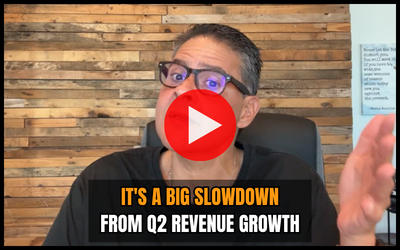
It’s also a significant slowdown.
Q2 revenue grew 140%.
Q3 revenue grew 45%.
Still extraordinary. But the trajectory moved in the wrong direction.
And the operating margin came in at 11%.
For every thousand dollars of revenue, Anthropic is generating about $110 in earnings before interest and taxes.
Not bad. But not enough to justify a $2 trillion valuation in the investors’ minds.
After the meeting, those investors told the bank: we’re thinking a trillion and a half.
Not two trillion.
That’s 25% off the valuation Anthropic was hoping for.
The Question Nobody Can Answer Yet
Here’s what I’ve been chewing on since I heard this.
Why did the growth rate slow from 140% to 45%?
There are a few possible explanations, and they each mean something very different.
One: normal maturation. Revenue growth slows as a business gets larger. That’s math.
Two: competition. ChatGPT got better this quarter. Maybe market share shifted back to OpenAI.
Three: the free Chinese models — Kimi, DeepSeek — are starting to chip away at the paying customer base. Companies that were willing to pay any price for AI a year ago are now asking harder questions about return on investment.
Four: the easy money is gone. The earliest adopters have already signed up. Now comes the harder work of expanding the market.
I don’t know which of these it is.
That’s the honest answer.
And frankly, neither does anyone else right now.
The Bigger Question
Here’s what I’ve really been sitting with.
We all know AI is going to change the world.
That’s not in dispute.
What is in dispute is who captures the economic value from that change.
My instinct — and this is something we’ve talked about here before — is that the application makers are going to extract more value than the model makers over time.
Think about it this way.
If I’m a cybersecurity company, I take Claude or ChatGPT or Gemini, customize it for my specific use case, and sell that solution directly to my customers.
I’m the one with the customer relationship.
I have the pricing power.
And over time, if enough application companies get big enough, they start putting pressure on the model makers to lower their prices.
Think about what Walmart does to its suppliers.
The closer you are to the customer, the more economic value you extract.
The further you are — the more you’re a commodity supplier — the more pressure you face on price.
Anthropic is trying to be both the model maker and the application layer.
That tug of war is very, very difficult to handicap.
Is their competitive advantage durable?
In my view — not yet.
What This Means for the IPO
This is still going to be one of the largest IPOs in American history.
But if the investors who sat in that San Francisco room walked out thinking $1.5 trillion instead of $2 trillion, that’s a more rational price for regular investors to participate in.
The private market guys who got in years ago made the real money.
And believe it or not, you can too.
Not in Anthropic of course, that ship has sailed.
Not in SpaceX either unfortunately…
SpaceX went public in June — the largest IPO in history.
By the first closing bell, roughly 4,400 SpaceX employees were millionaires.
But here’s the part almost everyone missed.
Only about $1 of every $20 of that stock was allowed to trade.
The rest is still frozen — locked up by the rules of the offering.
When that lockup ends, more than $600 billion worth of SpaceX stock is free to move.
And I believe a lot of that money is headed to one small public company trading for about $14.
NASA hired it to build and run a communications network around the Moon.
It’s the first time in the agency’s history it has handed that job to a commercial company.
Without that network, the far side of the Moon — and the lunar south pole, where NASA plans to land astronauts — goes dark.
In July, this little company filed an application with the FCC to switch that network on.
Printed inside it is a name you know very well.
SpaceX.
The last time NASA handed a first-of-its-kind services contract to a small company was 2008.
That company was SpaceX.
Here’s the name of the company and the full story:
But for the rest of us, a more grounded valuation is actually a better entry point.
We’ll see.
More on this as it develops.
Have a wonderful day.
I’ll see you tomorrow.
“The Buck Stops Here,”
Found this helpful? Share it with others.
Written by Dylan Jovine