Dear Reader,
A lot of the best ideas I’ve had in my career came from reading annual reports and quarterly reports.
Specifically, from looking at where big companies are directing their capital spending.
When CEOs talk about the future, they say “we’re investing in this,” and they paint a picture.
If you read carefully, it isn’t hard to unpack.
That’s what I’ve been doing lately, and it’s led me to one conclusion.
Robots are going to be a very big deal.
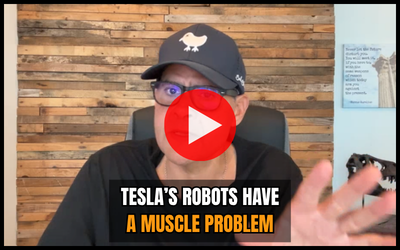
Tesla’s Snag
Tesla has ramped up production of its Optimus humanoid robot tenfold in recent months.
But production has hit some snags.
Problems with the robot’s hands.
Supplier constraints.
Issues with other automated equipment.
Their goal is 20,000 robots a week.
When I see a situation like this, I ask myself the same questions.
Where is this going?
Where are the bottlenecks?
Where is the value going to be captured?
I’ve been on a deep dive for the past few weeks, and one answer keeps coming back.
Actuators.
The Muscles of a Robot
Think of an actuator as a muscle.
There’s one at the elbow that helps lift.
One at the shoulder.
At the hips, the knees, the wrists, the hands.
A humanoid needs roughly 30 to 70 of them.
And each one has to be strong, precise, compact, light, efficient, and cheap, all at once.
Current technology isn’t built for mass manufacturing of actuators for humanoids.
It’s a brand new thing.
So why is it so hard?
First, power density.
A human-sized limb has to produce a lot of torque.
Every extra gram of weight increases the torque that the joints above it need.
Hands are the worst case.
A really good hand needs 10 to 20 degrees of freedom packed into a space smaller than a phone, with very fine force control.
That’s why the inside reports say Optimus has been slowed down by hand and forearm actuator problems.
Second, precision components.
These have thin supply chains.
Nobody has done this before.
Industrial robots use light tolerances and a handful of qualified suppliers.
For consumer humanoids, there are essentially none, and certainly none at scale.
That’s an opportunity.
Who Captures the Value
With any product I’m looking to invest in, I ask one question.
Who captures the most value?
At this stage of the product life cycle, actuators are 50% or more of a humanoid’s bill of materials.
Precision screws and reducers are very expensive to machine at scale.
So a lot of the value goes to the actuator companies.
And one of them is going to be a killer.
Somewhere there’s a CEO who is going to figure out shoulders, hips, elbows, wrists, and hands at scale.
That person is going to make a fortune.
Now, here’s how this plays out over time.
It becomes very much like the car business.
In the beginning, suppliers have the leverage.
For a period of time, they can pressure companies like Tesla.
Of every dollar split between Tesla and the actuator companies, the actuator companies might get 50% right now.
But as the product matures, Tesla gets its pricing power back.
Just like Walmart does with its suppliers.
Just like General Motors and Ford.
The suppliers’ share of every dollar goes down.
That’s why timing matters.
Why This Feels Familiar
I’ll never have a robot in my house.
I grew up watching The Terminator.
I’m not that crazy.
My daughter, on the other hand, told me last night she can’t wait.
My son is a little more skeptical, thank the Lord.
But this is getting ready for prime time.
There are companies building robot gyms, where the software can be trained for businesses that need it.
American and Western companies are investing very heavily, and that’s not even counting China.
This reminds me of when we saw that the nature of warfare was changing.
It was becoming network warfare.
We knew companies like Palantir, Rocket Lab, and Intelsat would become much more important as that played out.
Those were very big winners for us.
I think robots are at the same kind of starting line.
What I’m Doing About It
We’re updating our EI Era report.
I’m excited about it.
I have a whole list of actuator companies, and I’m doing a deep dive on each one.
I’m asking which ones have a durable competitive advantage, one that can last five years, with a real leap in technology over their competitors.
And I’m asking which ones are cheap.
Because you can have the greatest company in the world.
The question is what the stock is worth.
Those are two different questions.
There are plenty of great companies whose stocks are crazy overvalued, and we don’t touch them.
We wait for them to crash.
If you like digging into this kind of research, and I know many of you do, I’d love to have you do this exercise with me.
Email us.
Start getting into the project.
A brand new industry is being created for the first time.
It’s a lot of fun to watch it happen together.
And if you don’t have access to our updated EI Era report.
Have a wonderful day.
I’ll see you tomorrow.
“The Buck Stops Here,”
Found this helpful? Share it with others.
Written by Dylan Jovine