Consumer Sentiment Just Hit the Lowest Level in 74 Years. The Market Shrugged. One of Them Is Wrong.
A quick note from Behind the Markets
Welcome back from the long weekend.
Here's what the market woke up to this morning: consumer sentiment at its lowest level ever recorded. Not lowest since 2008. Not lowest since COVID. Lowest. Ever.
And yet futures are green.
That's the disconnect worth paying attention to this week — because between now and Friday, the data is going to force a reckoning with at least one of those two things.
1) Consumer Sentiment Just Hit a Record Low — and the Market Hasn't Priced It
On Friday, the University of Michigan dropped a number that should have stopped Wall Street cold.
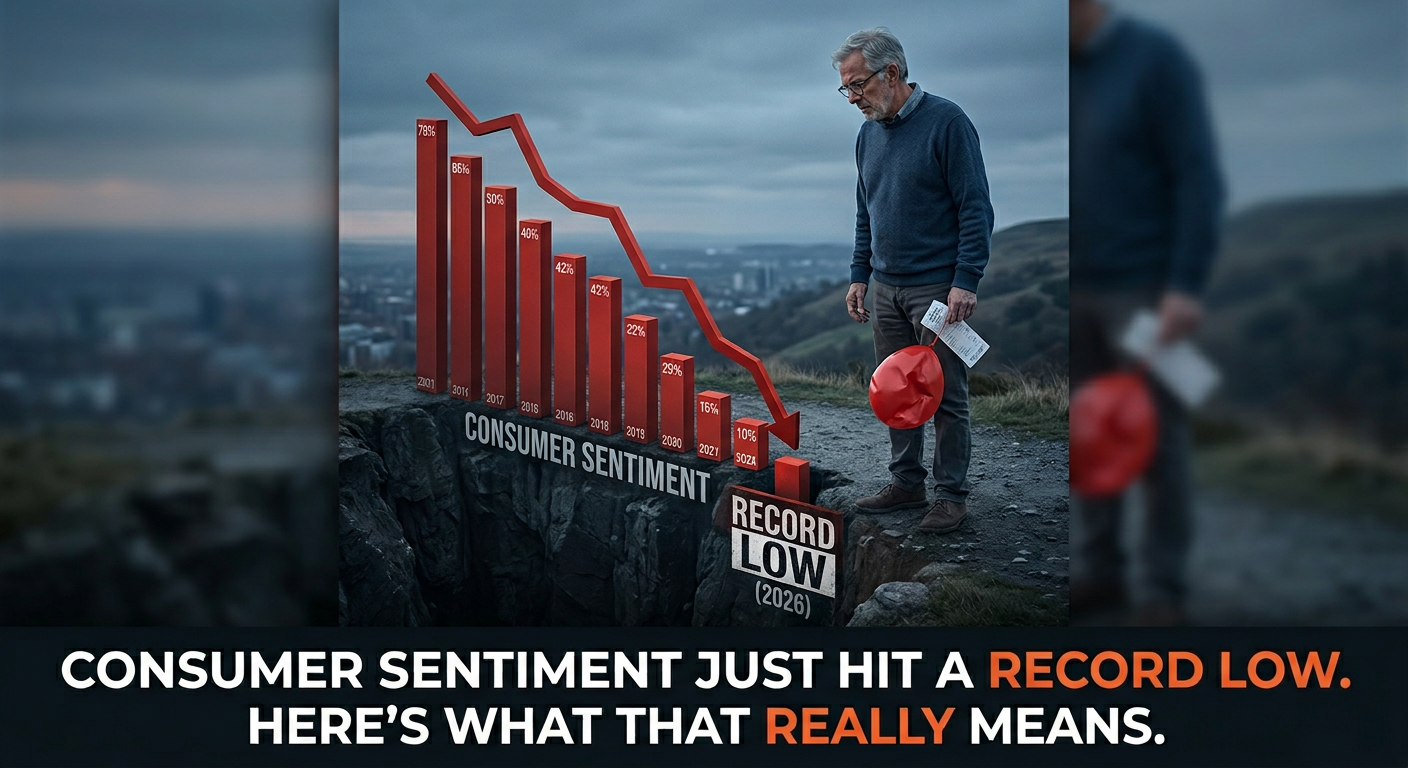
The final May Consumer Sentiment Index came in at 44.8 — down from 49.8 in April, revised sharply lower from the preliminary 48.2, and the lowest reading since the survey launched in November 1952. Not since the stagflation of the 1970s, not during the 2008 financial crisis, not during COVID — never has this index been this low.
Bloomberg called it "weaker than all projections in a Bloomberg survey of economists."
The details are worse than the headline. Current Economic Conditions plunged 12.8% to 45.8. Consumer Expectations fell to 44.1 — also a record low and down for the fourth consecutive month. A full 57% of respondents said high prices are meaningfully hurting their financial situations — up from 50% in April. Gallup's parallel survey found that 75% of Americans think economic conditions are getting worse. Only 16% rate conditions as excellent or good.
Year-ahead inflation expectations climbed to 4.8% — up from 4.7% in April and dramatically higher than the 3.4% recorded in February, before the Iran conflict escalated. Long-run expectations hit 3.9%, soaring from 3.5% in April and now far above the 2.8%–3.2% range that prevailed throughout 2024.
Survey director Joanne Hsu pointed directly at the cause: "supply disruptions in the Strait of Hormuz continue to boost gasoline prices." Gas is now at $4.55 per gallon nationally (AAA). The steepest sentiment declines hit lower-income households and those without college degrees — the populations most exposed to fuel and essentials costs.
Here's why this matters beyond the obvious. The Fed doesn't just watch realized inflation. It watches inflation expectations. When consumers expect 4.8% inflation a year from now, they behave differently — they demand higher wages, they pull forward purchases, they resist long-term financial commitments. That behavior itself becomes inflationary. It's the spiral the Fed has been trying to avoid since 2022.
One company that benefits when the consumer trades down under record pessimism:
Company: Costco Wholesale (SYM: COST)
The membership-model retailer that captures the trade-down wave — high-income consumers seeking value, low-income consumers needing it.
When 57% of consumers say high prices are hurting their finances and sentiment hits a 74-year low, discretionary spending contracts. But spending on essentials doesn't stop — it redirects. Costco's Q2 sales of $68.2 billion (comps +22.6%) proved it. The membership fee generates high-margin recurring revenue that's immune to sentiment readings. In a consumer economy running on fumes, Costco is the gas station — not the destination.
Bottom line: The market's reaction to a record-low sentiment print was to shrug. That's either confidence or complacency. History suggests you should know which one before Thursday's PCE data.
2) This Is One of the Most Loaded Short Weeks of the Year — Know What's Coming
Four trading days. Here's what's stacked inside them.
Today (Tuesday): The $69 billion 2-year Treasury auction — the first read on short-end demand after the long weekend. Also: Case-Shiller home prices and Conference Board Consumer Confidence, which will either confirm or contradict Friday's Michigan crater.
Wednesday: $70 billion 5-year note auction. ADP private payrolls. Durable goods orders. The 5-year is the auction most sensitive to near-term Fed expectations — if demand is soft, yields move and the equity market feels it.
Thursday: The monster. GDP second estimate for Q1 2026 alongside Core PCE — the Fed's actual preferred inflation gauge — plus personal income and spending data, jobless claims, and a $44 billion 7-year note auction. That is an extraordinary amount of market-moving data in a single morning.
Total Treasury supply for the week: $183 billion in coupon securities in four days.
The professionals aren't trading the individual prints. They're trading the sequence. If today's auction goes poorly, that's a warning. If Wednesday's ADP comes in soft while the 5-year auction struggles, yields spike into Thursday's PCE. That chain reaction is the real risk — not any single number.
One ETF that avoids the duration repricing while the auctions absorb $183 billion:
ETF: iShares 0-3 Month Treasury Bond ETF (SYM: SGOV)
Ultra-short Treasury exposure yielding approximately 3.94% with zero duration risk — the instrument that doesn't care whether the 5-year or 7-year auction tails.
When $183 billion in duration needs buyers during a compressed four-day week with GDP and PCE landing simultaneously — and consumer sentiment is at a record low — the shortest maturity is the safest ground. SGOV collects yield while the belly and long end of the curve absorb the stress test.
Bottom line: Short weeks feel calm. They often aren't. Four days of compressed catalysts with thinner-than-normal volume can amplify moves in both directions.
3) PCE Is the Fork in the Road. Thursday Morning Decides It.
The most important number this week isn't GDP. It's Core PCE.
March PCE inflation came in at 3.5% year-over-year — up sharply from 2.8% in February, driven by the energy spike following the Iran conflict. Core PCE (ex-food and energy) has been running around 3.1% and is expected to stay sticky in April's reading.
The Fed's target is 2%. Core PCE is running at 3.1%. That's not close.
And here's the bind. The economy is slowing — GDP growth has been decelerating, Q4 2025 was revised to just 0.5%. But inflation is reaccelerating — CPI at 3.8%, PCE at 3.5%, inflation expectations at record highs. That is the definition of stagflation: the one scenario where the Fed has no clean tool. Cut rates and you pour gasoline on inflation expectations already at 4.8%. Raise rates and you crack an economy already showing stress in housing (HMI at 34), consumer spending (sentiment at 44.8), and small-cap earnings (40–46% zombie rate).
One ETF that wins whether PCE lands hot or merely sticky:
ETF: Schwab U.S. TIPS ETF (SYM: SCHP)
Treasury Inflation-Protected Securities — the one asset class whose principal adjusts upward with inflation. If PCE stays at 3.5% or rises, SCHP's inflation adjustment keeps accumulating. Expense ratio: 0.03%.
If Core PCE surprises above 3.2%, the rate-cut trade dies completely and nominal bonds sell off. TIPS benefit from the inflation adjustment while avoiding the repricing risk. If Core PCE comes in below 2.9%, the market exhales — and TIPS hold their value because the principal doesn't deflate unless CPI goes negative. It's the asymmetric bet on Thursday's most important number.
Bottom line: Thursday's PCE isn't just a data point. It's a fork in the road for the entire "soft landing" narrative. The spread between the two outcomes is enormous — and it lands on one of the thinnest trading days of the year.
4) The "Frozen" Housing Market Is About to Get Data — Here's What to Watch
Today's Case-Shiller home price index and Wednesday's MBA mortgage data will tell two different stories about the same market.
Case-Shiller will likely show home prices still elevated in nominal terms. Prices haven't crashed — inventory remains historically low because 80% of existing mortgages carry rates at or below 6%. Sellers with 3% mortgages won't list into a 6.36%+ rate environment. The market isn't clearing. It's frozen.
MBA data will show the real picture: application volumes near multi-decade lows, refinancing activity essentially zero, and purchase demand constrained entirely to buyers with no choice.
The frozen market creates a split outcome by company type:
Homebuilders (NVR, DHI, Lennar) are actually benefiting — they can offer mortgage rate buydowns that existing-home sellers can't, capturing buyers who need to move. Builders with balance-sheet flexibility and buydown programs are taking share in a shrinking market. NAHB's data confirms the strategy: 36% cutting prices, 60% using incentives for 13 straight months.
Mortgage originators and servicers are being slowly crushed. Volumes are structurally depressed until rates fall meaningfully. The refi business is dead.
Home improvement retail (HD, LOW) is quietly feeling the freeze — households that can't move aren't renovating at the same rate. Both companies report this week, and margin commentary on big-ticket discretionary spending will be the tell.
Before You Go
The consumer is at a record-low confidence reading. Inflation expectations are at multi-year highs. The Fed is frozen. And markets opened Tuesday with green futures.
One of these things is not like the others.
The question worth sitting with this week: are markets right that the data will be "good enough" — or are they just running on momentum and hoping Thursday doesn't spoil the party?
History says momentum and hope are a fine strategy. Right up until they aren't.
Found this helpful? Share it with others.
Written by Behind the Markets