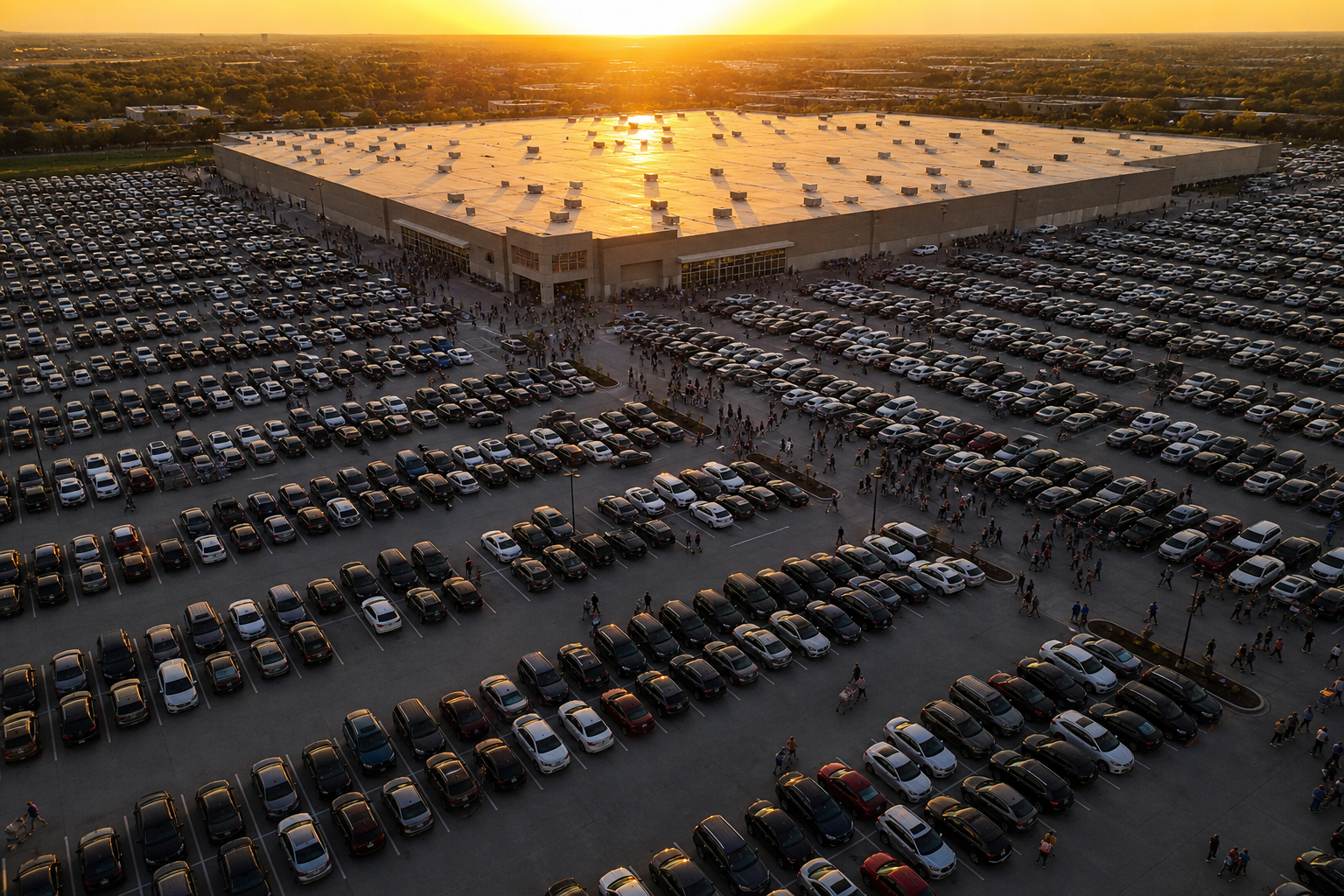
Key Points:
- Costco (COST) reported Q3 fiscal 2026 net sales of $69.15 billion, up 11.6% year-over-year, with comparable sales rising 9.8%
- Net income surged 15.2% to $2.19 billion, or $4.93 per share, beating last year's $4.28
- Year-to-date revenue has crossed $203 billion, putting Costco on pace for its first $280 billion year
- The stock barely flinched — trading near $1,000 a share — because at a 50x earnings multiple, perfection is already priced in
- The broader market continued its record-setting run, with the S&P 500 and Nasdaq both at all-time highs
The Most Boring Blowout Quarter in Retail
Costco just reported one of the best quarters in American retail history, and the stock didn't move. That tells you everything you need to know about where this company stands — and what Wall Street already expects from it.
Third-quarter net sales came in at $69.15 billion, up 11.6% from $61.96 billion a year ago. Comparable sales — the metric that strips out new store openings — rose 9.8% overall, or 6.6% excluding the effects of gasoline prices and foreign currency swings. Net income hit $2.19 billion, up from $1.90 billion last year. Earnings per share grew to $4.93 from $4.28.
By any objective measure, these are spectacular numbers. A company with 900-plus warehouses worldwide just grew same-store sales nearly 10% in a single quarter. Most retailers would celebrate that kind of growth for an entire year.
But the stock sits around $1,000 a share. It barely budged. And that reaction — or lack of one — is actually the most important part of the story.
Why the Market Shrugged
At roughly $1,000 per share, Costco trades at approximately 50 times earnings. That's the kind of valuation you typically see on high-growth tech companies, not a warehouse retailer that sells rotisserie chickens and bulk paper towels.
The market isn't paying 50 times earnings because of what Costco did last quarter. It's paying that multiple because of what it expects Costco to keep doing — quarter after quarter, year after year, with the mechanical reliability of a Swiss watch.
And so far, Costco has delivered. Year-to-date revenue through the first 36 weeks of fiscal 2026 has hit $203.37 billion, up 9.6% from $185.48 billion. Annualized, that puts Costco on track for roughly $280 billion in full-year sales — which would make it one of the three or four largest companies in America by revenue, alongside Walmart, Amazon, and Apple.
Net income for the first 36 weeks is $6.23 billion, or $14.01 per diluted share, up from $5.49 billion and $12.34 per share. The membership model continues to be the engine. Once customers pay their annual fee, they shop with the loyalty of people who've made a financial commitment — and Costco's renewal rates consistently hover above 90%.
What the Numbers Really Tell You About Consumers
Forget the economic models for a moment. If you want to know how the American consumer is actually feeling, look at what they're doing at Costco.
Comparable sales growth of 9.8% doesn't happen when people are cutting back. It happens when households are trading down from higher-priced retailers but trading up in volume. Costco isn't just surviving in this economy — it's actively capturing share from the rest of retail.
The pattern has been remarkably consistent. When inflation runs hot, consumers don't stop spending. They redirect spending toward value. And in America, value has a name, a membership card, and a food court that still sells hot dogs for $1.50.
That's the Costco paradox: the company's growth accelerates precisely when the economic backdrop looks most challenging for retailers. Higher grocery prices push more shoppers through the doors. Tighter household budgets make the membership math more compelling, not less.
The $1,000 Question
Here's where it gets uncomfortable. Costco stock is now hovering around $1,000 per share. At roughly $440 billion in market capitalization, investors are paying about 1.6 times trailing sales and 50 times trailing earnings.
Is that expensive? In absolute terms, yes. The S&P 500 average is closer to 22 times earnings. You're paying a premium of more than double for the privilege of owning a retailer.
But Costco isn't a normal retailer. It has virtually no competition in its niche. Membership renewal rates above 90% create a revenue stream that's closer to a subscription business than a store. And management has demonstrated, over decades, the kind of disciplined execution that justifies a scarcity premium.
The bull case is simple: Costco will keep growing 8-10% a year, keep expanding internationally, keep raising membership fees every few years, and compound earnings indefinitely. If you believe that, paying 50 times earnings for one of the most durable consumer franchises on Earth might be reasonable.
The bear case is equally simple: even great companies can be overpriced, and at 50 times earnings, any stumble — a single quarter of disappointing comps, a recession that actually dents spending, a fee increase that drives attrition — could send the stock down 20% before you finish your morning coffee.
Where Things Stand
The S&P 500 closed Thursday at 7,567, another all-time record. The Nasdaq also set a fresh high. Markets appear to be shrugging off concerns about inflation, geopolitical tensions, and interest rates in favor of a simpler narrative: corporate earnings are strong, and companies like Costco keep proving it.
Costco's quarter was exactly what the market expected — which is why the stock didn't move. When perfection is priced in, perfection isn't a catalyst. It's just the minimum.
Must Read Spotlight: Elon’s $480 Trillion Currency Masterplan

He's waited 27 years for this moment. Elon Musk just launched his biggest disruption ever, which could totally reset how millions of people access their money and even pay tax. Here's exactly what to buy to profit.
Found this helpful? Share it with others.