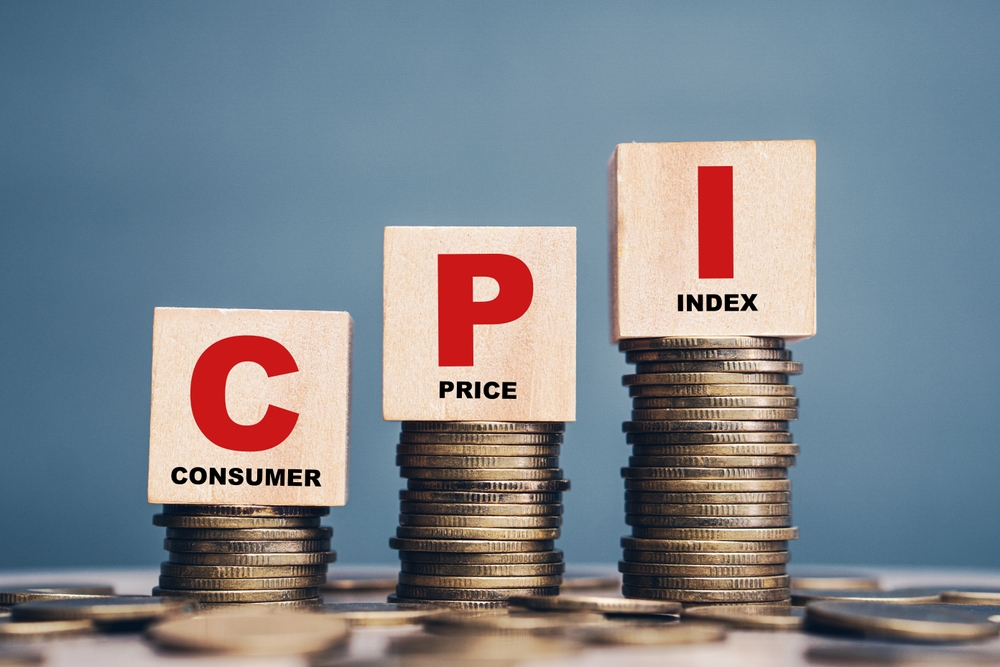
Today's CPI Print Is a Trap — Unless You Know Where to Stand
A quick note from Behind the Markets
Wall Street loves "consensus." Not because it's right — because it's comfortable.
And when everyone lines up on one side of the boat, you don't need a storm to tip it.
This morning's inflation data is the kind of event where retail can win — because you can think in scenarios while the institutions are forced to sell a single narrative.
1) CPI Isn't Data. It's a Positioning Event.
The CPI print isn't just about inflation. It's about who's trapped.
The FactSet consensus expects headline CPI up 0.9% month-over-month and 3.7% year-over-year for March — a massive jump from February's 2.4% annual rate. Core CPI is forecast at +0.3% monthly and 2.7% year-over-year.
That's the part most people stop at. Here's the part to focus on:
If headline runs hot because energy is screaming higher, the media will wave it away as "volatile." But markets don't trade the media's excuses. They trade rates. And if core is sticky too, the Fed can't hide behind "temporary" anything.
BofA Securities forecasts a 10.6% month-over-month jump in energy prices alone for March — the first full month reflecting the Iran war's impact on crude. That's not noise. That's a supply shock feeding into transportation costs, shipping rates, and the price of virtually everything that moves by truck, rail, or ship.
One way to position for it:
ETF: Vanguard Energy Index Fund (SYM: VDE)
Low-cost, broad exposure to U.S. oil and gas stocks — the sector that benefits most when energy-driven CPI runs hot.
Energy stocks surged 38% in Q1 2026 while the S&P 500 fell. That's not a coincidence — it's the market telling you where the pricing power lives. When inflation is energy-led, the companies producing the energy don't suffer from it. They collect the premium. VDE gives you diversified exposure across the majors, the independents, and the services companies without betting on a single name.
Bottom line: CPI is less about "inflation" and more about whether the market has to re-price the entire rate path again. If you're long duration — unprofitable tech, levered real estate, long-dated bonds — you're the one holding the grenade.
InvestorPlace Media
Navellier Warns: This Could Leapfrog Elon’s SpaceX IPO
Elon Musk could take SpaceX public in 2026, at an estimated $1.75 trillion valuation. The IPO would include Elon's AI model, Grok. But according to Louis Navellier, a radical new AI model will launch this year… over 1,000 times more powerful than Elon's. And the company behind it could outperform SpaceX in the process.
Click here for full details (including Louis' new pick — free).
2) The Fed Wants Optionality. Hot CPI Steals It.
Brown Brothers Harriman framed March CPI as a potential one-year high: 3.4% y/y headline CPI and 2.7% y/y core CPI.
What matters isn't the exact number. What matters is the political and market psychology.
A hot print makes the Fed look behind the curve. It pushes real yields up. It tightens financial conditions whether Powell wants it or not.
The Fed already tipped its hand at the March meeting. Seven of 19 FOMC participants now see zero rate cuts in 2026 — up from what was a near-consensus on multiple cuts just three months ago. The dot plot still shows one cut this year, but the longer-run neutral rate estimate edged up to 3.125%. And the CME FedWatch Tool shows 98.4% odds the Fed holds steady at 3.50–3.75% at the April 29 meeting.
The FOMC March 17–18 minutes are due Wednesday, and BBH positioned it as a "hawkish hold" environment where the hurdle for a hike is being watched — not just the timing of cuts.
One way to play the "higher for longer" stance:
ETF: iShares 0-3 Month Treasury Bond ETF (SYM: SGOV)
Ultra-short duration Treasury exposure that collects yield without taking rate risk.
When the Fed is stuck and the rate path is uncertain, the smartest move isn't to guess what Powell does next. It's to park capital where you're getting paid to wait. SGOV currently yields in the range of 3.5%+ annualized with virtually zero duration risk. That's the financial equivalent of sitting in the tall grass while everyone else fights over the clearing.
Bottom line: "Higher for longer" is back the moment inflation stops trending down. You don't need to guess Powell's emotions — you just need to understand the reaction function.
3) A Quiet Risk Nobody Prices: Inflation Expectations
Here's the sleeper issue: expectations.
BBH flagged University of Michigan 5–10 year inflation expectations rising 0.3 points to 3.5%, a six-month high.
This is how "temporary" becomes permanent.
When households start believing inflation is structurally higher, wage demands follow, price-setting behavior shifts, and the Fed loses credibility. It doesn't happen overnight — then it happens all at once.
The Fed itself just quietly raised its 2026 inflation forecast from 2.4% to 2.7% in the March Summary of Economic Projections — the largest single-year upward revision in recent cycles. When the people setting rates start revising their own numbers higher, pay attention. That's not a forecast. That's an admission.
Meanwhile, Morningstar's chief U.S. economist now expects PCE inflation — the Fed's preferred measure — to hit 3.6% for 2026, up from a 2.6% forecast at the start of the year. That's a full percentage point revision in three months.
One way to hedge sticky expectations:
ETF: Schwab U.S. TIPS ETF (SYM: SCHP)
Treasury Inflation-Protected Securities — bonds whose principal adjusts upward with the CPI.
TIPS are the one asset class designed for exactly this scenario: inflation that runs hotter and longer than expected. When CPI goes up, the principal on TIPS goes up with it — which means your interest payments increase, too. If expectations keep climbing and the Fed stays on hold, TIPS quietly accumulate value while nominal bonds get crushed. The Schwab version carries a rock-bottom expense ratio of 0.03%.
Bottom line: Sticky expectations make a future Fed pivot harder, not easier. That's why one or two hot prints can matter more than a dozen soft ones.
Trade Algo
🚨 Starting Over With $2,000? Here's Exactly What I'd Do.
Forget guessing. The world's best traders all share one habit: they follow breakout volume. Scan dark pools for unusual Smart Money activity, spot the technical breakout, and enter the trade. It's a 3-step system — and now there's a tool that does the heavy lifting for you.
TradeAlgo is offering FREE AI-powered Dark Pool SMS alerts — get the exact ticker the moment unusual activity hits.
👉 Claim your free access before it closes →
4) How to Think About CPI Like a Pro (Without the Bloomberg Terminal)
Here's a simple framework for today's CPI.
Scenario A: Headline hot, core cool. Energy-driven. The market may try to shrug it off as "transitory." Watch the 2-year Treasury yield — if it shrugs too, the market is buying the story. If it doesn't, the story's already falling apart.
Scenario B: Headline hot, core hot. That's the dangerous one. Rates up, multiples down. Growth stocks with no earnings take the first hit. This is the scenario where "higher for longer" hardens into consensus and the rate-cut trade dies on the table.
Scenario C: Everything cooler than expected. Relief rally — but don't confuse relief with "fixed." One cool print doesn't reverse a war-driven supply shock. The question becomes whether it's sustainable or a one-month head fake.
The key number to track in real time: the U.S. 2-year Treasury yield. Forget the headlines, forget the cable news reaction, forget the first 30 minutes of equity trading. The 2-year tells you what the bond market — the real referee — thinks about the rate path. If it spikes, the CPI print changed something. If it doesn't, the market already had it priced.
Bottom line: Don't react to the headlines. React to the rate market. The bond market is the real referee.
Before You Go
If CPI comes in hot again… what breaks first?
Is it the stock market narrative? Or the consumer?
Found this helpful? Share it with others.
Written by Behind the Markets