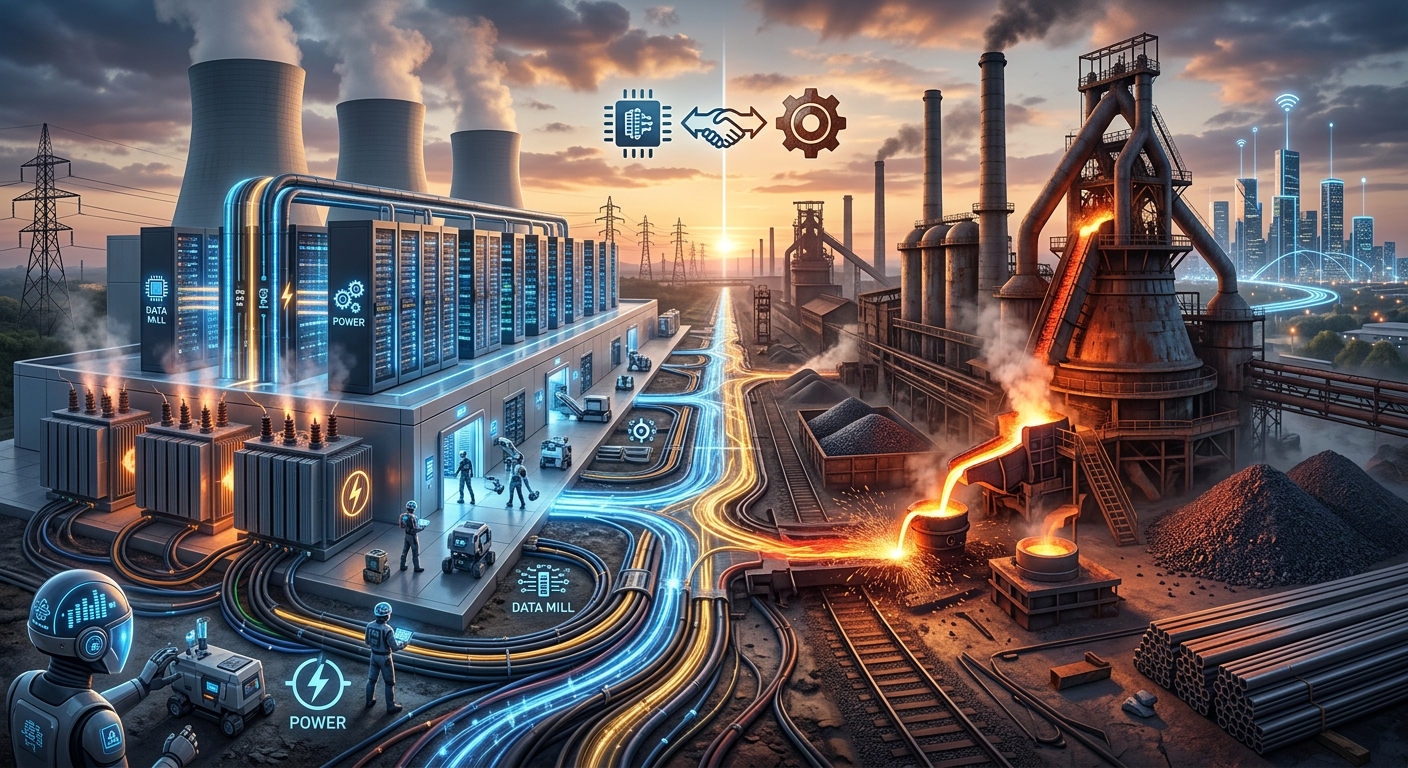
AI's Real Bottleneck Doesn't Trade Like a Tech Stock. It Trades Like a Toll Road.
A quick note from Behind the Markets
Wall Street wants you staring at AI "hype cycles" like it's a meme stock.
But the real constraint is physical.
Not GPUs. Not software. Power.
And when something becomes scarce, the people who control access start charging rent.
Today: three rent collectors — a regulated utility that just got Big Tech to pay for its growth, the gas producer feeding the whole buildout, and the company selling the wire.
1) AI's Dirty Secret: Electricity Is Becoming the Bottleneck
Every investor has heard the same AI story:
"More compute, more chips, more cloud."
Here's the underfollowed reality: electricity and grid capacity are turning into a gating factor.
The data-center boom is colliding with a system built for yesterday's demand.
That matters for markets because it changes who has pricing power.
When power is constrained, the winners are the businesses that can:
secure interconnection capacity
build/own generation and transmission upgrades
sell the equipment that expands the grid
Want to see what that looks like when it's real — signed, regulator-approved, and paid for by the customer? Watch what just happened in Louisiana.
Company: Entergy (SYM: ETR)
The regulated utility that got Meta to fund its growth — seven power plants, 240 miles of wire, and the bill goes to Big Tech.
Entergy is a regulated utility serving 3 million customers across Arkansas, Louisiana, Mississippi, and Texas, with about 27 gigawatts of rate-regulated generation. Boring, right? Here's what boring just landed: Meta is building its largest data center ever — a $27 billion, 4-million-plus-square-foot facility — on Entergy Louisiana's grid, and Meta agreed to fund seven new natural gas power plants (5.2 gigawatts), battery storage, and new transmission lines to power it, with a further agreement in March expected to deliver roughly $2 billion in customer savings — Meta funding the plants, transmission, and storage while shifting costs away from existing ratepayers. State regulators have already approved the core infrastructure plan.
Here's what you should take away from the news: the world's most powerful companies are so desperate for electrons that they'll pay a utility's construction bill just to get in line. That's what "the bottleneck charges rent" looks like in a regulatory filing. The growth is visible years out: an $11.6 billion 2026 capital plan and a target of more than 8% annual EPS growth through 2029.
The stock currently trades around $113. The honest risks: this is no longer a sleepy value stock — shares were already up about 25% on the year by spring as the market woke up, so you're paying a premium multiple for that visible growth, and at least one firm trimmed its target (BTIG to $126 from $131) in June. Gulf Coast utilities also carry hurricane risk — major storms can create large costs Entergy may not fully recover from customers. And note the calendar: earnings land July 29, next week, alongside the Fed. Regulated doesn't mean risk-free — it means the risks are listed in the rate case.
Bottom line: AI is becoming an energy story. If you're only watching semis, you're late — the tech giants themselves are already paying the utilities' bills.
2) "Green" Meets "Reliable": Gas, Nuclear, and the New Energy Reality
Retail investors get fed a cartoon:
Renewables good. Fossil fuels bad.
But grids don't run on morality.
They run on reliability.
AI workloads don't care about press releases. They demand firm power, predictable uptime, and real transmission.
That's why you're seeing renewed interest in gas peakers, nuclear life extensions, and the serious conversation around small modular reactors (SMRs). Notice that even the Meta deal above — the flagship AI project of the moment — is being powered by seven gas plants, with nuclear listed as a future exploration alongside solar. When the most image-conscious company on Earth needs firm power now, it buys gas.
The big takeaway isn't political. It's financial: capex is coming — and it will flow to the assets that keep the lights on. And every gas plant needs one thing forever: molecules.
Company: EQT (SYM: EQT)
America's biggest natural gas producer — and it just told you exactly how strong demand is.
EQT is one of the largest natural gas producers in the country, an Appalachian pure-play spanning Pennsylvania, Ohio, and West Virginia, with about 90% of production coming from dry natural gas — the exact fuel the firm-power buildout burns.
Here's why the timing is fresh: EQT reported second-quarter earnings this week and the stock rallied 8.5% — not because of the headline numbers (revenue and EPS actually missed), but because management raised full-year production guidance to 2.38–2.45 trillion cubic feet, up from 2.28–2.38, while lowering costs, and announced major new supply deals that more than offset the miss. Producers don't raise volumes into weak demand. And the cash engine is real: EQT generated more than $1.8 billion of free cash flow in the first quarter alone — nearly matching its entire 2022 haul, a $6-plus gas year — earned a Fitch upgrade to BBB, and carries a 25-analyst consensus of 17 Buys, 3 Outperforms, 5 Holds, zero Sells, with a mean target of $67 against a price currently around $53.
The two-sided truth: this is a commodity stock wearing an AI costume, and the commodity has been soft — EQT's realized gas price actually fell about 6% year over year to $2.65, and its dry-gas concentration makes it unusually sensitive to gas price swings, which cut both ways. Morningstar considers the shares to be trading at a premium already. If mild weather or oversupply hits gas prices, the AI-demand story won't save the next two quarters. Own it for the multi-year demand wave, sized for commodity volatility.
Bottom line: The "energy transition" is turning into an "energy addition." More of everything — and gas is the everything that ships today.
3) The Hidden AI Trade: Copper, Transformers, Switchgear, and Permitting
Everybody loves to talk about AI models.
Nobody wants to talk about transformers.
But the grid buildout has a boring, unavoidable supply chain:
copper and specialty metals
transformers and switchgear
high-voltage equipment
permitting and right-of-way constraints
These are not moonshot products. They're industrial bottlenecks. And bottlenecks don't need "hypergrowth" to be great investments — they just need persistent demand and limited supply.
But here's the problem with the famous names in this trade: we've covered them, and most have re-rated hard. So today, go one layer down — to the company that distributes all of it.
Company: Wesco International (SYM: WCC)
The middleman for the entire electrical buildout — wire, switchgear, and gear for data centers and utilities, with a record backlog to prove it.
Wesco isn't a manufacturer with a hot product that can be leapfrogged. It's the B2B distribution layer of the electrical economy — the company contractors and data-center builders call to actually get the cable, switchgear, and components. And the numbers just told the whole AI-power story in one earnings report: record first-quarter sales of $6.08 billion, up 13.8%, with data-center sales of roughly $1.4 billion — now about 24% of the entire company, growing 70% year over year — record backlog up 22%, adjusted EPS up 52.5%, and a raised full-year outlook. Stephens expects data centers plus utility infrastructure to approach half of Wesco's sales by 2027.
The timing angle: the stock ran hard this year, then pulled back about 10% — and the Street bought the dip, with Stephens upgrading to Overweight just last week specifically citing the pullback, while recent targets cluster well above the current ~$340 price: $375 at Barclays and Baird, $395 at Oppenheimer, $400 at Raymond James, $415 at KeyBanc, and $440 at DA Davidson, which initiated at Buy citing data centers, electrification, and the industrial recovery.
The honest risks: distribution is a thin-margin, cyclical business — if industrial construction rolls over, Wesco feels it fast. Execution stumbles on large, complex projects are a real hazard, and after the year's run some analyses suggest the shares may already be modestly overextended, with fair-value estimates spanning a wide range. This is "quality on a pullback," not "cheap" — the run-up caveat applies, just less violently than for the equipment makers we've already covered.
Bottom line: If AI is a multi-year buildout, the "picks and shovels" aren't just chips. They're the physical guts of the electrical system — and someone has to sell every foot of it.
4) Wall Street's Favorite Lie: "We'll Just Build More Data Centers"
If you've listened to enough management teams, you've heard it:
"We're expanding capacity."
Cool.
Where's the power coming from?
The next phase of AI capex is going to expose a split:
companies with real secured power and interconnection wins
companies with PowerPoint capacity
That distinction will show up in unexpected places: delays, cost inflation, and "strategic partnerships" that are really just emergency procurement.
Here's your homework checklist — no ticker for this section, just the test you should run on any company promising an AI buildout. Look for: a named utility counterparty (like Meta naming Entergy), a regulator's approval on file (like the Louisiana commission's), megawatts with a date attached, and who's paying for the interconnection. If the answer to all four is a press release adjective — "significant," "strategic," "expanding" — you're looking at PowerPoint capacity. Sell the adjectives. Own the nouns.
Bottom line: In the next 12–24 months, power availability becomes a competitive moat — and a landmine for the overpromisers.
Before You Go
The market loves digital stories because they feel infinite.
But every boom eventually hits the real world: land, labor, materials, and power.
Today's three names sit at three different tolls on the same road: the utility whose growth is being funded by the richest customer on Earth, the producer supplying the fuel every "reliable power" plan actually burns, and the distributor selling the wire either way. None are guarantees — that's why we flagged the premium valuations, the commodity sensitivity, and next week's earnings dates in plain language.
When the constraint shows up, that's when the easy money ends — and the smart money starts.
Found this helpful? Share it with others.
Written by Behind the Markets