The S&P Was Up 0.17%. The Equal-Weight Was Down 1.29%. The Russell Was Down 2.34%. That's Not a Bull Market.
A quick note from Behind the Markets
Wall Street is back to its favorite coping mechanism: ignoring the parts of the market that look ugly.
If the S&P prints a new high, they call it "healthy." If small-caps roll over, they call it "noise." If inflation re-accelerates, they call it "one-off."
That's how retail investors get trapped — listening to the people paid to stay bullish.
Today, I want you to watch the divergences, the policy tells, and the sectors that actually have pricing power.
1) The Big Index Is Fine. The Market Is Not.
The S&P 500 was up +0.17% for the week and closed near 7,501. The headlines wrote themselves.
But underneath, the market was bleeding.
Clearbrook Global's weekly commentary put the numbers side by side: the equal-weighted S&P 500 fell -1.29%. The Russell 2000 fell -2.34%. The Russell Micro Cap fell -2.00%. That's the cap-weighted index rising while the average stock — and every small stock — went the other direction.
Add the breadth data from Monday: 235 new 12-month lows versus 120 new highs at all-time index levels. Only 5.6% of S&P 500 stocks made a 52-week high the same week the index did. Only 52% of components traded above their 50-day moving average. Financials (XLF) down 10% from their January peak.
This is capital hiding in the biggest balance sheets. A handful of AI-linked mega-caps are carrying the entire market while cyclicals, small caps, and anything rate-sensitive gets quietly crushed.
Think back to February. After a cool CPI print on February 13, the Russell 2000 surged 3.2% in a single session and the market priced three rate cuts by year-end. That entire thesis — the "Great Rotation" into small caps — has been destroyed by the Iran war, oil above $100, and CPI at 3.8%. The same Russell 2000 that was supposed to lead in 2026 is now down 2.34% in a week while the S&P makes new highs.
One ETF that strips out the concentration illusion:
ETF: Invesco S&P 500 Equal Weight ETF (SYM: RSP)
Every S&P 500 company weighted equally — the instrument that shows you what the median stock is doing, not what the top 10 are doing.
RSP is your breadth gauge. When RSP rises alongside the cap-weighted S&P, the rally is broad and sustainable. When RSP falls while the S&P rises — as it just did — the rally is narrow and fragile. The divergence between the two is now one of the widest in market history. That's not bullish. That's the market telling you risk is rising under the surface.
Bottom line: Narrow breadth is the market telling you risk is rising. Don't confuse index performance with opportunity.
2) Inflation Isn't Dead — It's Wearing an Energy Mask
Wall Street won't say this out loud: the inflation problem never disappeared. It just rotated.
April CPI came in at 3.8% year-over-year and 0.6% month-over-month. Core CPI rose 0.4% monthly and 2.8% annually — the hottest core reading since January 2025. Energy surged 3.8% for the month and 28.4% year-over-year. Food at home jumped 0.7% — the biggest monthly increase since August 2022. Shelter accelerated to 3.3%. And real wages went negative — falling 0.5% for the month and 0.3% year-over-year.
Navy Federal's chief economist said it plainly: "For the first time in three years, inflation is eating up all wage gains."
The April PPI confirmed the pipeline pressure: wholesale prices surged to 6% year-over-year [VERIFY]. That's the input cost wall hitting corporate margins before it shows up in consumer prices.
The energy driver is structural, not transitory. The Strait of Hormuz has been disrupted for 12 weeks. 230 tankers remain stranded. The UAE left OPEC. Brent is above $110. Gas is at $4.48. And Kalshi gives only 56% odds that Hormuz traffic normalizes by August.
One company that thrives in the exact inflationary environment that's destroying everything else:
Company: ConocoPhillips (SYM: COP)
The largest independent U.S. oil and gas producer — breakeven below $50, $9B+ returned to shareholders in 2025, and a business model where every dollar of energy inflation flows to the bottom line.
When CPI is 3.8%, energy is up 28.4%, and real wages are negative, ConocoPhillips isn't suffering from the environment. It's collecting on it. At $100+ WTI, every dollar above breakeven flows to buybacks and dividends. COP is the "bond proxy with upside" — a cash-flow machine that gets more valuable as the inflation regime persists and the Fed stays boxed.
Bottom line: When energy spikes, it's not just an oil trade. It's an earnings trade — and small caps usually pay first.
3) The Fed Doesn't Need to Hike to Keep You Stuck in "Higher for Longer"
The market is starting to accept what retail investors have felt all year: the "rate cuts are coming" story was a sales pitch.
Clearbrook reported that the market has effectively priced out Fed rate cuts through the end of 2027. Traders assign virtually zero probability to reductions through 2027 — a complete reversal from February, when three cuts were priced by year-end. The odds of a rate hike have risen to roughly 39% after the PPI reading.
The FOMC minutes from the April 28–29 meeting drop today. That meeting produced four dissents — the most since 1992. One governor voted for a cut. Three presidents objected to dovish language. It was Powell's final meeting as chair. The minutes will show you exactly how fractured the Fed is — and how the internal debate is shifting from "when do we cut" to "do we need to hike."
In a higher-for-longer world: junk debt refinancing becomes a survival test. Private credit becomes less "private" when defaults hit headlines (Fitch: 9.2% record). Long-duration growth stocks become rate-sensitive again. And the $875 billion CRE maturity wall grinds through a refi spread that just got wider as the 30-year hit 5.14%.
One ETF built for a world where the Fed doesn't rescue anyone:
ETF: Invesco S&P 500 Quality ETF (SYM: SPHQ)
Rules-based selection of the highest-quality S&P 500 balance sheets — the companies that don't need rate cuts, don't need private credit, and don't need the bond market's permission to survive.
When rate cuts are priced out through 2027 and hikes carry 39% odds, the companies that self-fund — high ROE, low leverage, clean accounting — get relatively more valuable. SPHQ owns them. It's the instrument for a world where Powell's replacement is more hawkish, not less, and the rescue trade never arrives.
Bottom line: Don't build a portfolio that requires Powell to rescue it. Build one that survives when he doesn't.
4) China Held Rates Steady — the Real Story Is What That Implies
China's central bank held lending rates unchanged again: the one-year LPR at 3.00% and the five-year LPR at 3.50%.
"No cut" is a signal. Policy makers are cautious. Stimulus expectations are becoming a tradeable catalyst rather than a guaranteed floor. And the two-speed economy we've been tracking — manufacturing at 50.3 with export orders at a two-year high, but non-manufacturing in contraction at 49.4 and domestic orders falling — hasn't changed.
When investors start waiting for stimulus, you get commodity whipsaws on every rumor, EM rallies that vanish when action doesn't follow, and U.S. multinationals priced for a China rebound that never arrives.
One company that captures China's industrial demand as optionality — not dependency:
Company: Freeport-McMoRan (SYM: FCX)
The world's largest publicly traded copper producer — direct exposure to China's factory output without dependence on its domestic consumer or its central bank's stimulus decisions.
FCX is currently trading around [VERIFY: current price]. Copper goes into everything China's export factories produce — and China's export orders just hit their highest level in two years. But FCX also has structural demand from the AI data center buildout, global electrification, and defense manufacturing that provides a floor regardless of what Beijing does. It's the "China optionality without China dependency" play.
Bottom line: China policy is a catalyst, not a foundation. Don't underwrite your whole thesis on "stimulus soon."
5) The Sector Leadership Tells You Who Has Pricing Power (and Who Doesn't)
When inflation pops and rates bite, the scoreboard is sector performance.
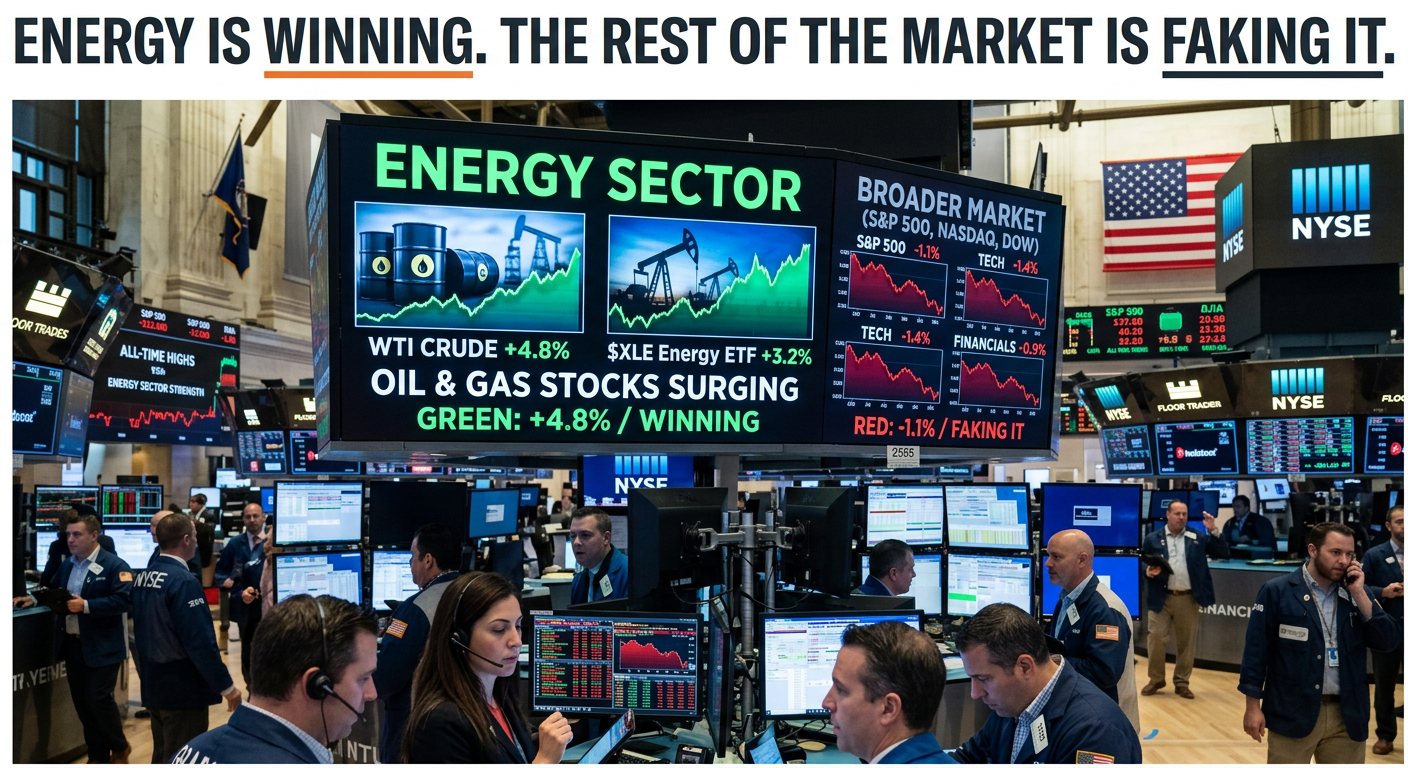
Clearbrook's numbers for the week: Energy +7.03%. Year-to-date: +33.50%. That's the sector that has pricing power in an inflationary environment — because it produces the commodity driving the inflation.
On the other end: Consumer Discretionary -3.04% for the week. That's the sector getting squeezed by the K-shaped consumer — high-income spending still robust, low/mid-income getting hit by food, fuel, and credit stress.
The spread between energy and consumer discretionary is telling you everything: the commodity producers collect the inflation tax. The consumer-facing businesses pay it. And the companies in between — industrials, financials, healthcare — are sorting based on who can pass through costs and who can't.
One ETF that owns the sector with the most pricing power in this tape:
ETF: Energy Select Sector SPDR Fund (SYM: XLE)
The benchmark U.S. energy sector ETF — up 33.50% year-to-date while the average stock went nowhere. The sector that benefits when oil stays above $100, inflation stays sticky, and the Fed stays boxed.
XLE doesn't need rate cuts. It doesn't need a trade deal. It doesn't need AI hype. It needs oil above $100 and a Fed that can't lower rates. Both conditions are met and likely to persist. In a market where 235 stocks made new lows at all-time highs, XLE's +33.50% is telling you exactly where the pricing power lives.
Bottom line: In this tape, pricing power wins. Everything else is begging for a rate cut.
Before You Go
Here's a question to sit with tonight:
If small-caps keep rolling over while the S&P makes new highs… are you looking at a bull market, or a capital flight?
Retail investors don't need more "market optimism." We need a plan for what breaks when the story changes.
Found this helpful? Share it with others.
Written by Behind the Markets