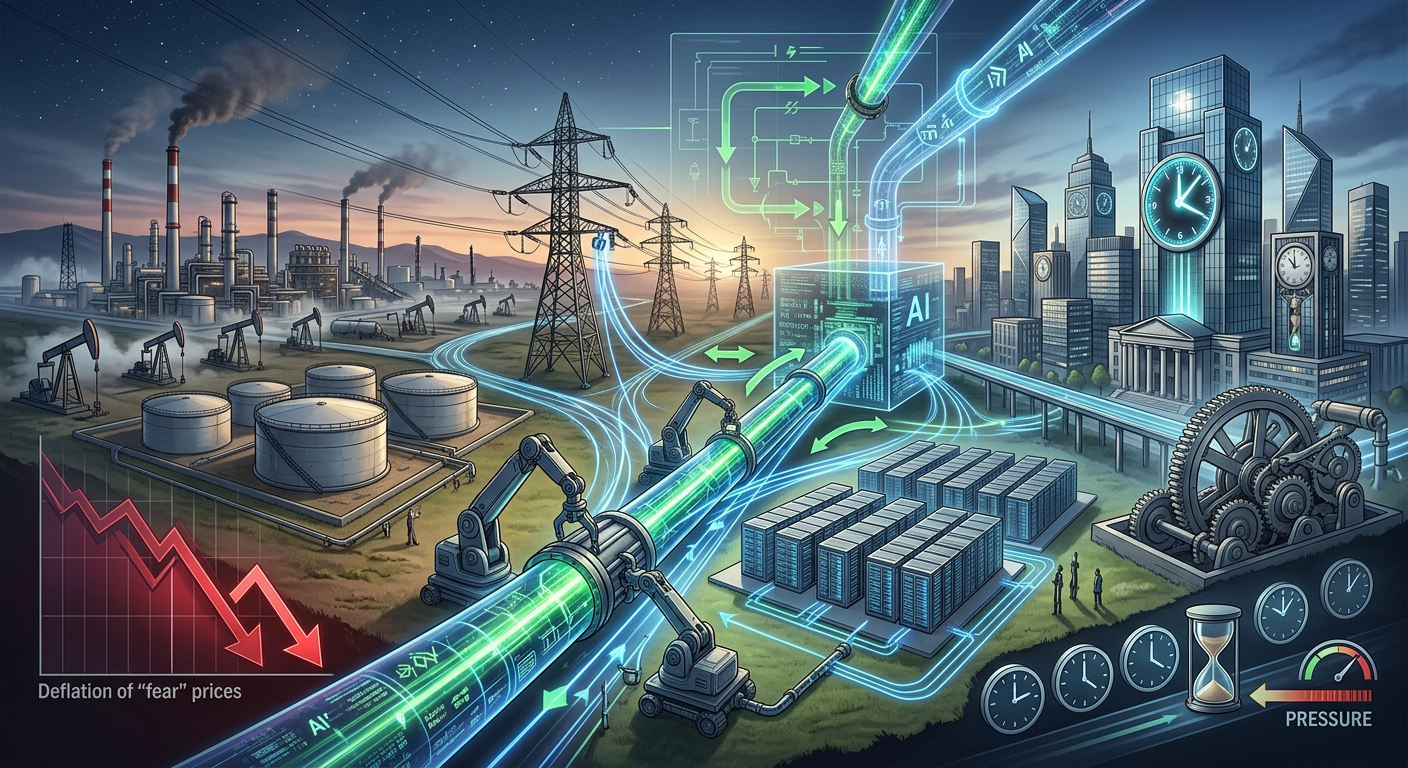
Oil's Fear Bid Is Gone, FERC Just Rewired the AI Trade, and the Banks Are on the Clock
A quick note from Behind the Markets
Happy Monday.
Wall Street's back at its desk pretending last week was "normal." It wasn't.
Energy just repriced. The Fed just signaled it's not done. And the next shoe isn't a meme stock — it's capital requirements, power bottlenecks, and whether consumers can keep spending when savings get tapped out.
Let's talk about the week ahead like independent investors — not like sell-side marketers.
1) Oil's risk premium is evaporating — and that changes the inflation tape (fast)
If you want the cleanest "Monday morning" macro signal, it's this:
Oil just moved like a war ended.
Brent crude dropped below $78 late last week — its lowest level since early March — as the first tankers crossed the Strait of Hormuz again and Kuwait, Saudi Arabia, the UAE, and Iraq prepared to restart halted output. Crude has now erased nearly all the gains from the conflict, down roughly 38% from its April peak.
Here's why you should care even if you never touch an energy stock. Lower energy prices can cool headline inflation quickly. That changes the Fed narrative, the bond market narrative, and the "soft landing" story. It also changes what breaks next — because lower energy doesn't magically fix credit, refinancing, or the consumer.
The contrarian angle: Wall Street will sell this as "risk-on." Sometimes it is. But sometimes it's just a shift in where the pressure shows up. If energy drops while core inflation stays sticky, you can get the worst mix: bonds still tight, but the commodity hedge is gone.
So who actually benefits from crude falling? Not the producers — the refiners. When crude (the input) drops faster than gasoline and diesel (the output), the spread in between widens. And that spread is where refiners make their money.
Company: Valero Energy (SYM: VLO)
One of the largest independent U.S. refiners; turns crude into gasoline, diesel, and jet fuel
Valero runs roughly 3 million barrels a day across 14 refineries, and it makes money on the crack spread — the gap between what it pays for crude and what it gets for refined products. Falling crude on the back of Hormuz normalization, right as summer driving season props up gasoline and diesel demand, is close to an ideal setup. Q1 2026 already showed it: refining operating income swung to $1.8 billion from a loss a year earlier, and EPS of $4.22 crushed estimates.
VLO currently trades around $253, near the upper end of its range, with analyst targets clustered nearby and crack spreads that several analysts expect to push refining earnings to multi-year highs. The honest caveat: refining is brutally cyclical and margin-driven. If crude rises again on a Hormuz setback, or if a demand scare hits, the crack spread compresses and VLO falls with it. This is a margin bet, not a buy-and-forget. But of all the ways to play oil rolling over, owning the refiner beats owning the barrel.
Bottom line: Oil down is not automatically stocks up. Watch whether the "inflation relief" gets swallowed by tighter financial conditions anyway.
2) FERC just moved: AI data centers are getting a grid fast lane — and someone else eats the bill
AI isn't a software story anymore. It's an industrial buildout with a political bill attached.
On June 18, FERC voted unanimously to issue "show-cause" orders to the six largest U.S. regional grid operators — PJM, MISO, SPP, CAISO, ISO-NE, and NYISO — forcing them to justify or rewrite how big new loads like AI data centers connect to the transmission system. Crucially, the orders push large-load customers to bear more of the interconnection upgrade costs rather than spreading them across ordinary ratepayers, with compliance filings due in 60 days.
This is the part Wall Street keeps skipping. The grid can't absorb a surge in load growth without upgrades. Upgrades mean costs. Costs mean a fight over who pays.
If regulators force data centers to pay "cost to serve," the buildout slows and concentrates in places with existing capacity. If they push costs onto ratepayers, you get backlash — and eventually rules. Either way, the "AI trade" gets less dreamy and more regulated.
And either way, somebody has to actually build and sell the hardware. That's the boring, high-conviction angle.
Company: Hubbell (SYM: HUBB)
Electrical and utility grid equipment — transformers, switchgear, connectors, and distribution gear
Hubbell sits right on the choke point this FERC order is about. Its Utility Solutions arm makes the transmission and distribution equipment — the grid hardware that has to get built and installed before a single new data center can interconnect. As the buildout accelerates and the interconnection queue gets worked down, the demand flows straight to suppliers like Hubbell. The company just closed a $3 billion acquisition of NSI Industries on June 9, deepening its electrical-products portfolio.
HUBB currently trades around $485, with a 52-week range of roughly $386 to $566 and analyst targets averaging in the mid-$500s. The business throws off real cash — over $5.8 billion in revenue, mid-teens net margins, and a long dividend track record. The caveat: it's a premium-valued industrial (high-20s P/E) that's already run hard on the grid theme, so it'll pull back if the AI-capex narrative cools. But unlike the model-makers, Hubbell sells a physical product the grid literally cannot expand without.
Bottom line: The highest-conviction AI angle right now is boring: power equipment, grid services, and the bottlenecks that decide which projects actually get built.
3) Next week's real catalyst for banks: stress test results + capital return politics
Retail investors still underestimate how policy-driven bank stocks are. Not just Fed policy. Regulatory policy.
The Fed will publish the 2026 bank stress test results on Wednesday, June 24, at 4 p.m. ET, covering 32 large lenders against a severe global recession scenario — one that models 10% unemployment, a 30% home-price decline, and a brutal 39% drop in commercial real estate values.
Here's the nuance Wall Street will gloss over: the Fed has already said this year's results won't change capital requirements — stress capital buffers are frozen through 2027 while it overhauls the test. So the test won't mechanically force capital changes. But it still shapes perception: stress outcomes inform how much capital banks feel comfortable returning, capital return shapes the multiple the market pays, and in a market where growth is expensive again, "boring" buybacks and dividends become a bigger deal.
Also: commercial real estate is still the slow-moving train wreck nobody wants to price cleanly. So you get this weird setup — bank stocks can rally on capital-return optimism while the underlying credit cycle keeps deteriorating under the hood.
That divergence is exactly what independent investors can exploit: by being selective, and by refusing to average down into obvious landmines. Which means favoring the fortress over the fragile.
Company: JPMorgan Chase (SYM: JPM)
Largest U.S. bank; diversified money-center with a fortress balance sheet and minimal stress-test risk
When the question is "who sails through a severe-recession stress test and keeps returning capital," JPMorgan is the default answer. It's the most diversified, best-capitalized bank in the country — consumer banking, investment banking, and asset management all under one roof — which is exactly the profile that absorbs a CRE shock better than a regional concentrated in office loans. Q1 2026 net income came in around $16.4 billion with EPS of $5.94, beating estimates.
JPM currently trades around $331, just off an all-time high near $338, and pays a dividend it just keeps raising (next ex-date in early July). The honest caveat: at a record high and a premium book-value multiple, you're paying up for quality — there's little "margin of safety" in the price, and a genuine credit downturn would still ding even the strongest bank. But the whole point of this section is to own the fortress, not the fragile regional sitting on a pile of office paper. JPM is the fortress.
Bottom line: Stress tests are a headline. The real question is whether capital-return optimism is masking the next wave of credit pain.
4) The data that can hit markets hardest: Core PCE + "the consumer finally cracks" tells
This is the week the market stops talking about "the Fed meeting" and starts talking about "the Fed's next move."
The main event is core PCE — the Fed's preferred inflation gauge — due later this week. If core PCE runs hot, the market hears one word: hike.
But don't just watch the inflation print. Watch the consumer mechanics underneath it. Here's the anti-Wall-Street checklist. If spending is holding up because savings are falling, that's not strength — that's a fuse burning. If delinquencies tick up while stocks levitate, that's not "resilience" — that's lag. And if small caps can't refinance cheaply, "good GDP" won't save them.
This is where self-directed investors think like a credit investor instead of a headline trader. And it points to a specific kind of business: the one that gains when the consumer gets squeezed and starts trading down.
Company: Walmart (SYM: WMT)
Largest U.S. retailer; defensive, necessity-driven, and a prime beneficiary when shoppers trade down
When savings thin out and budgets tighten, shoppers don't stop spending — they shift it. They trade down from specialty and department stores to value retail, and they buy more groceries and essentials. Walmart is the biggest beneficiary of that exact behavior, and it has been steadily winning higher-income shoppers, too. It's the closest thing to a "consumer cracks" hedge that still participates if the consumer holds up.
WMT currently trades around $117. The honest caveat: it's a defensive name trading at a rich multiple for a retailer, so it's not "cheap," and a genuinely strong consumer would let flashier discretionary names outrun it. But in the precise scenario this section is warning about — sticky inflation plus a fraying consumer — Walmart is built to take share, not lose it.
Bottom line: The market can survive hot inflation or slow growth. What it can't survive is both — especially with leverage in the system.
Before You Go
Contrarian question for the week:
If oil is rolling over and Wall Street is cheering "disinflation"… why are long rates still acting like they don't believe it?
That tension is where Monday's real trade setups will come from.
Found this helpful? Share it with others.
Written by Behind the Markets