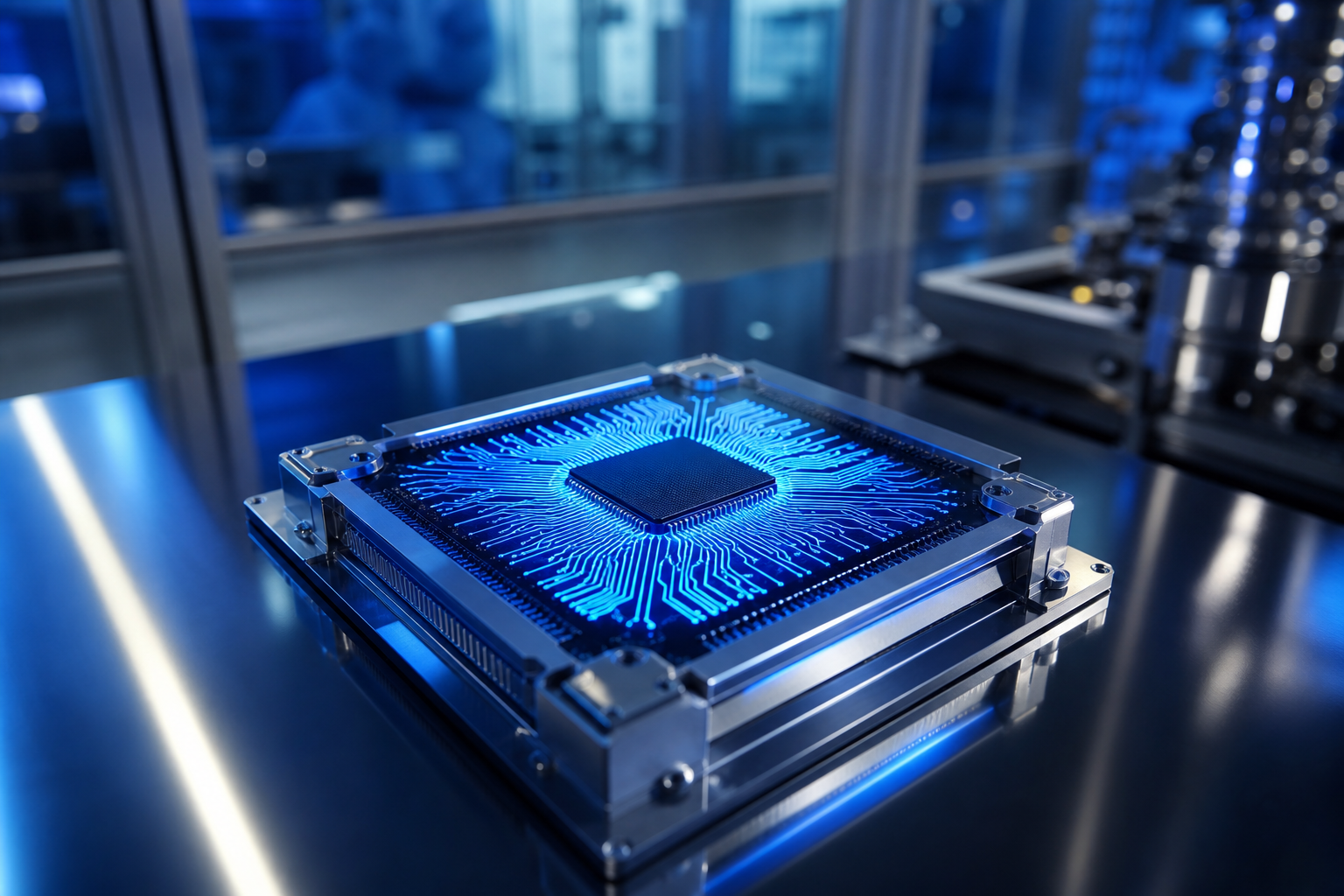
IBM (IBM) surged 12.5% on Thursday after the U.S. Department of Commerce announced a $1 billion CHIPS Act investment into a new IBM-backed quantum chip foundry called Anderon. IBM is putting up another $1 billion in cash, plus its intellectual property and workforce, to build what will be America's first purpose-built quantum wafer factory — headquartered in Albany, New York.
The stock closed at $252.97, gaining $28 in a single session and making it the biggest winner in the Dow by a wide margin. In a market still obsessing over AI, the government just made a massive bet that the next computing revolution will be quantum — and that IBM will be at the center of it.
KEY POINTS:
• 🏭 The U.S. Department of Commerce is investing $1 billion through the CHIPS Act to help IBM build Anderon, America's first dedicated quantum chip foundry. IBM will match that with $1 billion in cash and contribute IP, assets, and specialized talent.
• 📈 IBM's stock surged 12.5% to $252.97, its biggest single-day gain in years. Shares extended gains in after-hours trading. The rally made IBM the top-performing Dow component on Thursday.
• 🔬 Anderon will be a standalone 300-millimeter quantum wafer foundry in Albany, New York, fabricating chips not just for IBM but for multiple quantum technology vendors worldwide.
• 🌐 The deal is part of a broader $2 billion White House quantum funding package spanning nine companies. GlobalFoundries also surged 15% after receiving a proposed $375 million award. Quantum stocks QBTS and RGTI also received investments.
• 📊 The Dow set a new record closing high of 50,285, up 0.55%. The S&P 500 edged up 0.2% to 7,446 and the Nasdaq added 0.1% to 26,293.
Why This Deal Matters More Than You Think
For years, quantum computing has been the technology that was always "ten years away." Researchers talked about it at conferences. Universities published papers. A handful of startups raised funding. But nobody was building the manufacturing infrastructure to produce quantum chips at scale. Until now.
Anderon changes that equation. This isn't a research grant or an academic partnership. It's a factory — a real, physical production facility designed to manufacture quantum wafers on 300-millimeter lines, the same industrial-grade fabrication process used for today's most advanced semiconductor chips. IBM plans to make Anderon available to external quantum hardware vendors, essentially creating the TSMC of quantum computing.
Commerce Secretary Howard Lutnick called it a cornerstone of the Trump administration's strategy to maintain U.S. dominance in next-generation computing. And he wasn't being subtle about the motivation. China has been pouring billions into quantum research, and Washington doesn't want to make the same mistake it made with conventional chips — letting manufacturing drift overseas until a crisis forces the money back home.
The Bigger Quantum Picture
IBM wasn't the only beneficiary. The $2 billion White House package sent shockwaves through the entire quantum sector. GlobalFoundries jumped 15% after announcing it had launched a new Quantum Technology Solutions division and disclosed a proposed $375 million Commerce Department award. The government is even taking equity stakes in several recipients — roughly 1% of GlobalFoundries — signaling how strategically important it considers quantum technology in the competition with China.
IBM has been building toward this moment for over a decade. The company operates the world's largest fleet of quantum computers and has made its quantum systems available through the cloud to over 100 organizations. The Anderon foundry gives IBM something no competitor currently has: an integrated path from quantum chip design to manufacturing to deployment.
The Market Backdrop
Thursday's broader market continued its post-NVIDIA rally with a classic rotation. The Dow led, gaining 276 points to close at a fresh record of 50,285 — its second straight session above 50,000. But the rally was narrow. The S&P 500 barely moved and the Nasdaq was essentially flat, as investors took profits in the biggest AI and tech names.
The day's biggest loser told its own story. Walmart dropped 7.2% — the Dow's worst performer — after issuing guidance that fell short of expectations despite beating on revenue. The retailer warned that surging fuel costs are pressuring shoppers and could drive retail inflation higher in the coming months. With April inflation hitting 3.8%, its highest in nearly three years, the consumer squeeze is becoming harder to ignore.
Oil fell roughly 2% on Thursday to its lowest close in two weeks as markets digested signs of progress in U.S.-Iran negotiations. Secretary of State Marco Rubio said there were "some good signs" that an agreement could eventually be reached, though the Strait of Hormuz remains a major flashpoint.
What This Means for Your Money
IBM has spent the last five years reinventing itself — shedding legacy businesses, focusing on hybrid cloud and AI, and quietly building the most advanced quantum computing program in the world. Thursday's announcement validates that strategy in a way that a quarterly earnings beat never could. When the federal government writes a billion-dollar check and tells you to build the future, the market pays attention.
The question investors need to answer now is whether quantum computing can follow the same trajectory as AI — moving from "interesting research" to "trillion-dollar industry" faster than anyone expects. If it does, IBM just positioned itself at the very center of it. And based on Thursday's 12% move, the market is starting to believe.
Up Next: 'I Just Flew Over Elon Musk's Next Big Venture'

A former consultant to the Pentagon was able to enter the airspace near one of the most secure sites in the world. Hidden there, he says, is a potential $10 trillion tech breakthrough that could define the next decade of Elon Musk's career. Click here to learn about the stocks tied to Elon Musk's next big venture.
Found this helpful? Share it with others.