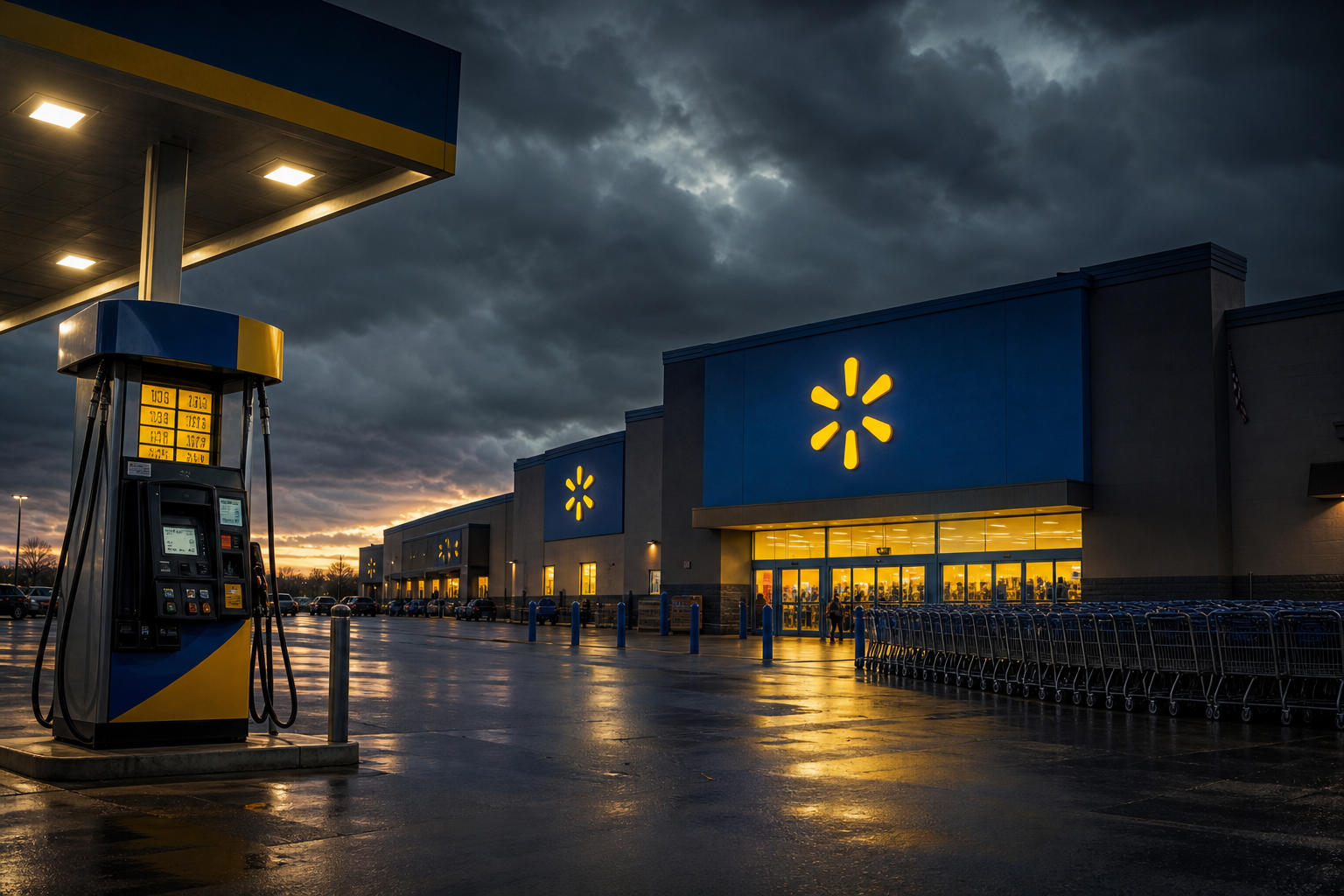
Walmart (WMT) reported first-quarter revenue of $177.8 billion — beating Wall Street's estimate by nearly $3 billion — and the stock cratered 7.2% on Thursday. It was the Dow's worst performer by a mile.
The numbers looked fine on the surface. Revenue grew 7.3% year over year. E-commerce sales surged 26%. Delivery grew 45%. Earnings per share of 66 cents matched consensus. But none of that mattered because of what came next: Walmart told Wall Street that high gasoline prices are squeezing its customers, and its profit outlook for the rest of the year fell short of expectations.
When the biggest retailer in America — the company that serves more households than any other — warns that its shoppers are feeling the pinch, investors listen.
KEY POINTS:
• 💰 Walmart's Q1 revenue hit $177.8 billion (+7.3% YoY), topping estimates by $2.9 billion. E-commerce grew 26%, delivery grew 45%, and the company executed roughly 7,200 price rollbacks. EPS of $0.66 matched consensus.
• 📉 The stock dropped 7.2% — its worst day in over a year — after management guided Q2 EPS to $0.72-$0.74, below the $0.75 Wall Street expected. Full-year EPS guidance of $2.75-$2.85 also missed the $2.91 consensus.
• ⛽ Fuel costs slashed $175 million from Q1 operating income. Management warned that if elevated gas prices persist, retail price inflation could accelerate in Q2 and the second half of the year.
• 📊 April inflation hit 3.8% — the highest in nearly three years — and consumer price growth outpaced wage growth for the first time since 2003. The Middle East conflict continues driving energy costs higher.
• 🏪 Despite the headline miss, Walmart's underlying business is strong. Advertising revenue grew over 30%, marketplace sales surged nearly 50%, and membership fees rose 17%. More than 60% of U.S. households can now receive deliveries in 30 minutes or less.
The Gas Price Problem
Here's the uncomfortable truth that Walmart's report laid bare: gasoline prices are becoming a tax on everything.
When gas costs more, it costs more to ship goods to stores. It costs more for customers to drive to those stores. And it leaves less money in their wallets when they arrive. Walmart estimated that fuel alone wiped $175 million from its operating income in Q1 — and the company warned that things could get worse before they get better.
The root cause is no mystery. The conflict in the Middle East has kept oil prices elevated for months. WTI crude has traded in a $90 to $110 range since late March, and while prices dipped 2% on Thursday on faint hopes of a U.S.-Iran deal, the Strait of Hormuz — through which roughly 20% of the world's oil flows — remains a pressure point. Until that changes, energy costs aren't coming down meaningfully.
For Walmart's core customer — the budget-conscious American household — this creates a cascading problem. In April, inflation hit 3.8%, its highest level in nearly three years. Consumer prices are now rising faster than wages, something that hasn't happened since 2003. That means the average American family has less purchasing power every month, and Walmart is watching it play out in real time across its 4,700 U.S. stores.
The Walmart Paradox
What makes this report so fascinating is the disconnect between the business and the stock. Walmart's actual results were excellent. Revenue beat by billions. Traffic accelerated. General merchandise — the higher-margin stuff retailers crave — performed well. The company's advertising business grew over 30%. Its marketplace grew nearly 50%. These aren't the numbers of a company in trouble.
But Wall Street doesn't trade the present. It trades the future. And Walmart's future guidance told a cautious story. Full-year earnings of $2.75 to $2.85 per share came in below the $2.91 consensus. Second-quarter EPS guidance of $0.72 to $0.74 missed the $0.75 target. CFO John David Rainey said the company is being "prudent" given the "somewhat unstable" backdrop. Translation: we see storm clouds, and we're not going to pretend otherwise.
That honesty cost Walmart about $30 billion in market cap in a single day.
What the Consumer Is Telling Us
Walmart's results should be read as a weather report for the American economy. The company doesn't just sell to a narrow demographic — it reaches roughly 90% of U.S. households. When Walmart says its customers are trading down, managing their budgets more carefully, and pulling back on discretionary purchases, that's not an earnings anecdote. That's an economic signal.
The timing is especially telling. This quarter covered February through April — a period when tax refunds typically boost spending. Walmart acknowledged that refund-related spending helped results. The question is what happens when that tailwind fades and gas prices remain stubbornly high.
What This Means for Your Money
Walmart dropping 7% on a revenue beat feels wrong. And on some level, it is. The business is executing beautifully — growing e-commerce, expanding delivery, building advertising revenue, gaining market share. But the stock isn't trading on execution. It's trading on the gap between what investors hoped for and what management was willing to promise.
That gap exists because Walmart sees something the rest of us are just starting to notice: the American consumer is running out of margin. Gas prices are eating into budgets. Inflation is outpacing wages. And the one retailer that knows more about consumer behavior than anyone on Earth is telling you to be careful. When Walmart whispers, smart investors listen.
Time Sensitive: Why Elon actually needs the SpaceX IPO
The mainstream financial media can't stop talking about SpaceX.
Elon's a genius!
The world's first trillionaire!
Colonies on Mars!
The investment of the century!
But they're missing the real story.
The SpaceX IPO isn't about space; it's about Artificial Intelligence.
Not long ago, Elon quietly combined SpaceX with his AI company, xAI.
That not only elevated his net worth to $800 billion.
It put xAI in position to receive hundreds of billions of dollars from the IPO.
Where will that cash go?
New AI data centers to power Elon's Grok AI model.
As it turns out, building data centers takes lots and lots of money. (Alphabet just announced it'd spend $185 billion on AI capex this year, for example.)
Elon spent $18 billion on his record-breaking Colossus data center alone.
The Real Reason Behind Elon's SpaceX IPO
(And Why Every Investor Should Care)
Greg Martin of Rainmaker Securities says xAI now has an "insatiable need for capital."
Which explains why Elon's suddenly taking SpaceX public.
So why should investors care?
Because a brand-new category of AI computer is coming in 2026...
A data cluster 1 TRILLION times more powerful than anything we've seen so far.
And once this device comes online...
It'll leapfrog ChatGPT... Gemini and even Elon's Grok... instantly.
And it will trigger a $100 trillion reset of the AI markets this year.
I consider this the biggest prediction of my 40-year career.
And I reveal all the details here in my brand-new presentation...
Including the name and ticker of one company behind this $100 trillion opportunity.
Fair warning: This information is very time sensitive. I could decide to take it down at any time. Please check it out now, before that happens.
Found this helpful? Share it with others.