Morning Watchlist: Monday Edition
The Week in Review A quick note from Behind the Markets
It's the start of another week. And this morning, we're thinking about breakups.
Last week, KFC ended a forty-year relationship with Pepsi. Bumble — the dating app — quit the stock market entirely. And somewhere in the middle of October's financing panic, the market walked out on the construction crew that buries America's internet in the ground.
Every breakup tells two stories: the loud one about who left, and the quiet one about who keeps the house. We work the quiet story. Three breakups this morning. Three pairings.
Let's get into it.
1) The Forty-Year Breakup
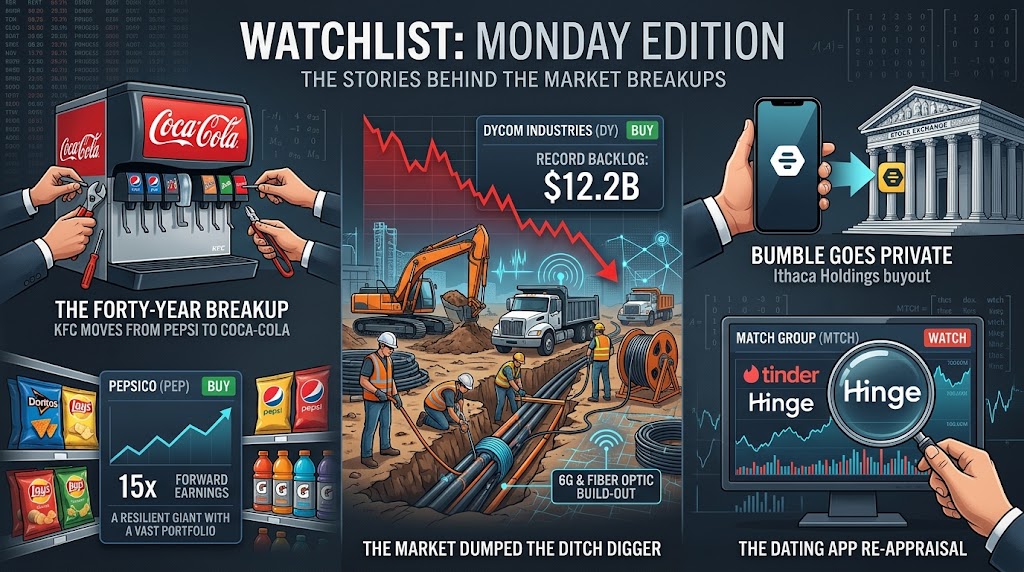
On Thursday, the Wall Street Journal broke it: KFC is switching its 3,718 US restaurants from Pepsi to Coca-Cola by spring 2027, ending a beverage partnership that reaches back roughly four decades — to the years when PepsiCo literally owned the chicken chain. Coke, which already pours at McDonald's and Wendy's and took Dunkin' from Pepsi in 2012, adds another trophy to the fountain case. Freedom Capital Markets' Jay Woods called it "just a bad look for PepsiCo... when you lose a big-name brand partner like that."
A bad look, on a bad year. PepsiCo has spent 2026 cutting prices on Lay's and Doritos to win back shoppers who said no, trimmed its full-year profit outlook on October 8th even while beating the quarter, and has activist Elliott Management standing in the register. The stock has been scraping six-year lows.
Now read the fine print of the breakup. The same announcement said Yum just renewed PepsiCo at Taco Bell — for ten years — and kept it at KFC's international business, while Pizza Hut (which left the Yum family this year) still pours Pepsi too. A fountain account is marketing real estate more than it is profit: losing KFC is losing the kiosk by the food-court door while re-signing the anchor tenant for a decade. A bruise to the ego. A rounding error to the rent roll.
The pairing: PepsiCo (PEP) — Buy
The market read the breakup and skipped the renewal in the same paragraph. At about $130.66 Friday morning — when the stock actually rose almost 2% the morning after the news, because there was nobody left to panic — the $178 billion company trades near 15 times next year's expected earnings against the S&P 500's roughly 21, with a 4.5% dividend yield, about 6% above its 52-week low. Analysts sit at Hold with an average target of $141.59, above the price — the crowd-absent shape we bought at TransUnion, Lincoln, Ingredion, and CF. This is the headline company, we know; pairing strength earns the exception, the way it did with Constellation Brands two weeks ago — a slow year priced as a terminal one, in a company that still owns Gatorade, Frito-Lay, and the best shelf space in the supermarket.
The honest risks: soda volumes fell again last quarter, the core snack customer is the same squeezed shopper the whole trade-down migration tracks, and GLP-1 moderation is a secular headwind, not a headline. The kill: volumes shrinking through the price cuts. If cheaper Doritos can't hold share, the cheap multiple was a warning label, and we'll say so.
2) The Market Dumped the Ditch Digger
Ericsson had a Thursday. The Swedish network-equipment maker beat earnings — $0.18 a share against the $0.14 expected — on sales up 7% and profits up about 40%, and its US shares jumped 11.2%. The same day, Verizon and Ericsson completed the first outdoor 6G field call. And the CEO delivered a warning the market filed under "telecom" when it belongs under "everything": AI demand has made memory chips so expensive that Ericsson will push structural price increases. His words: "You can only do tactical actions for so long."
Line those up. Carriers are buying gear again. The next upgrade cycle just made its first phone call. And the gear is about to cost more. Now ask who gets paid in every version of that future — whichever vendor's radio wins, whatever a memory chip costs. The crews. Fiber doesn't trench itself, and antennas don't climb towers.
The pairing: Dycom Industries (DY) — Buy
Dycom is the electrician in a town where every house is being rewired: it plans, trenches, and splices fiber and builds wireless infrastructure for America's biggest phone and cable companies — increasingly including the long-haul routes stitching AI data centers together. Its backlog hit a record $12.2 billion as of August, up 53% in a year. First-half revenue grew 50.6% — 20.5% of it organic — and the Street expects earnings up 44% this fiscal year.
And the stock has been cut in half. From a $566 high, Dycom closed Thursday at $257.78 — printing a fresh 52-week low that same session — at about 14 times forward earnings. The S&P 500: about 21. The average analyst target is $520.91, roughly double the price, with all eleven analysts at Strong Buy. Targets chase, we know. But a 100% gap is a loud argument.
Why it's cheap, honestly: Dycom pushed about $150 million of wireless program revenue into fiscal 2028 back in August and the multiple never recovered; a handful of customers dominate its revenue; and October's panic has been selling everything that touches the AI build-out — including the crew that gets paid in cash, by the foot, mostly by boring phone companies. One more thing the panic missed: Dycom's costs are labor, trucks, and diesel. There's no DRAM on a ditch digger's bill of materials. The kill: the rewiring stopping — an AI-capex retrench that freezes the fiber routes (the same watch item we carry on Powell and Sterling), or a big customer pausing another program; August's deferral proves it can happen.
3) Bumble Left the Building
On Tuesday, Bumble agreed to go private: Ithaca Holdings is paying $6.05 a share — a 56% premium — for about $1.3 billion. Bumble went public in 2021 at a valuation near $14 billion. It is leaving the market at roughly nine cents on the IPO dollar, with second-quarter revenue down 15.2% and paying users down 16.4%. Founder Whitney Wolfe Herd stays involved, and says the company is building something to eventually replace swiping itself.
When the second-biggest house on the block sells, every house on the street gets an appraisal — and the last big public name on this street is Match Group, owner of Tinder and Hinge. Match is a landlord with two tenants: the anchor store, Tinder, is past its prime and still pays most of the rent; the boutique, Hinge, raised its own rent 22% last quarter. The whole property trades at $44.10 as of Thursday's close — $10.1 billion, about 14.6 times next year's expected earnings versus the S&P's 21, with trailing earnings per share up 39%.
The pairing: Match Group (MTCH) — Watch
So why Watch and not Buy at 14.6 times? Three reasons. The stock sits within 2% of its 52-week high, up more than 50% off the low — the crowd re-rated Match while Bumble was being marked down. The average analyst target, $42.06, is below the price. And the Bumble lesson cuts both ways: an appraisal is also a warning. In a shrinking aisle — Match's own revenue slipped 1% last quarter — "cheap" fell 91% from its IPO before somebody finally wrote a check. The entrance: the November 2nd report showing Tinder's paying users stabilizing while Hinge compounds, or a pullback toward the high-$30s that pays for the wait. The kill: Hinge decelerating before Tinder bottoms. Then it's Bumble with a better balance sheet.
Before You Go
That's the watchlist: a forty-year breakup priced like a divorce, a ditch digger dumped at a 52-week low with a record backlog, and a dating aisle appraised at nine cents on the dollar. One theme, as always: in every breakup, somebody quietly keeps the house — and it's rarely the one doing the shouting. (Monday's steel doubleheader and the week's crowded earnings calendar got Sunday's full treatment; we won't repeat it here.)
Found this helpful? Share it with others.
Written by Behind The Markets