Morning Watchlist: Tuesday Edition
A quick note from Behind the Markets
It's Tuesday, and tonight — inside a single hour after the closing bell — the market gets three answers it's been waiting on. The most famous new stock on Earth shows whether it can turn a profit. The airline with one of America's biggest fuel bills shows what $100 oil did to its quarter. And Netflix hands in its homework.
But this morning's theme is price tags. On Monday, Washington tried to talk down the price of a barrel, somebody paid $3.4 billion for the humble tin can, and the countdown started on the first profit report from the rocket company whose shopping trip cost the phone carriers $39 billion in a morning.
What's a thing actually worth? Three stories this morning. Three pairings.
Let's get into it.
1) The Rocket Opens It's Books Tonight
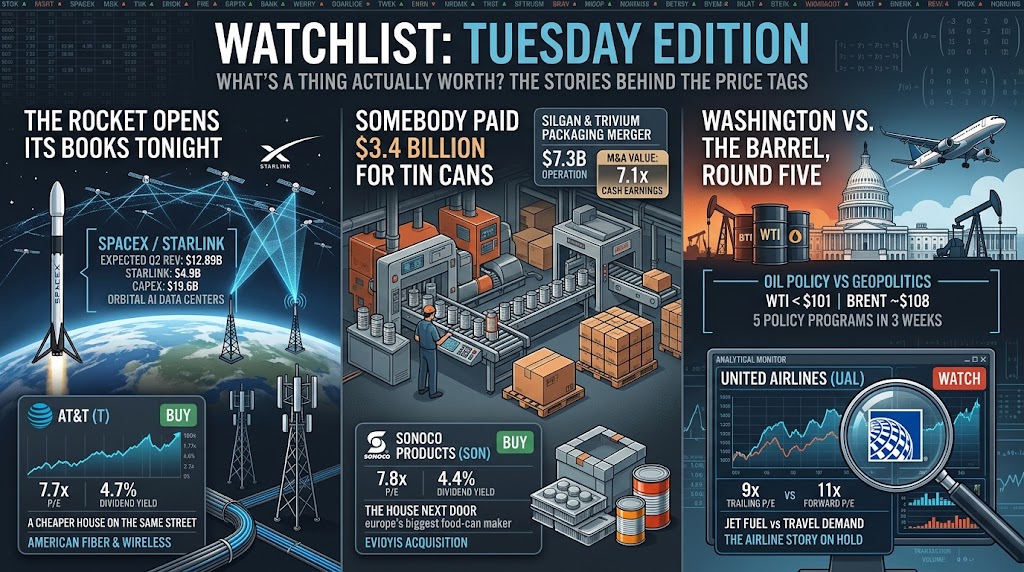
Tonight at 4:30 ET, streamed on X, SpaceX reports its second quarter as a public company — and the first one Wall Street expects to be profitable. Consensus, per Bloomberg: $12.89 billion of revenue, up roughly 65% from the prior quarter, and about 15 cents of adjusted earnings. Analysts project Starlink reaching 14.3 million subscribers, up from 12 million.
Now look at the revenue mix, because this is the part the phone industry should frame. About $6.4 billion of that quarter is expected to come from AI compute — the orbital data-center business SpaceX has been signing hosting deals for at a pace of one giant contract a month. Starlink, the thing that terrified the carriers, is expected to contribute about $4.9 billion. The invader's side business is now bigger than the invasion. And the whole machine runs on the borrowed checkbook October just repriced: forecast capex of $19.6 billion would leave free cash flow near negative $11.6 billion for the quarter.
Rewind two weeks. When SpaceX spent about $8 billion on 800 MHz spectrum, the market erased roughly $39 billion of carrier value in a morning. AT&T had its worst day since 2000, down about 10% to near $22. The market sold the supermarket because a food truck bought the parking spot across the street. Tonight, the food truck opens its books — and they're expected to show it's mostly busy building a casino.
The pairing: AT&T (T) — Buy
We bought Verizon on this exact markdown on October 12th, and it's up about 5% since. AT&T is the cheaper house on the same street. At $23.44 as of Thursday's close, the company trades at 7.7 times trailing earnings — a number flattered by one-time gains, so use the forward multiple, about 10 times against the S&P 500's 21 — with a 4.7% dividend yield and an average analyst target of $28.76, well above the price. It just sold AT&T Mexico for $2 billion and formed a fiber joint venture with BlackRock's infrastructure arm and CPP Investments: the house is being simplified down to American fiber and wireless, the two things Starlink's sliver of satellite capacity can't replicate in dense cities, where towers do the work. Starlink's entire quarter is expected to be about $4.9 billion. AT&T collects $127 billion a year.
The honest risks: tonight's print could dazzle — a first profit and 14 million subscribers will make loud headlines — and Bernstein already downgraded AT&T to Market Perform on exactly this fear; the debt load is heavy in a 5% world; and AT&T's own report lands Wednesday morning (consensus near $0.61), so the exam is immediate. The kill, same as Verizon's: Starlink prices a real phone plan AND AT&T's subscriber lines actually bend. Then the cheap multiple was a warning.
2) Somebody Paid $3.4 Billion for Tin Cans
On Monday, Silgan Holdings and private-equity firm American Industrial Partners agreed to buy Trivium Packaging — a metal food-and-aerosol can maker — at a $3.4 billion enterprise value, merging it with Silgan's own can businesses into a $7.3 billion metal-packaging operation. The price: 7.1 times Trivium's trailing cash earnings, or 4.8 times counting the $225 million of expected synergies. Silgan keeps 60%, collects about $2.3 billion in cash, and its stock jumped more than 5% Monday morning. The deal closes in mid-2027.
Think about what a tin can is. A few cents of steel that keeps a dollar of food safe for years, unimproved in any important way for a century, and completely indifferent to brands — the store-label soup sliding up the trade-down migration ships in the same can as the name brand. Boring, essential, and now carrying a fresh professional appraisal.
And when a house on your block sells, every house on the block is worth more on Tuesday than it was on Monday.
The pairing: Sonoco Products (SON) — Buy
Sonoco is the house next door. It paid about $3.9 billion for Eviosys — Europe's biggest food-can maker — which made it one of the largest metal food-can producers on Earth, stacked on top of a century-old industrial packaging business. At about $49 (the October 14th close, our latest verified print — before Monday's deal news), the $4.9 billion company trades at 7.8 times trailing earnings and about 8.2 times forward, against the S&P's 21, with a 4.4% dividend yield. Trailing revenue grew 17.7%. Eleven analysts rate it a Buy with an average target of $59.33, about 20% above the price.
Why it's cheap, honestly: packaging volumes have been soft, BofA downgraded it to Neutral five weeks ago, and the target-cut parade followed (Truist to $62, UBS to $51, Citi to $63 — all still above the price). The Eviosys purchase left real debt on a balance sheet in a 5% world. And the tariffed steel we cheered at Steel Dynamics on Sunday is Sonoco's input bill — one aisle's umbrella is another aisle's invoice. As always, the appraisal is not the thesis — the pantry is. The kill: volumes shrinking while the debt bill runs. One more thing: Sonoco reports its own third quarter Wednesday, so this exam, too, is immediate.
3) Washington vs. the Barrel, Round Five
On Monday, President Trump waived the Russia sanctions and tariffs due under the Graham Act — putting new sanctions on hold just before they took effect — with Secretary Rubio saying the president may take up to 60 days to assess the impact. Oil slipped from a five-month high on the news: WTI fell under $101, Brent to around $108, after surging nearly 7% last week. Phillip Nova's Priyanka Sachdeva called it "another desperate attempt to keep oil prices in check" ahead of the midterms.
Count the programs now aimed at the price of fuel: the G7's 100-million-barrel reserve release, the refiner meetings, the dyed-diesel order, General License 135 legalizing Russian diesel imports, and now a sanctions waiver. Five programs in three weeks. The counterweight is still shooting: the UK navy counted ten attacks on commercial ships in and near the Strait of Hormuz last week — the busiest month for attacks since March — and Russia's foreign minister landed in Tehran Monday with Iran's seven-day ceasefire offer still on the table, still unsigned.
So who pays the bill all five programs are aimed at? Airlines. Delta's fuel bill rose 62% to $4.1 billion last quarter and ate an otherwise-record quarter. And tonight, after the close, United Airlines reports.
The pairing: United Airlines (UAL) — Watch
Jet fuel is to an airline what rent is to a restaurant — the bill that decides whether a good month counts. Washington is now arguing with the landlord on every tenant's behalf. United is one of the biggest tenants on the street: $62.9 billion of trailing revenue, up 8.5%, at $96.10 as of Thursday's close — down 5% that day alone, about 31% off its high. Twenty-five analysts rate it Strong Buy with an average target near $152, nearly 60% above the price.
So why Watch and not Buy? Because the stock trades at 9 times trailing earnings but about 11 times forward — the forward number sitting above the trailing one means estimates are falling, the same rule that kept us out of Nike. Wells Fargo said it plainly while cutting its target: "Fuel continues to delay the airline story." And a policy barrel is borrowed, not earned — the same reason Knight-Swift stayed a Watch. The entrance: tonight's print showing demand holding while the fuel bill crests, or a markdown toward the ~$85 low that pays for the war risk. The kill: escalation sending Brent through $110 and repricing kerosene, or travel demand breaking in a 29,000-jobs economy. Alaska Air — our fuel-side watch — reports Thursday, and Copa, the unhedged de-escalation winner we already own, rides the same tape.
Before You Go
That's the watchlist: the rocket's first expected profit tonight, a $3.4 billion appraisal for the tin can, and Washington's fifth swing at the price of oil. One theme, as always: the market is arguing about price tags, and the best ones are hanging on the stocks nobody's shouting about.
Two receipts before you go. Cleveland-Cliffs opened steel week Monday morning with a beat — adjusted EPS of $0.28 against a 45-cent loss a year ago, EBITDA of $612 million topping its own guidance, 2027 guided above $4 billion, and the CEO calling it "our strongest quarter in three years" — a receipt for the whole tariff-umbrella shelf. Steel Dynamics' pre-announced double landed Monday night, after our press time; you've seen the grade, we haven't. And Monday morning opened with the AI panic catching its breath — Intel up 4% premarket on a JPMorgan upgrade, the 10-year near 5.07%, and October hike odds fading under 20% into a quiet Fed. Whether the bounce survived Monday's close, you already know.
This morning brings GM, RTX, Hasbro's Christmas report card, and the Synchrony, Ally, Western Alliance, and Nasdaq exams from Sunday's checklist. Tomorrow: AT&T before the open — then Meta, Tesla, IBM, Lam Research, and Crown Castle, all within an hour of the close.
Found this helpful? Share it with others.
Written by Behind The Markets