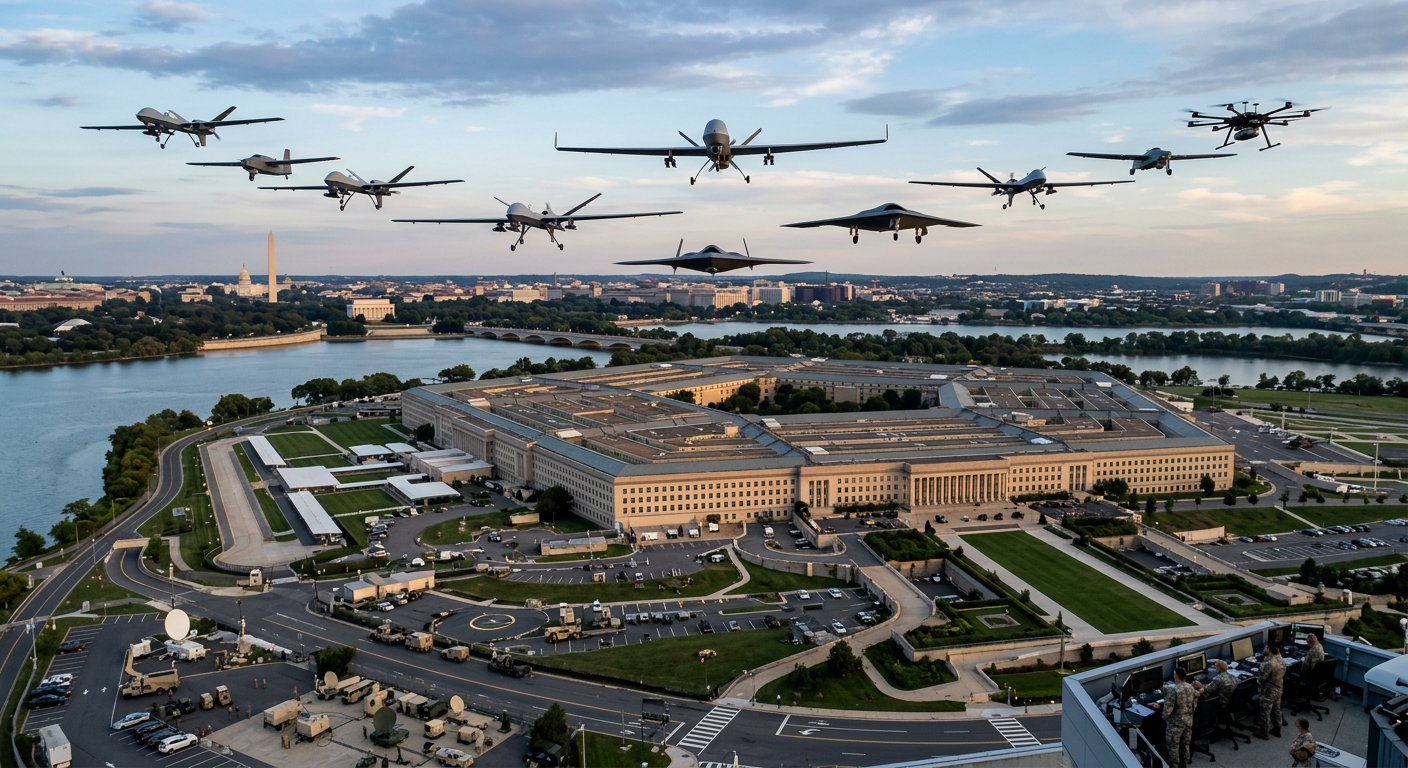
$70 Billion for Drones and Counter-Drones. $29 Billion in Q1 Contracts Alone. And a $20,000 Drone Still Costs $3 Million to Kill.
A quick note from Behind the Markets
Good morning.
Wall Street talks defense like it's just another sector ETF.
But defense is not a sector. It's a political mandate and an industrial bottleneck. And bottlenecks are where retail investors can still steal edges.
1) "There's No Easy Way to Counter Drones." That's the Tell — and It's Now a $70 Billion Budget Line.
Estonia's defense minister told Deutsche Welle there's "no easy way to counter drones," even as NATO countries expand capabilities.
That sentence is worth billions. Literally.
The FY2027 Pentagon budget requests more than $70 billion for drone platforms and counter-UAS systems combined. The Army's small counter-drone procurement alone hits $994 million — nearly double the FY2026 enacted level. The Pentagon's Institute for Defense and Government Advancement projects total U.S. anti-drone spending exceeding $10 billion from 2024 to 2029, peaking at $1.9 billion in FY2027. And globally, publicly announced counter-UAS contracts blew past $29 billion in Q1 2026 alone.
The problem — and the investment opportunity — is the cost-exchange asymmetry. A $20,000 Iranian Shahed drone forces the U.S. to fire a $3–5 million interceptor missile. A Rutgers study documented the math: this cost exchange is "unprecedented in modern air defense." It's not sustainable. And it's forcing a complete rewrite of how defense dollars get spent.
The battlefield data from Ukraine makes the urgency undeniable: autonomous warfare systems, including drones and counter-drone systems, now account for an estimated 80% of battlefield deaths. AI-powered FPV drone guidance improved mission success rates from roughly 15% to 60% — compounding the threat that counter-drone systems must defeat. And electronic warfare's dominance is eroding as adversaries adopt fiber-optic and AI-autonomous drones that are immune to RF jamming.
The next wave of defense spending isn't "more missiles." It's detection (radar, RF sensing, acoustic), electronic warfare (where it still works), hard-kill point defense (cheap interceptors and directed energy), and command-and-control software that fuses sensors into decisions in real time.
One company at the center of the counter-drone buildout:
Company: AeroVironment (SYM: AVAV)
The leading U.S. manufacturer of small tactical drones (Switchblade) and counter-drone systems — including the Locust X3 laser system at under $5 per shot and the combat-proven Switchblade family.
AVAV is currently trading around $201.20. The company bridges both sides of the drone equation: the attack drones creating the threat (Switchblade, used in Ukraine and by CENTCOM forces) and the counter-drone systems solving it (Locust X3). When the Pentagon is spending $994 million on small C-UAS and $70 billion on the broader drone ecosystem, AVAV captures demand on both the offensive and defensive sides. The Locust X3's economics are the key: at under $5 per engagement versus $3–5 million for a traditional interceptor, it represents the cost-exchange math the Pentagon needs to make drone defense sustainable.
Bottom line: Drone warfare is forcing a rewrite of procurement. The winners are the unglamorous enablers: sensors, EW, and software that can scale.
2) The Contrarian Angle: The Best Defense Investments May Not Look Like "Defense Stocks"
The market is already crowded in the obvious primes. Retail investors keep asking: "What's the next Lockheed?"
Wrong question. The better question is: who sells the picks-and-shovels that every country needs regardless of which prime wins the contract?
Here's the proof that the investment opportunity is shifting downstream. The Pentagon just awarded Eric Schmidt's Perennial Autonomy a $500 million contract through JIATF-401 for the Merops interceptor drone — a cheap, attritable system designed to kill enemy drones at a 13:1 cost exchange ratio. One Merops system has already destroyed nearly 2,000 enemy drones in active combat.
Perennial wasn't a traditional defense contractor. It was a startup backed by the former Google CEO, battle-tested in Ukraine before any U.S. service branch placed an order. Lithuania bought 48 Merops in April. Polish and Romanian forces have deployed alongside the system on NATO's eastern flank. And the company opened manufacturing in Germany through Munich-based Twentyfour Industries.
The Drone Dominance program — the Pentagon's roughly $1 billion effort launched December 2025 to procure hundreds of thousands of small attack drones — runs on the same logic: drones as consumable supplies, not durable aircraft. Counter-drone interceptors are the defensive half of the same bet.
Think about the modern defense stack: Components (power electronics, ruggedized compute, RF parts). Subsystems (sensors, communications, guidance, counter-drone kits). Integration (the prime contractor). Primes fight for headlines. Suppliers quietly raise prices. And in shortages, suppliers get paid first.
One company positioned in the defense electronics and sensor layer where every counter-drone program pulls demand:
Company: L3Harris Technologies (SYM: LHX)
Top-tier defense electronics — sensors, electronic warfare, ISR, and secure communications. The components that sit inside NASAMS, Patriot, counter-drone detection systems, and the 158 HBTSS tracking satellites.
L3Harris is currently trading around $307.64. When the Pentagon spends $70 billion on drones and counter-drones, $994 million on small C-UAS, and $500 million on a single interceptor program — the sensors, RF detection, electronic warfare, and communications equipment inside those systems come from a small number of qualified suppliers. L3Harris is one of them. The company generates demand pull from every counter-drone program simultaneously — not because it builds the interceptor, but because it builds the detection and targeting layer that makes every interceptor effective.
Bottom line: The most mispriced defense opportunities tend to be the sub-tier manufacturers and software vendors that sit inside multiple programs.
3) What to Watch Next: The Demand Signal Is Shifting From "Platforms" to "Mass"
Wall Street hates this reality: in a real conflict, you don't just need a few exquisite systems. You need a lot of good-enough systems.
The numbers prove it. The Drone Dominance program is buying hundreds of thousands of small attack drones — treating them as ammunition, not aircraft. The counter-drone market is bifurcating into two tracks: AI weapon station retrofits that transform existing guns into autonomous drone killers, and autonomous interceptor drones that are cheap enough to expend on every engagement.
The global spending confirms it. Counter-UAS spending will hit $12.6 billion globally in 2026 according to Unmanned Airspace — with major new layered defense programs announced in Colombia, Nigeria, Poland, Saudi Arabia, Qatar, and the UAE alongside the U.S. and NATO. Germany committed $13 billion for Ukraine assistance including an anti-drone shield over Ukrainian cities. Norway and the UK are contributing approximately $700 million each for air defense.
When NATO countries coordinate purchases — and the NASAMS fleet now spans 14 countries, the PAC-3 spans 17 nations, and the Merops is deploying across Lithuania, Poland, and Romania — the value shifts from bespoke projects to production capacity. Standardization creates scale, predictable sustainment, and recurring upgrade cycles.
This is where the "mass production" edge lives: factory expansions and second-source suppliers, multi-year procurement contracts (not one-off awards), and alliances buying the same kit together. The company that can build, ship, and service at scale wins — not the one with the best prototype.
One ETF that captures the full defense industrial base positioned for the mass-production era:
ETF: iShares U.S. Aerospace & Defense ETF (SYM: ITA)
Broad exposure to the defense fleet — primes, tier-one suppliers, electronics companies, and the industrial base supplying both the drone and counter-drone waves.
ITA holds every layer of the defense stack: RTX (NASAMS, AMRAAM, counter-drone radar), L3Harris (sensors, EW, satellites), Northrop (GPI, B-21, autonomous systems), Lockheed (HIMARS, F-35, PAC-3), AeroVironment (Switchblade, Locust), and the sustainment companies that keep everything running. When $70 billion flows into drones and counter-drones, $994 million into small C-UAS procurement, and $29 billion in global contracts land in a single quarter, every layer of the defense ETF benefits. ITA is the fleet approach to an industrial mobilization.
Bottom line: Defense is becoming an industrial scaling story. The trade is not just who has the best tech — it's who can build it, ship it, and service it.
Before You Go
If you want a retail edge in defense, stop chasing the headline contracts.
Find the choke points.
In a drone era, "no easy way to counter" means the spending is just getting started.
Found this helpful? Share it with others.
Written by Behind the Markets