Morning Watchlist: Wednesday Edition
A quick note from Behind the Markets
Wall Street wants clean stories. Housing is either a recovery or a collapse. AI is either a revolution or a bubble.
Reality is messier, and that's where the edge lives. Two quotes from the past 48 hours make the point.
The first is from Home Depot's CFO, describing a quarter that beat expectations: "We continue to operate in what I call 'frozen housing market conditions.'" Beat the numbers, best comparable sales in nearly four years — in a frozen market.
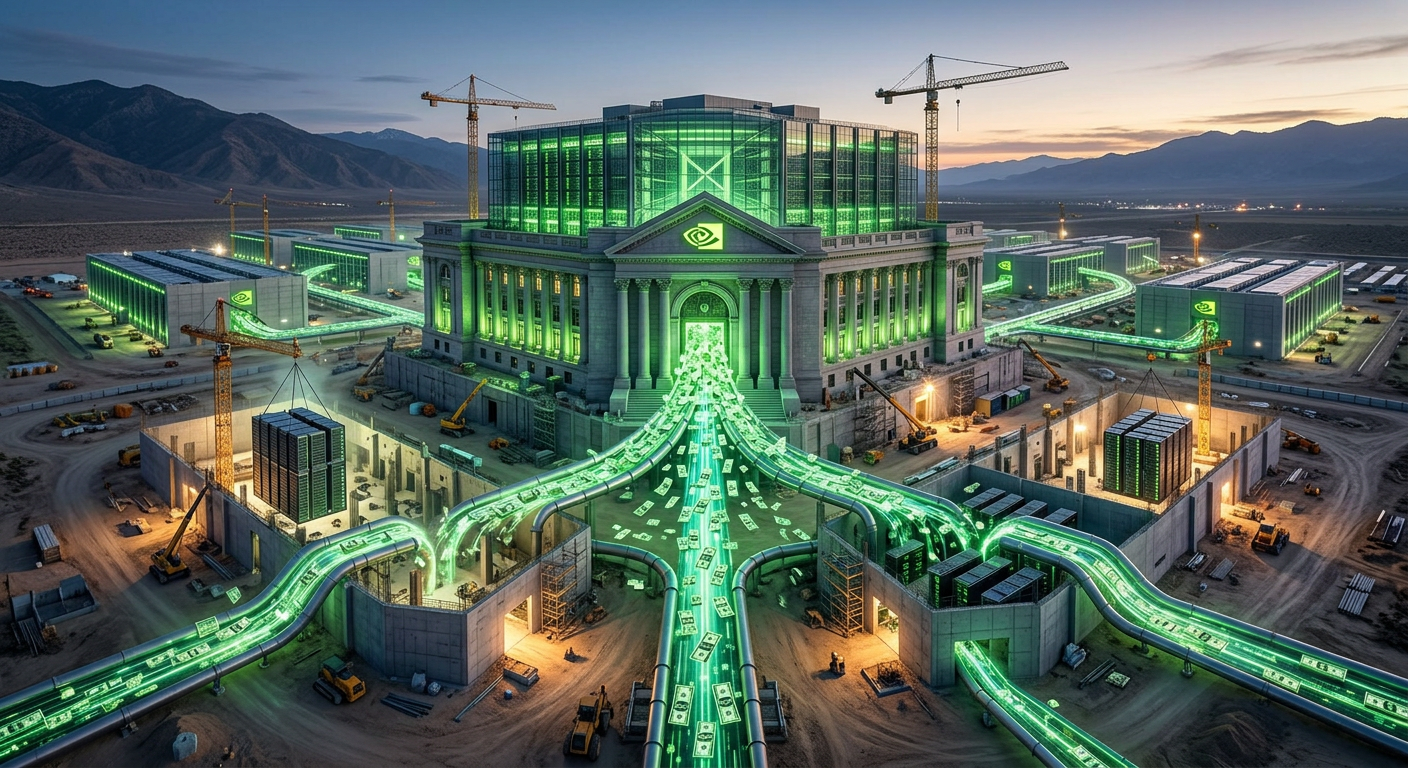
The second is from Jensen Huang, on the day Nvidia agreed to guarantee up to $105 billion of obligations for a data center that will buy Nvidia's chips: "Is this circular financing? No. OpenAI will pay the lease."
When a CEO has to publicly deny that his deal is circular, you've learned something about what the market is worried about. And when a retailer beats in a frozen market, you've learned that the label on the sector isn't describing the cash flows underneath it.
Today: four operating layers that keep working even while the headline argues with itself.
1) The Housing Market Is Frozen. The Repair Economy Is Not.
Home Depot reported yesterday morning, and the numbers were better than the narrative. Revenue rose 5.7% to $47.9 billion, ahead of the $47.3 billion expected. Adjusted earnings of $4.92 beat the $4.73 consensus. And comparable sales rose 1.7% against expectations of 0.9% — which CFO Richard McPhail noted is the company's best comp since the third quarter of fiscal 2022. U.S. comps rose 1.3%. Six-month operating cash flow reached $11.4 billion, up from $9.0 billion.
The explanation matters more than the beat: "broad-based demand across the business as customers continued to engage in smaller projects." And McPhail's description of the customer is the most useful sentence of the quarter — a "healthy cohort," but one that "told us they have the means to spend, they're just hesitant."
That's a different housing trade from the one Wall Street keeps pitching. High mortgage rates and expensive homes stop people from moving. They don't stop a roof from leaking, a water heater from failing, or a contractor's backlog from filling up. Turnover is frozen; maintenance is not optional.
Two things to keep you honest before you extrapolate.
First, a one-time item is doing real work. Home Depot received $730 million in tariff refunds during the quarter — which McPhail said represents "the vast majority" of what the company expects — and the reaffirmed guidance explicitly counts on those refunds to "partially offset unplanned fuel, energy, and other product input costs." That's a genuine benefit, but it isn't repeatable.
Second, look at what the company still guides to. Despite the beat, full-year comparable sales guidance stayed at flat to 2% and EPS growth at flat to 4%. Management reaffirmed rather than raised. A beat that doesn't move the annual number is telling you the year is still expected to be roughly flat.
The real risk to watch: deferred maintenance eventually becomes deferred spending. A hesitant customer with the means to spend can stay hesitant for a long time.
Bottom line: Don't wait for housing turnover to recover before looking for housing winners. The overlooked trade is the infrastructure of repair.
2) Nvidia Just Became the Bank of the AI Boom
Nvidia agreed to guarantee up to $105 billion in conditional lease and power payment obligations to SB Energy, per its SEC filing. Not a loan — a guarantee. Nvidia is also investing $1.5 billion in SB Energy, joining SoftBank and OpenAI as an investor, and becomes the exclusive compute supplier at the PORTS-Pike Technology Campus in Pike County, Ohio — a site owned by the Department of Energy that once enriched uranium for the nuclear arsenal and Navy submarines.
The scale is difficult to absorb. 8 gigawatts of computing capacity, starting with 4.25 and an option for 3.75 more. More than one million Nvidia chips. A 20-year lease with OpenAI as the tenant. First 800 megawatts online in 2028, full build by 2032. And Huang's own estimate of what Nvidia collects: $150 to $200 billion of revenue from this site alone.
So Nvidia is guaranteeing $105 billion of its customer's obligations in order to sell that customer $150–200 billion of hardware. Huang rejected the circular-financing characterization. Readers can weigh the denial themselves — but note that last week Nvidia also teamed with six large asset managers to build financing platforms deploying $500 billion of third-party capital into data-center projects. The chipmaker is now, functionally, arranging the credit for its own demand.
Now the detail almost everyone missed, and it's the investable one.
To power this site, SB Energy will build a 9.2-gigawatt natural gas plant on the property. Estimated cost: $33 billion — reflecting a 66% rise in gas plant construction costs over two years, per BloombergNEF. And here is the consequence: that plant will compete for natural gas against LNG export markets, a combination that analysis suggests could triple natural gas prices in parts of the country.
Pike County, Ohio sits in the Appalachian Basin — which produces just over one-third of all Lower 48 natural gas.
The Stock: EQT Corporation (NYSE: EQT)
EQT is the largest natural gas producer in the United States, and its acreage sits directly on top of the demand this buildout is creating. Management isn't guessing at it: on the last call, executives described more than 45 Appalachian demand and takeaway projects under construction or evaluation, representing nearly 20 billion cubic feet per day of potential demand, with their power-demand base case moving from 6 toward 10 Bcf/d. Nine tracked data-center sites in Pennsylvania and eleven in Ohio.
The company is also converting that proximity into contracts rather than hope. It signed a 10-year, 325 million cubic feet per day power supply agreement with CPV Shay, priced to PJM power — which the CFO described as giving EQT direct exposure to power-market tightness without requiring capital. It has LNG offtake agreements beginning in 2028, including twenty-year deals with Commonwealth LNG and Sempra's Port Arthur Phase 2. Second-quarter results, reported July 21 (event risk cleared), brought raised full-year production guidance — up about 90 Bcfe at the midpoint — and lowered capital spending by $25 million, with $330 million of free cash flow and gross margins above 80%. Management says it operates at the low end of the cost curve.
The other side is substantial, and anyone buying gas producers needs to sit with it.
The commodity is weak right now. EQT realized just $2.89 per MMBtu last quarter. Second-quarter earnings of $0.39 missed the $0.42 consensus by about 7%, and in the two months before that print, consensus EPS estimates for the company fell 26% with six downward revisions in thirty days. Earlier in the year the company deliberately curtailed 10–15 Bcf of production because prices were too low to bother. Henry Hub oversupply is a real and persistent problem, and the entire gas complex has been downgraded on it.
And the demand thesis is a forecast, not a contract. Management itself said it expects only a portion of those 45 projects to materialize. The bear case is straightforward: AI-driven gas demand and the associated infrastructure buildout are being overestimated, and Appalachian concentration means there's nowhere to hide if that's right. This is a commodity producer with a story attached — own it for the assets and the cost position, and treat the data-center demand as optionality rather than the thesis.
Bottom line: The AI boom is moving from a chip shortage to a credit test. Follow the scarce physical inputs — and notice that the largest new gas plant in the country is being built on top of the country's largest gas basin.
3) China Is Quietly Becoming the West's Aluminum Shock Absorber
China has emerged as a swing supplier of aluminum to Western markets disrupted by the Iran war — at a moment when London Metal Exchange aluminum inventories have fallen to their lowest level since 1990, a 36-year low.
The popular story says the West is decoupling from China. The physical market says something more complicated: when a critical input gets scarce, buyers follow available metal. China can ease the shortage — and in doing so, Western manufacturers become more exposed to Chinese processing, shipping, and policy decisions, not less. Relief and dependence arrive in the same shipment.
The investable angle isn't to buy a miner or a smelter. It's the converters — the companies that turn available metal into a specification a customer can actually use, on a date they can plan around. In a stressed market, that capability prices better than the metal itself.
The Stock: Kaiser Aluminum (NASDAQ: KALU)
Kaiser makes semi-fabricated specialty aluminum products — engineered plate, sheet, coil, extrusions, rod, bar and tube for aerospace and high-strength applications, packaging, general engineering, and automotive. It is precisely the "delivers a specification on time" business the section describes, and its second quarter, reported July 22, was extraordinary.
Adjusted earnings of $5.53 per share against roughly $2.18–2.72 expected — more than double. Adjusted EBITDA of $166.3 million, up 148%, at a 38.1% margin on conversion revenue versus 18.1% a year earlier. The margin literally doubled. Shipments rose 6% to 306 million pounds on improving aerospace build rates and easing destocking, with packaging demand for coated products strong. Management raised full-year guidance, now expecting adjusted EBITDA growth of 45–55%. Net debt leverage improved to 2.1x, liquidity stands at $628 million with nothing drawn on the revolver, and the quarterly dividend is $0.77. CEO Keith Harvey put it plainly: what began as an aerospace recovery has become a portfolio-wide growth story.
Net sales rose from $823 million to $1.26 billion — but that is mostly not growth. The increase largely reflects an 83% rise in the hedged cost of alloyed metal, which Kaiser passes directly through to customers under contracted selling prices. The number that measures the actual business is Conversion Revenue, and it rose 17%. Strong — but 17%, not 53%. When aluminum prices spike, this company's top line inflates without the economics changing. Know which line you're reading.
Second, roughly $27 million of the quarter's EBITDA came from metal price lag — a timing benefit from the gap between when metal is bought and when it's priced into sales. Management is straightforward about this: it expects aluminum price dynamics to normalize, and its raised guidance assumes neutral metal lag for the rest of the year. Credit them for not extrapolating a windfall. But it means the second half won't look like the first.
Third, the price. The stock jumped nearly 11% on the report to about $182, approaching its 52-week high of $196 — against an average analyst target near $159. It trades above the Street, and at least one analyst moved to Hold explicitly citing excessive valuation above $170. Management also noted that much of its capacity is already committed, and that delivery performance at its Warrick facility still needs improvement.
Bottom line: China can cushion a Western supply shock without solving it. The premium belongs to companies that convert available metal into usable product — but pay for conversion revenue, not for a pass-through metal price, and don't pay a premium to the Street after an 11% pop.
4) China's Biotech Pipeline Is Becoming a Geopolitical Bargaining Chip
Chinese innovative-drug out-licensing reached a record pace in the first half of 2026. This isn't one transaction. It's a structural reorganization of where pharmaceutical risk is developed and where it's commercialized.
And the same week brought the other side of the trade: Fulcrum Therapeutics agreed to merge with private biotech Slate Medicines after abandoning its lead sickle-cell program. A public shell with cash and a listing, meeting a private asset that needs both. That transaction type tells you as much about biotech's capital markets as any licensing headline.
The obvious read is that big pharma is hunting growth. The more useful read is that pharmaceutical geography is being contractually redesigned around risk-sharing — Western buyers want lower-cost research and manufacturing, Chinese developers want global partners and commercial reach, and both want somebody else holding the part they're least sure about.
Which brings back the discipline that travels: deal value is not asset value. Focus on upfront cash versus milestones, manufacturing rights, territory splits, clinical stage, and whether the buyer can actually commercialize. A headline number with two-thirds behind milestones is a buyer telling you where the risk lives.
Bottom line: Biotech globalization isn't disappearing. It's being contractually redesigned. Follow the infrastructure that makes cross-border science investable.
Before You Go
The market rewards simple labels because simple labels are easy to trade. Frozen housing. AI bubble. China risk.
But underneath the labels: a retailer just posted its best comparable sales in four years inside that frozen market. A chipmaker is guaranteeing $105 billion of its customer's lease obligations — and building the case for a $33 billion gas plant sitting on top of America's largest gas basin. Manufacturers are quietly buying Chinese metal while their governments discuss decoupling. And drug developers keep signing cross-border deals while the same governments debate dependence.
Identify the bottleneck, find who gets paid to solve it, then check whether the balance sheet survives the wait — and whether the number you're reading is real revenue or a pass-through.
Found this helpful? Share it with others.
Written by Behind the Markets