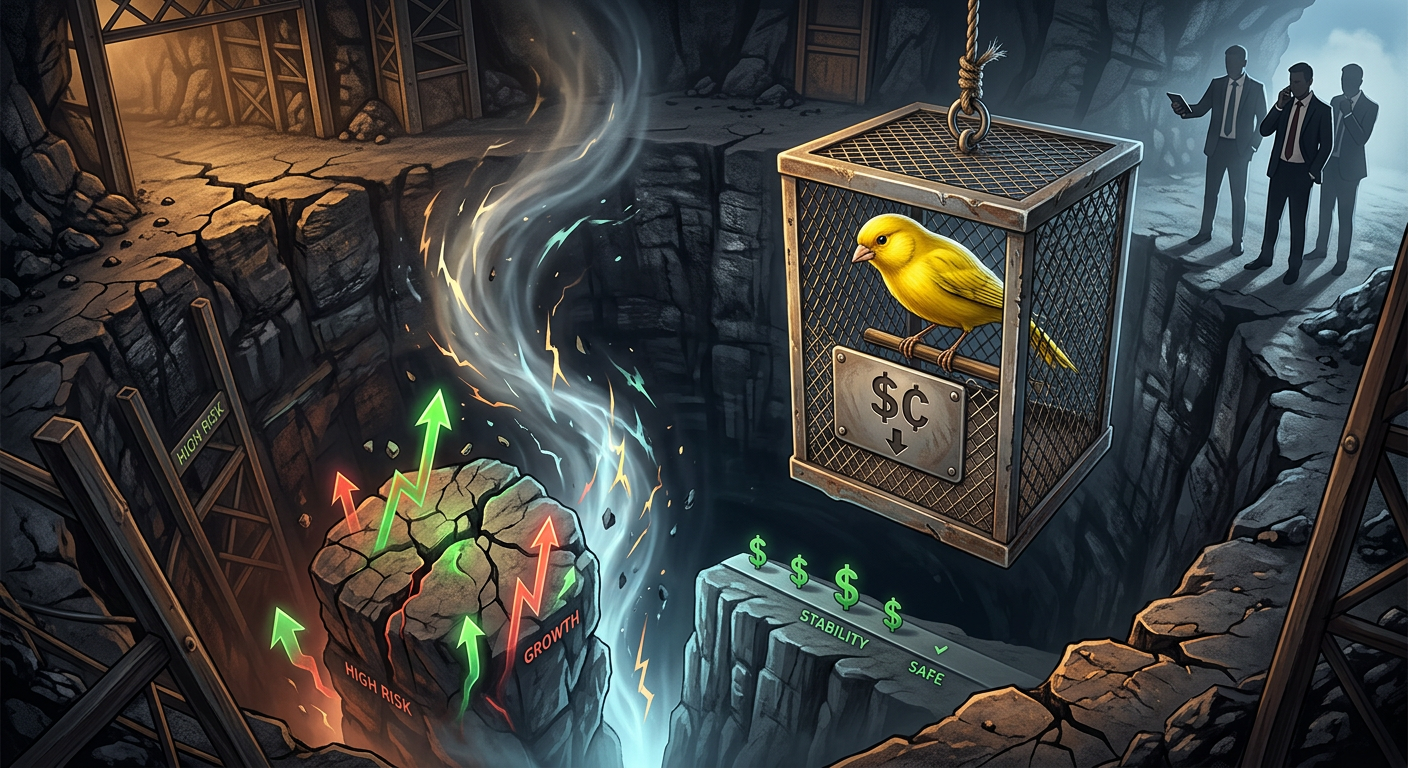
When the 3x ETFs Do the Moving, That's Positioning — Not Fundamentals. Here's Where the Edge Is.
A quick note from Behind the Markets
Wall Street loves simple stories. "Risk-on." "Soft landing." "AI forever."
But when the tape starts punishing the same crowded pockets that powered the rally, you don't ignore it. You use it.
Today I'm focused on the spots where retail investors can actually get an edge: under-owned cash flow, unsexy infrastructure, and the parts of the market where liquidity disappears when the narrative flips.
1) Semis Didn't Just Dip — The Leverage Reset Is the Signal
You don't need a headline to know the AI trade is overheating. When the leveraged semiconductor ETFs start swinging like meme stocks, that's a positioning tell — not a fundamentals update.
We've now watched it happen repeatedly. In early June, the Philadelphia Semiconductor Index posted its worst two-day drop since March 2020 after Broadcom declined to raise its AI outlook. Weeks later, the 3x-long semis ETF (SOXL) cratered nearly 20% in a single premarket session — a move driven not by news but by the mechanical, forced selling those funds must do to rebalance their leverage. And chips kept sliding into early July. When SOXL is down double digits, SOXS (3x short) is spiking, and bellwethers like NVDA are only modestly lower, that spread screams forced de-risking — leverage getting tapped on the shoulder, not investors calmly revising a spreadsheet.
So what do you do with that? Don't chase the front-end hype names. Build a watchlist around the second-order winners — power, cooling, test and inspection, networking, and boring industrial suppliers that get paid across the cycle. The freshest of those angles is the one that inspects every wafer, no matter whose chip wins.
Company: KLA Corporation (SYM: KLAC)
The dominant force in semiconductor process control — the inspection and metrology tools every advanced fab needs
KLA is the toll booth of chip quality. It utterly dominates process control — inspecting and measuring wafers for defects during manufacturing — with a market share more than four times its nearest competitor. Whether the winning AI chip comes from Nvidia, AMD, a hyperscaler's custom silicon, or a memory maker, it has to be inspected on KLA's equipment. That translates into remarkable economics: roughly $12.2 billion in trailing revenue, a 60%+ gross margin, a 33% net margin, and a large, recurring service business attached to its installed base. (Note: KLA did a 10-for-1 stock split on June 12, so the share price now reads in the low hundreds, not the thousands.)
KLAC trades around $260–300 after the split, near record highs and richly valued — and here's the honest risk that cuts against the "paid no matter what" framing: KLA's revenue is ultimately tied to fab capital spending, which is cyclical. If chipmakers pull back capex in a genuine downturn, KLA's orders soften, and at a premium multiple with a beta near 1.7, the stock can drop hard (it fell double digits in the recent selloff). This is "own the structural chip buildout through its highest-quality supplier," not a recession-proof bond. But it's a far better place to be than the crowded front-end names when leverage unwinds.
Bottom line: When the 3x ETFs are doing the moving, you're seeing positioning unwind — usually the start of rotation, not the end of the theme.
2) Intel's Tape Is Telling You Something Uncomfortable About "National Champion" Narratives
Every cycle has its protected stories. Intel is one of them. It's "strategic." It's "domestic." It's "the comeback." And yet the tape doesn't care — INTC has been one of the sector's most persistent laggards, sliding again in the recent selloff as its foundry business keeps burning cash and it struggles to catch Nvidia and AMD in AI.
We're not here to dunk on Intel, just to highlight what retail investors miss: government-backed narratives create time… but they don't create execution. CHIPS Act money and "strategic" status can extend a runway; they can't guarantee the plane takes off.
If you want to play the reshoring/CHIPS angle, the smarter hunting ground is usually the picks-and-shovels: equipment suppliers, specialty materials, and second-tier packaging beneficiaries that ride the same policy wave without needing a miracle turnaround. One clean example sits in the materials layer.
Company: Entegris (SYM: ENTG)
Critical specialty materials and contamination-control supplier to virtually every chip fab
Entegris makes the unglamorous consumables and purity systems that fabs can't run without — filtration, contamination control, CMP slurries, specialty gases, and deposition materials. It's a "the fab buys this whether Intel or TSMC wins" business, with market-leading positions across multiple steps of the manufacturing process, and it benefits directly as new fabs get built on U.S. soil under the CHIPS Act. Q1 2026 revenue of $812 million beat expectations, and management guided to continued growth.
ENTG trades around $170, near the upper end of its 52-week range ($68–$187). Be clear-eyed about the risks, and they're notable: it trades at a very high multiple (P/E near 90), its 2025 revenue and earnings actually declined year-over-year, it's cyclical like the rest of the fab supply chain, and — a real yellow flag — insiders have been persistent sellers (35 open-market sales and zero purchases over six months, including the executive chair). Goldman Sachs even carries a Sell rating on valuation. This is a high-quality franchise at a demanding price — a watchlist name to accumulate on weakness, not to chase here.
Bottom line: "Strategic" doesn't mean "uninvestable," but it also doesn't mean "can't go down." Follow cash flow and execution, not slogans.
3) The Small-Cap Tell: Breadth Is the Truth Serum
If you want one fast gut-check on market health, watch small caps. When a big chunk of the market is buying protection — bidding up the 3x-short small-cap products — instead of buying opportunity, that's a clue the "risk-on" label is thinner than the index suggests.
Here's the nuance that matters this week, and it's important to get right: after Thursday's weak jobs report, small caps actually bounced, with the Russell 2000 hitting record highs on rate-cut hopes. So the "everyone's hedging small caps" signal is more mixed right now than it was during June's risk-off days. That's exactly why breadth — not any single day's tape — is the truth serum. If small caps can lead on falling-rate optimism, the rotation has legs; if they can't hold it while mega-cap AI keeps wobbling, then rates and credit are quietly tightening the screws underneath.
If you're long small- and mid-caps here, own the balance-sheet survivors — real cash generation, insider buying, and business models that don't depend on "one more refinance." Avoid the stuff that needs the capital markets to stay open. In a higher-for-longer world, the companies that fund themselves are the ones that get to buy assets cheap when the weak players tap out.
Bottom line: The rally isn't "broad" if investors hedge small caps while cheering the index. Watch breadth — it tells the truth the headline number won't.
4) Macro Reality Check: Inflation Isn't Dead — It's Just Wearing a Different Mask
Wall Street desperately wants the "inflation is over" banner. But the data still has teeth.
A few points for your dashboard: core inflation is still running around 3% (higher on the Fed's preferred PCE measure); the policy rate is still elevated at 3.50–3.75%; and wage growth held at 3.5% in the June jobs report, keeping services inflation sticky. One correction worth making, though: energy is not "hot" right now — oil actually fell roughly 30% last quarter to around $67 as the Strait of Hormuz war-premium collapsed. The near-term inflation risk isn't gasoline; it's the sticky, services-and-wage kind that doesn't fade just because crude did.
Here's why this matters for investors: when inflation is sticky, the game shifts from "buy growth" to "buy durability." High-quality balance sheets matter. Pricing power matters. Contracted cash flow matters most of all. And the stuff that looked fine with easy money — weak businesses with a good story — gets exposed. The cleanest embodiment of "durable, contracted, pricing power" is a business most people find too boring to own.
Company: Linde (SYM: LIN)
The world's largest industrial-gas company; long-term take-or-pay contracts, pricing power, and a fortress balance sheet
Linde is the definition of durable, contracted cash flow. It supplies oxygen, nitrogen, hydrogen, helium, and specialty gases to hospitals, chip fabs, refineries, steelmakers, and food producers — often under long-term take-or-pay contracts with built-in price escalators, so revenue keeps flowing (and rising with inflation) regardless of the economic weather. It's the picture of resilience: a beta around 0.85 (it moves less than the market), a 33-year dividend-growth streak, and a $7.1 billion backlog of contracted projects under construction. Q1 2026 delivered 8% sales growth and 10% EPS growth, and management raised full-year guidance.
LIN trades around $515–530, near its 52-week high, with analyst targets clustered around $545–$600. The honest caveats: at ~32x earnings it's not cheap for a slow-and-steady compounder, the dividend yield is modest (~1.2%), it's a global business (so a strong dollar is a translation headwind), and energy-cost swings can pressure margins quarter to quarter. You're buying durability and pricing power, not a bargain or a growth rocket. But if inflation stays sticky and the "good story, weak balance sheet" names get exposed, Linde is exactly the kind of contracted-cash-flow fortress that keeps compounding.
Bottom line: If inflation stays sticky, the Fed doesn't have to hike to hurt you. It just has to not cut fast enough. Own durability.
Before You Go
The market's biggest trick is making you feel like you're late.
You're not.
Crowded trades crack first. Underfollowed cash-flow stories are what you buy when everyone else is staring at the same five tickers.
Found this helpful? Share it with others.
Written by Behind the Markets