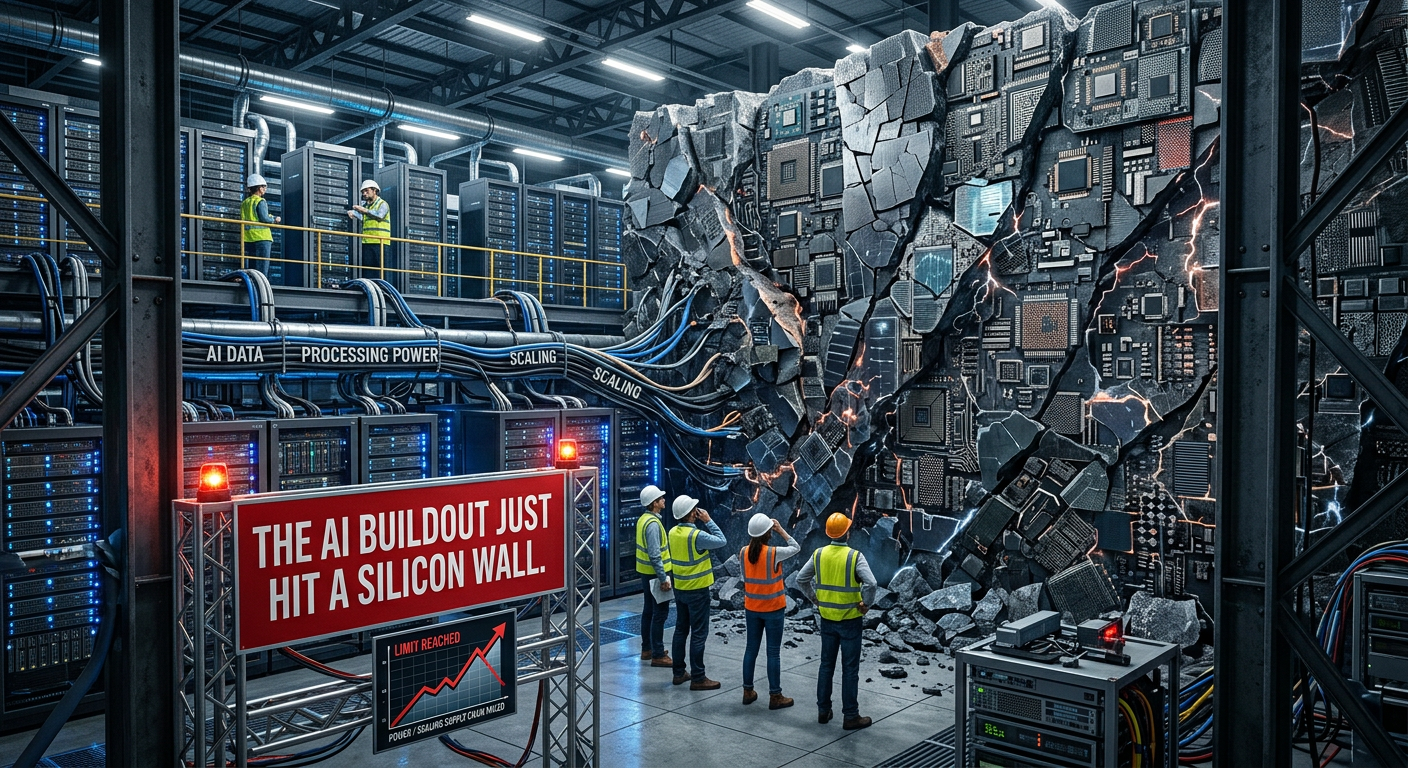
The AI Buildout Just Hit a Silicon Wall. GPU Lead Times Are 52 Weeks. Memory Is Sold Out Through 2026. And Packaging Can't Keep Up.
A quick note from Behind the Markets
Last year, everyone said AI would be capped by electricity. They were right.
But here's the plot twist: now the constraint is moving upstream — into chips, memory, and packaging. That's where pricing power lives.
1) The AI Buildout Hit a Silicon Wall — and It Changes the Whole "AI Trade"
The Center for a New American Security just published a report that should reframe how every investor thinks about AI: semiconductor manufacturing capacity — spanning advanced logic, HBM, and packaging — cannot keep pace with AI demand.
The constraint has officially shifted. For two years, electricity was the bottleneck — and it still is for the long term (half of planned data centers stalled, transformer lead times at 3–5 years). But in the near term, the binding constraint is silicon. You can have the land, the permits, and the power. If you can't get the chips, the data center sits empty.
The numbers are staggering. Hyperscalers are on track to spend $700+ billion on AI infrastructure in 2026 — Microsoft, Amazon, Alphabet, Meta, and Oracle all competing for the same constrained supply. Data center GPU lead times have stretched to 36 to 52 weeks. Nvidia redirected TSMC capacity away from H200 production toward its next-generation Vera Rubin chips after regulatory uncertainty stalled China sales — a direct reshuffling of the world's most constrained manufacturing capacity.
And CNAS flagged the concentration risk that makes this structural, not cyclical: TSMC fabricates the logic, SK Hynix/Samsung/Micron produce HBM, and TSMC packages it all together. Three companies in Asia — now the continent's three most valuable non-state firms — control the entire critical path. A disruption at any one of them cascades through the entire AI supply chain.
TSMC's capex spending was actually lower in 2023 and 2024 than in 2022, even as AI demand surged. The underinvestment created the gap. New fabs take years to build: TSMC's Arizona Fab 2 was pulled forward to 2027 (from 2028), but Intel's Ohio production was pushed from 2026 to 2030. The supply response is coming — but it's years behind the demand.
One company at the center of every AI chip bottleneck simultaneously:
Company: Taiwan Semiconductor Manufacturing (SYM: TSM)
The sole manufacturer of the world's most advanced AI chips — fabricating, and increasingly packaging, every major AI accelerator for Nvidia, AMD, Apple, Broadcom, and Google.
TSM is currently trading around $402.05. TSMC doesn't just make the chips. It packages them using CoWoS technology — the advanced packaging that integrates logic dies with HBM stacks on a silicon interposer. CoWoS capacity was the bottleneck that forced Google to revise its 2026 AI chip plans from 4 million to 3 million chips. TSMC is expanding CoWoS at an 80% compound annual growth rate — but demand still outpaces supply. The four largest AI chip designers consume 80–85% of total CoWoS output, leaving almost nothing for anyone else. When every dollar of AI capex must flow through one company's fabs and packaging lines, that company has the most durable pricing power in the entire technology stack.
Bottom line: When AI demand outstrips chip supply, the winners aren't just app-makers. They're the capacity owners.
2) Memory Is Becoming the Hidden Tax on AI Capex
Here's the detail retail investors miss: chips don't work without memory. And the memory market just underwent a structural transformation.
SemiAnalysis estimates memory could represent roughly 30% of hyperscaler AI spending in 2026 — up from just 8% in 2023 and 2024. That's a nearly four-fold increase in memory's share of the most valuable capex budgets on earth.
High-bandwidth memory (HBM) — the specialized DRAM stacked directly onto AI accelerators — has become the industry's most lucrative bottleneck. SK Hynix, Samsung, and Micron, which collectively control production, have preallocated their entire 2026 HBM capacity. There is no spot market. If you didn't lock in a contract months ago, you're not getting chips this year.
The economics have flipped the memory industry upside down. HBM gross margins are running at 60–70% — record levels for an industry that spent decades trapped in commodity pricing cycles. TrendForce describes the reallocation of DRAM capacity toward AI as "permanent" — a structural shift, not a cyclical one. Analysts forecast HBM prices may rise another 30–40% in 2026. Samsung is repricing contracts upward in the "high-teens percentage range."
And here's the constraint behind the constraint: current DRAM supply only supports approximately 15 gigawatts of AI infrastructure. The hyperscalers want to build 100+ GW by the end of the decade. The math doesn't work — not without massive new capacity that takes years to build.
One company with the most HBM pricing power in the world:
Company: SK Hynix (traded on Korean Exchange; U.S. ADR access via ETFs)
The world's dominant HBM producer, with roughly 50%+ market share of HBM3/HBM3E and the first to qualify HBM4 for next-generation AI accelerators.
For U.S. investors, direct SK Hynix access comes through the iShares MSCI South Korea ETF (SYM: EWY) — where SK Hynix is the largest or second-largest holding. The company's HBM dominance is the single most powerful pricing dynamic in semiconductors right now: 60–70% gross margins, 100% capacity preallocated, and a customer base (Nvidia, AMD, Google) that literally cannot build AI chips without its product. When memory shifts from "commodity" to "critical," the companies that control supply don't just participate in the AI boom — they tax it.
Bottom line: If the AI boom continues, memory pricing power can last longer than investors expect. The cycle just got distorted.
3) Packaging Is the Chokepoint Nobody Talks About
Even if you have chips and memory, you still need to assemble and integrate next-gen systems. And advanced packaging is where the whole supply chain can stall.
TSMC's Chip-on-Wafer-on-Substrate (CoWoS) technology is the packaging standard for every major AI accelerator. It integrates the logic die (the GPU) with HBM stacks on a silicon interposer, enabling the terabytes-per-second memory bandwidth that AI training requires. Without CoWoS, an Nvidia Blackwell GPU is just a collection of dies — not a product.
CoWoS was the binding constraint in late 2024 and early 2025. TSMC expanded capacity aggressively — growing at an 80% CAGR — and the four largest chip designers still consume 80–85% of total output. Google's 2026 AI chip production was cut from 4 million to 3 million specifically because of CoWoS limits.
As CoWoS loosened slightly, the bottleneck shifted to HBM. Now it's shifting again — toward advanced substrate supply and the integration complexity of next-generation multi-chiplet architectures. Each successive generation of AI accelerator requires more complex packaging, more HBM stacks, and larger interposers. The constraint doesn't disappear. It moves upstream.
One company positioned in the advanced packaging and semiconductor equipment layer:
Company: Applied Materials (SYM: AMAT)
The world's largest semiconductor equipment company — providing the deposition, etch, and packaging tools that TSMC, Samsung, and Intel need to expand the capacity that's currently constraining AI.
AMAT is currently trading around $422.93. Every time TSMC announces a CoWoS expansion, every time SK Hynix builds a new HBM line, every time Samsung ramps 3D NAND or HBM4 — the equipment comes from Applied Materials (and a small number of competitors). The company faces near-term China revenue headwinds from the MATCH Act (combined China revenue for AMAT/Lam/KLA was $19 billion in 2025). But the domestic and allied buildout — TSMC Arizona, Samsung Texas, CHIPS Act–funded expansions — is the multi-year demand offset. When the constraint is capacity and the solution is building more fabs and packaging lines, the equipment supplier is the permanent toll road.
Bottom line: If you want the second-order AI trade, stop looking for the coolest chatbot. Start looking for the bottlenecks.
4) The Clean Takeaway for Retail Investors
A framework:
Theme: AI capex stays big — $700+ billion in 2026, with no signs of the hyperscalers blinking despite negative free cash flow and rising debt.
Constraint: Chips, memory, and packaging limit the pace. GPU lead times at 36–52 weeks. HBM sold out through 2026. CoWoS at 80–85% utilization by four customers. Current DRAM supports only 15 GW of the 100+ GW the industry wants to build.
Positioning: Own the toll roads. TSMC fabricates the chips. SK Hynix makes the memory. Applied Materials builds the equipment. These are the companies that get paid regardless of which AI model wins, which hyperscaler spends the most, or which chatbot goes viral.
Avoid the "AI tourists" — the companies that slap "AI" on a press release but don't have a contract, a product, or a position in the critical path. In a supply-constrained world, placement matters more than story.
Bottom line: When supply is the constraint, valuation matters less than placement in the critical path.
Before You Go
If "silicon is the short-term constraint and power is the long-term constraint," what happens to all the AI hype names when deployments get delayed by 6–12 months — not because demand disappears, but because hardware can't ship?
Found this helpful? Share it with others.
Written by Behind the Markets