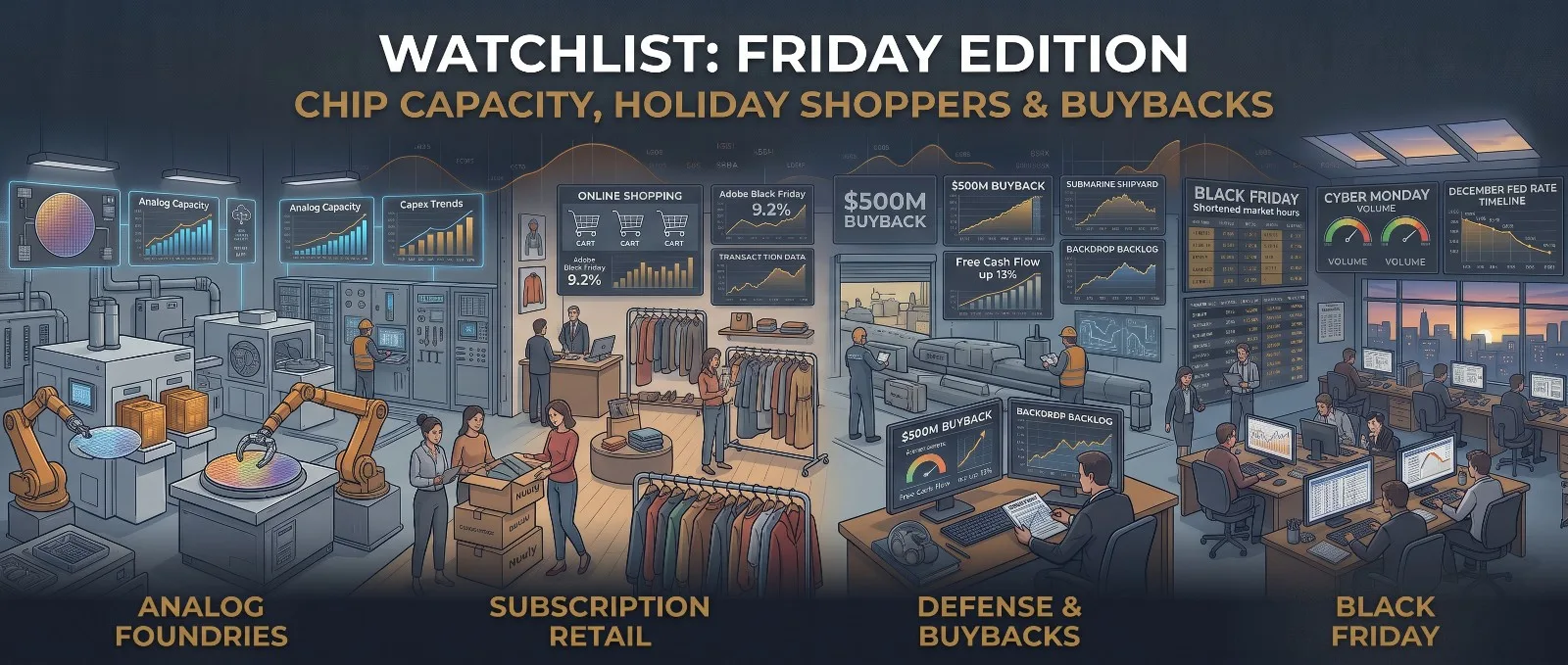
Morning Watchlist: Friday Edition
A quick note from Behind the Markets
It's Black Friday. The stock market is open, but only until 1 p.m. Eastern.
Before the holiday, the market split in two. On Tuesday, the Dow closed above 50,000 for the first time ever. The same day, the Nasdaq-100 fell almost 2%, and the S&P 500 posted its eighth loss in nine sessions.
One market was celebrating. The other was selling anything with a chip in it.
When the crowd sells in a hurry, it rarely reads the label. Three stories this morning. Three pairings. Let's get into it.
1) The Factory That Was Already Built
On Tuesday morning, Analog Devices reported the best quarter in its history. Revenue rose 42% to $4.37 billion. Adjusted earnings came in at $4.06 a share, against about $3.89 expected. Data center sales more than doubled.
The stock fell 17.4%, to $312.95. By Trefis' count, it was the worst day since at least 2003. Worse than March 2020.
Two things did it. The forecast for next quarter was roughly flat, about $4.4 billion in revenue, with margins slipping. And management admitted its factories are full. CFO Richard Puccio's words: capacity is "tight everywhere." So ADI plans to spend $1.6 billion to $1.9 billion on new capacity next year, up from about $700 million. It arrives starting in fiscal 2028.
The problem isn't demand. It's room.
Then the crowd sold the neighbor. Texas Instruments had no news of its own on Tuesday. It fell 11.25% anyway, to $258.44.
The pairing: Texas Instruments (TXN) — Buy
TI is the biggest maker of analog chips, the unglamorous parts that manage power and turn real-world signals like heat, sound and motion into data. Same aisle as ADI. Different store.
For years, TI did the thing Wall Street hated. It spent heavily on new 300-millimeter chip factories in Texas and Utah (bigger silicon wafers, so each chip costs less to make), right through a long slump in demand.
Now compare. ADI's capital spending is going up, to as much as $1.9 billion. TI's is coming down. Over the past 12 months, TI spent $2.6 billion on factories and equipment, down from $4.8 billion a year earlier. Free cash flow, counting CHIPS Act grants, more than tripled to $8.4 billion.
Picture two ski resorts on the same mountain before a big winter. One is sold out and just announced a new chairlift that opens in 2028. The other built its extra lifts years ago, when everyone called it a waste of money. When the snow comes, the skiers go where the lifts are running.
And the snow looks real. In October, TI reported revenue up 28% to $6.06 billion and guided the fourth quarter to $5.8 billion to $6.3 billion, roughly flat when the holiday quarter usually dips.
At $258.44, TI sits more than 20% below its 52-week high and pays $1.52 a share every quarter, about 2.4% a year at that price, after a 7% raise this fall.
The honest risks? This isn't cheap on earnings. A factory's bills arrive whether it's busy or not, so if analog demand stalls in 2027, TI's empty lifts become a cost. And if ADI's flat guide turns out to be the first sign the whole industry is cooling, rather than one company running out of room, we're wrong.
2) The Shoppers Showed Up Early
The National Retail Federation expects 182.7 million people to shop over Thanksgiving weekend, down slightly from 186.9 million last year. Not because people stopped shopping. Because they started sooner. Sixty percent had begun their holiday shopping by the start of November.
The money is moving online. Adobe forecasts $12.9 billion in U.S. online spending on Black Friday, up 9.2%, and $15.1 billion on Cyber Monday, a record. And shoppers are picky. Their top reason for shopping this weekend, per the NRF: deals "too good to pass up."
The holiday isn't canceled. It's choosier. And choosy shoppers punish any store that needs a markdown to move the merchandise.
That's what happened to one of the season's best stories on Tuesday night.
The pairing: Urban Outfitters (URBN) — Watch
Urban Outfitters owns three store brands, Urban Outfitters, Anthropologie and Free People, plus a clothing rental service called Nuuly. On Tuesday after the close, it reported record third-quarter sales of $1.665 billion, up 8.9%. Comparable sales rose 4.4%.
The stock closed Tuesday at $85.58 and fell roughly 10% to 12% in after-hours trading, to around $77.
Two reasons. Anthropologie, more than 40% of sales, grew comparable sales just 1.7% and needed more markdowns. And management guided the holiday quarter's comparable sales up only "low single digits," below Wall Street's hopes. Needham cut its target to $92 from $100, calling it "a surprisingly choppy quarter."
Now the part the crowd skipped. Nuuly works like a lending library for clothes. Members pay a monthly fee, borrow a box of pieces, send them back, and pick a new box. Nuuly's sales grew 28% to about $185 million, and its average active subscribers rose 27.6%. The library is the fastest-growing room in the building. The biggest room is just having a slow season.
At around $77, the stock trades near 13 times Needham's newly lowered earnings estimate for this fiscal year, about $6.00 a share.
So why Watch and not Buy? This holiday quarter is the test, and management just told us to expect a soft one. Our entrance: Anthropologie's comps turning back up, or the price falling further while Nuuly keeps compounding. The risk, plainly: if choosy shoppers mean deeper markdowns through December, 13 times a falling estimate isn't cheap at all.
3) The Contractor That Bought Itself a Raise
Amentum is a government contractor with more than 45,000 employees, doing work most investors never think about: nuclear cleanup at Britain's Sellafield site, engineering for Australia's nuclear submarine shipyard, defense intelligence systems, and space programs.
On Tuesday, the stock jumped 20.1% to $24.80. The reason wasn't sales. Fiscal 2026 revenue fell 4% to $13.8 billion, hurt by an extra week in the prior year, businesses it sold, and the government shutdown.
The reason was the cash. Adjusted earnings per share grew 13% to $2.51. Free cash flow, the cash left after running the business and investing in it, rose 13% to $583 million. And the board approved the company's first-ever buyback: up to $500 million of its own stock. CEO John Heller called it part of "a disciplined capital allocation strategy."
The pairing: Amentum (AMTM) — Buy
At $24.80, Amentum is worth about $6.1 billion, by our math. The buyback authorization equals roughly 8% of the whole company.
Imagine you own one of ten equal shares in a pizza shop. The shop uses its own profits to buy out one of your partners. Same ovens, same customers, same size pie. You now own a ninth of it instead of a tenth.
Management guides this fiscal year's adjusted earnings to $2.50 to $2.70 a share and free cash flow to at least $600 million. Even after Tuesday's jump, that's about 9.5 times earnings. Leidos, a larger rival, trades near 11. And $600 million of cash against a $6.1 billion company is close to a 10% yield in free cash.
Boring businesses with shrinking headlines and growing cash flow are exactly where we like to look.
The risks, plainly. Amentum carries about $3.6 billion of debt, and an authorization lets a company buy back stock without promising that it will. Only about $6 billion of its $48.3 billion backlog is funded so far, and changes to NASA contracts already cut roughly $1.5 billion from it. Management guides fiscal 2027 revenue roughly flat to slightly up. If sales keep shrinking instead, the buyback just slices a smaller pie into fewer pieces, and we're wrong.
Before You Go
That's the watchlist. A chipmaker sold because its neighbor ran out of factory room. A choosier holiday, and a retailer whose fastest-growing business got lost in the selloff. And a quiet contractor buying back about 8% of itself.
One theme connects them: when the crowd sells in a hurry, it sells the label, not the business.
Your calendar: Cyber Monday is Monday, and Adobe expects it to be the biggest online shopping day on record. The Fed meets December 8th and 9th. And tomorrow, we'll look back at the week's calls.
Found this helpful? Share it with others.
Written by Behind The Markets