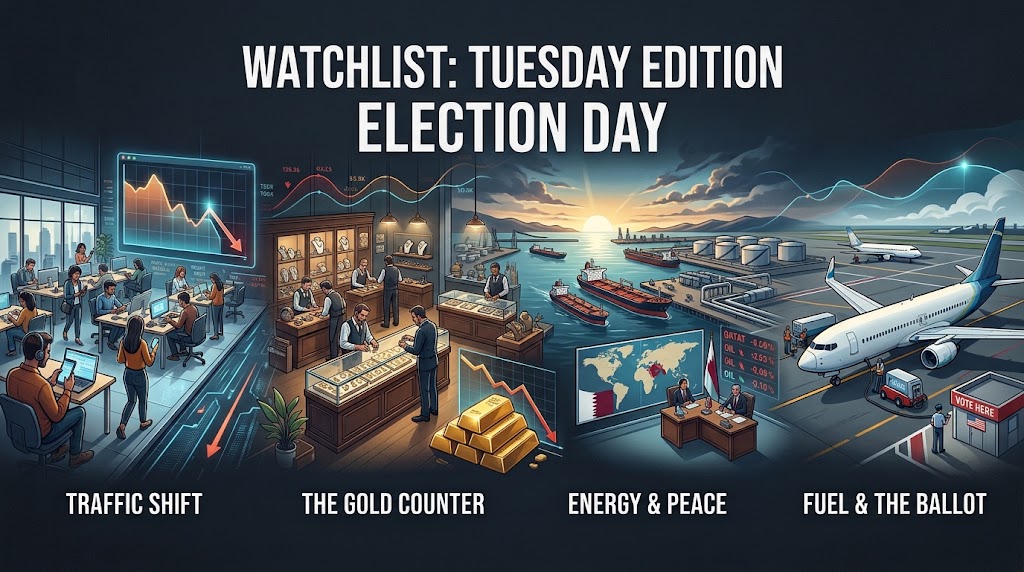
Morning Watchlist: Tuesday Edition
A quick note from Behind the Markets
It's Election Day. The country heads to the polls this morning — but the market, as usual, voted early.
Friday was Wall Street's worst session since June. The S&P 500 fell 1.8%, the Nasdaq 100 dropped 3.5%, and the VIX — the market's fear gauge — jumped 13%. By Monday morning the panic was already burning off: Asian markets bounced, and oil slid 3% on talk of peace in the Gulf.
Here's what we know about panic days: they're repricing days. The crowd marks everything down at once — and somewhere in the pile, it puts the markdown tag on the wrong item. Three stories this morning. Three pairings.
Let's get into it.
1) Google Moved the Sidewalk
Thursday night, Reddit turned in a quarter most companies would frame. Revenue up 53% to $895 million. Earnings of $1.40 a share, up from 80 cents a year earlier. Free cash flow nearly doubled.
Friday, the stock fell 29% — the worst day in its life as a public company — to $91.73. That made eight straight red sessions, down 41% over the streak, and 66% below the record it set last September.
What spooked the crowd was one line. Google search referrals to Reddit fell by more than a million visits a week during October, and CEO Steve Huffman said the quiet part out loud: Google's AI mode, which answers questions right on the results page, "does not drive traffic" to sites like Reddit. The company warned that total daily users could fall by a low-double-digit percentage this quarter.
So the market sold the whole company. But read the next line down. More than 80% of Reddit's money comes from logged-in users on its own app — and while logged-out US visitors fell 9% in a single quarter, logged-in US users have now held steady for six straight quarters.
Reddit is a bar that got its foot traffic from a busy sidewalk — and Google just moved the sidewalk. The tourists who used to wander in are gone. The regulars, the ones who run tabs, come in through their own door. Friday's price treated both crowds as one.
The pairing: Reddit (RDDT) — Watch
At $91.73, Reddit costs about 17.8 times its trailing earnings — the S&P 500: 21 — for a business that just grew 53%, holding $2.8 billion of cash and almost no debt. That's normally the kind of mismatch we buy. So why Watch? Because the warning is real and unresolved: if the regulars start leaving too, cheap was the first symptom, not the sale. The entrance: the January report showing US logged-in users holding while ad prices keep climbing — or a markdown into the $70s that pays us to find out. The kill: logged-in users declining, or Google walking away from the data-licensing renewal that comes due after 2027.
2) The Dairy Farm Trade, Run in Reverse
In August, with gold above $4,500 for the first time in history, we told you gold miners are dairy farms: the cows cost the same, the barn costs the same, so when milk hits a record, every extra dollar falls straight to the farmer's bottom line.
Milk just crashed. On Friday, gold fell 3.5% to just under $3,870 an ounce — a one-year low, down roughly 13% from the record — knocked down by margin calls out of the tech wreck (when stocks fall hard enough, investors sell whatever still has a bid), by rising December rate-hike odds, and by peace talk draining oil's fear premium. By Monday morning it had steadied near $3,906.
That math cuts the farmers both ways. But every market has two sides of the counter, and the other side of the gold counter is simple: somebody buys the stuff by the ounce, every week of the year. The biggest specialty jeweler on Earth — the company behind Kay, Zales, Jared, and Blue Nile — told us in September exactly what record gold was doing to it: eating into its margins even in a quarter it beat.
That bill just got marked down.
The pairing: Signet Jewelers (SIG) — Buy
Signet's September report was already quietly strong: same-store sales up 2%, adjusted operating income of $107 million against $85 million a year earlier, and the full-year profit outlook raised to $10.45–$12.15 a share from $9.20–$11.00 — with $700 million of buyback authority against a $4.4 billion market value. At about $115, the stock trades near 9 times next year's expected earnings. (That's the forward P/E — the price of a dollar of next year's expected profit. The S&P 500: about 21.) Now hand that business the cheapest gold in a year, five weeks before Christmas — the quarter that decides a jeweler's whole year.
The honest warts: this holiday's inventory was bought over the summer at higher gold prices, so the relief lands with a lag, and the squeezed shopper who skipped Halloween candy can skip the jewelry counter too. The kill: gold re-spiking — or a trade-down Christmas that finally reaches the engagement ring.
3) The Barrel Is on the Ballot
While the country votes today, the oil market is watching a different contest. On Sunday, OPEC+ held its December production targets steady — the third straight pause. By Monday, Brent crude had slipped about 3% to near $110. But the real mover wasn't the cartel. It was the peace plan: a Qatari-brokered proposal that Tehran says could reopen the Strait of Hormuz within two days — American measures on day one, ships moving on day two. Washington hasn't answered; the president says he's in no hurry. One strategist warns that if the talks stall after today's midterms, Brent could run toward $120. Goldman Sachs, meanwhile, now sees $105 by December and an $88 average next year.
So who gets paid first if peace actually breaks out? The companies the war has hurt most. Start with the airline that planned this year around jet fuel at $2.50 a gallon and just paid $3.94 — with a fourth-quarter guide of $4.65 to $4.85. Fuel has added $1.8 billion to Alaska Air's costs this year, enough to turn 14% revenue growth and a premium cabin growing 24.5% into a guided full-year loss.
Alaska is a food truck whose propane price tripled mid-season: the line out front never got shorter — every burger just lost money. Propane gets repriced daily. The line doesn't.
The pairing: Alaska Air Group (ALK) — Watch (our third look, after August 26 and September 24)
We watched this one twice last quarter, and both times the fuel bill kept rising — the right call, twice. What's changed: the damage is now fully in the company's own guide, the stock has fallen more than 40% from its high to about $35 — pennies above its 52-week low of $32.33 — and Wall Street's argument about it is the widest in the aisle: JPMorgan's target says $74, Citi says Sell at $33. Management claims $3 to $4 a share of core earnings improvement coming in 2027 regardless of fuel. So why still Watch? A floated peace plan is a poll, not a result — Brazil just reminded us what polls are worth — and Alaska carries 66% debt-to-capital into whichever answer comes. The entrance: Washington taking the deal and tankers actually moving — fuel falling on the invoice, not in a communiqué — or a washout through $32 that pays for the politics. The kill: talks collapsing after the election and Brent running toward $120 against that $4.85 fuel guide.
Before You Go
That's the watchlist. A 30% markdown on a company that grew 53%, the cheapest gold in a year sitting one counter away from the jeweler's Christmas quarter, and an airline priced for permanent war on the eve of a peace plan. One theme this morning: a panic marks everything down at once — the work is finding the tag the crowd stuck on the wrong item.
Housekeeping, because this is the busiest stretch of exam season. Apple reported last night, after we went to press — we'll grade our Cirrus Logic position against it tomorrow, and Cirrus hands in its own paper Wednesday night. Tonight brings AMD's exam (Monday's flu-or-weather question), Jackson Financial's answer to its short seller, and Modine's margin test; Viper's earnings call is this morning. And Friday at 8:30 AM, the October jobs report — roughly 68,000 expected after September's 29,000 — all but settles the Fed's December 9th decision, where a hike is priced near 80%.
Found this helpful? Share it with others.
Written by Behind The Markets