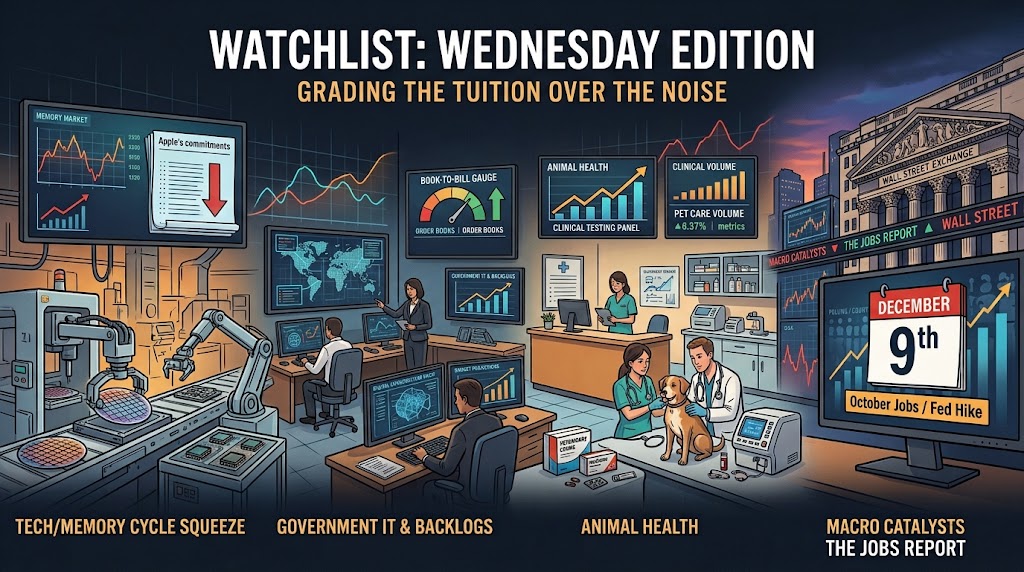
Morning Watchlist: Wednesday Edition
A quick note from Behind the Markets
We went to press before the first polls closed. So this morning you know something we didn't: how the midterms broke. We'll leave the counting to the counters — the market spent Monday telling us it had other things on its mind anyway.
Here's what it was chewing on. In the span of twelve hours, three of the best report cards of earnings season landed. Apple grew revenue 12% to a September-quarter record. Palantir turned in the fastest growth in its history. Leidos beat its profit estimate by 57 cents and raised its outlook for the third straight quarter. Two of those three stocks fell anyway.
The lesson sits in the gap. The market doesn't grade the report card. It grades the tuition. Three stories this morning. Three pairings.
Let's get into it.
1) The Most Expensive Word in Tech
Monday night, Apple reported the quarter Wall Street wanted: $114.5 billion in revenue, up 12%, with iPhone sales up 17% to a September-quarter record of $57.6 billion. Then John Ternus, in his first earnings call as CEO, used one word that cost the stock 4% by Tuesday's premarket.
The word was "unprecedented." That's how he described what's happening to memory-chip prices, as the AI buildout devours the world's supply. Apple expects memory to cost even more in the December quarter, guided its gross margin down — and, here's the part worth reading twice, raised its manufacturing purchase commitments by about $33 billion in a single quarter. (A purchase commitment is a promise to buy: Apple signing contracts now for parts it needs later, before prices climb further.)
So the biggest component buyer on Earth just told you memory prices are rising and that it's paying ahead to lock up supply. Now look at what the crowd did to the company that sells the stuff. Micron — the only American maker of DRAM, the memory at the center of the squeeze — fell 5.8% on Monday to about $834, swept up in the chip selloff, now a third below its high.
The pairing: Micron (MU) — Buy
Micron just closed the best year in its history — $74.33 a share in earnings — and CEO Sanjay Mehrotra says the company expects "an even stronger fiscal 2027." It holds 26 long-term customer agreements backed by roughly $32 billion in commitments, mostly cash deposits, with three-quarters of that revenue under defined pricing frameworks — floors included. This is a wedding venue booked solid through next year, deposits in hand, being offered at the price of an empty hall. At about $834, the stock costs roughly 11 times those record earnings. The S&P 500: 21.
The honest risk is the oldest one in semiconductors: cyclical stocks look cheapest right at the top, and Intel's PC warning plus Apple's margin wince are the sound of customers straining under these prices. The kill: device makers cutting orders instead of paying up, turning record earnings into last cycle's earnings. The deposits and price floors are why we think this cycle's floor sits higher than the crowd fears. (We've owned this squeeze from the storage aisle since October 25th, through Western Digital. Micron is the purer claim on it.)
2) A Perfect Report Card, Marked Down
Also Monday night, Palantir printed the best quarter of its life. Revenue up 96% to $2.31 billion. US commercial revenue up 148% — overtaking its government business for the first time ever. Operating margins of 62%. Guidance raised again.
By Tuesday's premarket, the stock was down about 8%, more than 20% below its record.
What spooked the crowd was a line further down the page. Total contract value — the paperwork that becomes future revenue — grew just 6% this quarter, after growing 49% last quarter. Revenue is now running ahead of new signings. And at Monday's close, Palantir cost about 126 times its trailing earnings. At that price, slowing paperwork is a five-alarm fire. Which raises the question we ask every time the crowd pays any price for a story: who does the same work for a tenth of the tuition?
Tuesday morning, one answer reported in.
The pairing: Leidos (LDOS) — Buy
Leidos is one of the largest government-IT contractors in America — same customer as Palantir's biggest, same AI-modernization budget, very different price tag. Palantir is the celebrity architect of the government's renovation; Leidos is the general contractor on the same job site. The architect gets the magazine covers. The contractor bills the hours either way.
Tuesday's report: earnings up 19%, a dividend raised 4.7%, $5.5 billion in new bookings — $1.20 of new work signed for every $1.00 billed (that ratio is called book-to-bill; above 1, the order book fills faster than it empties) — and funded backlog up 22%. Third straight quarterly guidance raise, with a share count that keeps shrinking. At roughly $140, Leidos costs about 11 times this year's expected earnings. Palantir: 126 times trailing. The honest warts: strip out acquisitions and revenue grew less than 1%, and the health segment shrank 12%. The kill: organic growth never showing up — a contractor that only grows by buying other contractors eventually runs out of houses to buy — or a budget fight that freezes the government checkbook.
3) The Dog Eats First
Quietly, one of Monday's biggest winners anywhere in the market wasn't an AI stock. IDEXX Laboratories — the company behind the blood panels and diagnostics at your vet's office — jumped 22% after beating estimates and raising its full-year outlook. The drivers, in the company's own telling: aging pets and more testing per visit, even as clinic traffic slows.
Read that as a market signal, because it is one. Household budgets shrink from the outside in — the streaming service goes first, the restaurant goes next, and the dog's medicine goes last. IDEXX just showed you where pets sit on the ladder.
Now walk one counter over. Zoetis — the largest animal-health company in the world, maker of Apoquel for itch and Simparica Trio for fleas, ticks, and heartworm — has lost 46% of its value in a year. Same waiting room, opposite stock chart. The difference: Zoetis feels those slower clinic visits in its own registers, it cut its outlook earlier this year as rivals crowded its two biggest franchises, and the Street expects earnings down 11% when it reports Thursday morning.
The pairing: Zoetis (ZTS) — Watch
At about $80, Zoetis costs roughly 13 times this year's guided earnings — the S&P 500: 21 — for a franchise the market priced like a luxury good for a decade. Ten of seventeen analysts sit on Hold, with the average target near $96. So why not buy before Thursday? Because IDEXX proved the pet owner is still paying — it didn't prove they're paying Zoetis. The entrance: Thursday's report showing companion-animal volumes stabilizing, or another markdown that pays us to wait out the competition question. The kill: a second guidance cut, or rivals eating Apoquel faster than the puppies age into Simparica.
From the Ledger
On Sunday we wrote that a supply-chain leak is the neighbor telling you the bakery cut its flour order — and that Monday night, the baker speaks. He spoke. A record iPhone quarter and a holiday guide of 7-to-10% growth is about as far from the feared 15-to-20-million-unit cut as a report can get. The trouble Apple flagged — memory prices — squeezes Apple's margin, not its suppliers' order books. Our Cirrus Logic position (bought September 2nd, reaffirmed Sunday) carries the thesis into Cirrus's own report tonight, where the Street wants about $540 million in revenue. We'll grade that paper Friday.
Before You Go
That's the watchlist. The world's biggest component buyer paying ahead while the seller's stock goes on sale, a 96% grower priced for perfection next to an 11-times contractor on the same job site, and fresh proof that the dog eats first. One theme this morning: the market doesn't grade the report card — it grades the tuition.
The exam calendar stays crowded. AMD, Jackson Financial, and Modine all handed in papers Tuesday night — we'll grade them, and Monday's AMD Watch, in tomorrow's note. McDonald's reports this morning, carrying the traffic number our Lamb Weston fry thesis runs on, with CVS alongside and Expedia tonight. Zoetis sits its exam Thursday, Brookdale too. And Friday at 8:30 AM, the October jobs report gets the last word before the Fed's December 9th meeting — all while a newly counted Congress figures out its seating chart.
Found this helpful? Share it with others.
Written by Behind The Markets