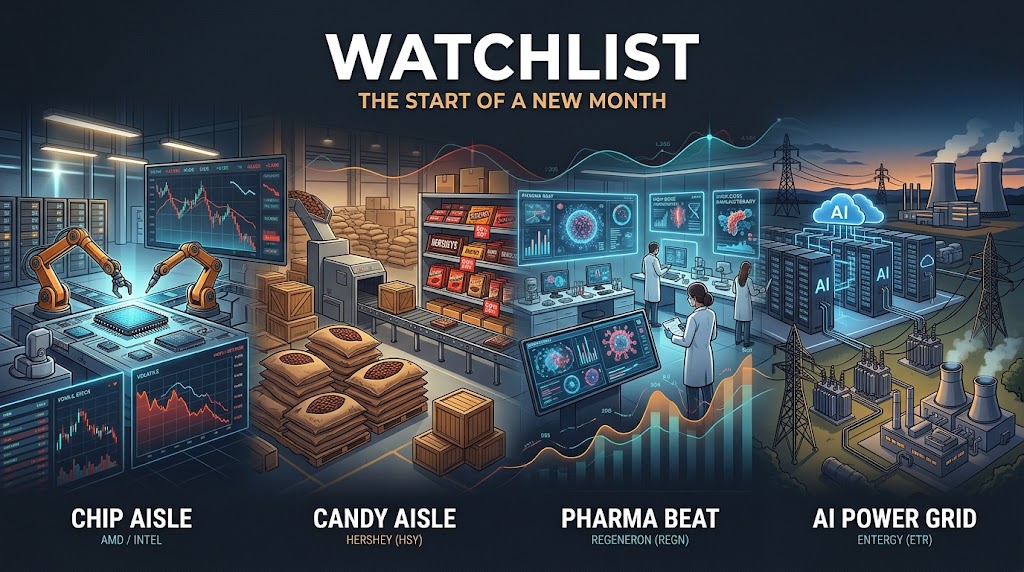
It's the start of a new week and a new month. The leftover Halloween candy is half price this morning — and oddly enough, that's the most useful market signal on the shelf. More on that in a minute.
First, the pattern we couldn't stop noticing as October wound down. Thursday night, Intel grew revenue 21% — and by Friday's premarket, the stock had been marked down 25%. Thursday morning, Hershey beat profit estimates by 25% — and fell anyway. Friday morning, Regeneron beat by nearly as much — and jumped 12%.
Same week. Same kind of beat. Three different grades. The difference was which line the crowd bothered to read. Four stories this morning. Four pairings.
Let's get into it.
1) Intel Grew 21% and Lost a Quarter of Its Value
Thursday night, Intel reported two companies wearing one ticker.
Company one is the data-center and AI business: $7.3 billion of quarterly sales, growing 78% on the same buildout we've been tracking all month. Company two is the PC chip business, still Intel's biggest room, where sales fell 5% and the CFO said the slowdown should run at least through the first half of next year.
Then came the guide. After earning 60 cents a share in the third quarter, Intel told Wall Street to expect a dime in the fourth. Friday's premarket took a quarter of the company's value for it.
So the question that decides the whole chip aisle this week: is the PC slump Intel's flu, or the street's weather? We have a suspicion — the same memory squeeze that's been raising iPhone prices is raising PC prices, and shoppers are balking — but a suspicion isn't an answer. Tuesday night, we get one. AMD, which sells chips into both rooms, hands in its own paper.
The pairing: Advanced Micro Devices (AMD) — Watch
If the slump is weather, AMD's PC segment catches the same cold Tuesday night. If it's Intel's flu, AMD spends next year taking share from a wounded rival. So why not just buy it? The ticket. At about $550 as of Tuesday, AMD trades near 50 times forward earnings (the S&P 500: 21) after more than tripling from its March low to an October record. Paying that to learn Tuesday's answer is buying scalper seats to a game that might get rained out — and this stock already slid roughly 12% in one mid-October week when the crowd worried about how AI gets financed, something AMD is personally involved in. The entrance: the market pricing Intel's PC problem into AMD's data-center engine — a contagion markdown that confuses the two rooms. The kill: AMD's own PC numbers proving it's the weather.
2) The Candy Aisle Is Half Off. So Is the Stock
Here's the strange thing about that discount candy shelf: cocoa — the bean all of it is made from — has also been marked down by roughly half this year. Chocolate prices never followed it down.
Thursday morning, Hershey showed you where the difference went: into the gross margin — 46 cents of every sales dollar, up from 33 a year earlier. Earnings came in at $2.64 a share against the $2.11 expected, the fifth straight quarter over the bar, and the company raised its full-year profit outlook.
The stock fell about 1% anyway, to around $162 — within sight of its 52-week low, down from $239 at the high. The crowd is reading the other line: two years of price hikes (11 points of pricing last quarter) have cost Hershey volume (10 points of it), industry Halloween candy sales were running nearly 7% below last year by mid-October, and CEO Kirk Tanner allowed that "financial pressures could shape final purchase decisions." A ghoulish thing to have to say during Halloween week.
But think about what cheap cocoa actually is. A pizzeria whose cheese bill just got cut in half doesn't need a single new customer to make more money — and if it trims the price of a slice, it gets the customers too. Margin now, ammunition later. Hershey is already reaching for the ammunition, saying it will put more real chocolate back into its recipes as cocoa falls.
The pairing: Hershey (HSY) — Buy
At roughly 19 times next year's expected earnings (the S&P 500: 21) with a 3.5% dividend, Wall Street rates it a Hold — 16 of 25 analysts on the fence, average target near $201. That's often exactly the crowd you want to be early against. The honest warts: part of the quarter's margin jump was one-time help — tariff refunds and hedging gains, not just cheap beans — and the sales outlook was trimmed to the low end of its range. The kill: cocoa re-spiking on a bad West African crop, or volumes still shrinking a year from now after the price hikes have lapped.
3) The Plane With One Engine "On Fire"
For two years the market has priced Regeneron like a plane with an engine burning. The engine is Eylea, its blockbuster eye drug, and the fire is real: original Eylea's U.S. sales fell 41% last quarter, to $400 million, as Amgen's cheaper copycat took share.
Friday morning, we got the rest of the story. Revenue rose 36% to $5.1 billion against the $4.56 billion expected. Earnings per share came in at $20.07 — the Street wanted $16.25. The burning engine got rebuilt mid-flight: a higher-dose version of Eylea replaced nearly the whole decline, leaving combined U.S. Eylea sales down just 1%. And the other engine is roaring — Dupixent, the eczema-and-asthma blockbuster Regeneron shares with Sanofi, grew worldwide sales 35% to $6.5 billion in the quarter. Management raised its full-year outlook and expanded the Sanofi partnership, with $1 billion up front for four new antibodies.
The stock jumped 12% Friday morning, from about $815 before the report.
The pairing: Regeneron (REGN) — Buy
Even after that pop, Regeneron costs roughly 14 times next year's expected earnings. The S&P 500: 21. That's a clearance price for one of the most productive drug labs in America — a company that just grew earnings 70%. The honest risks: the Sanofi collaboration's accounting flattered this particular quarter, and the company now leans harder on one drug, Dupixent, whose patent clock is the next decade's big question. The kill: Dupixent's growth stalling, or the biosimilars winning the Eylea fight after all.
4) The Water Company in the Boomtown
Thursday night, Amazon told us its cloud business — nearly three times the size it was in 2021 — is growing as fast as it did in 2021: 39%. The AI buildout's bill keeps climbing. On Friday we paired the heat all that computing throws off. Today, something even simpler: every one of those chips has to plug into a wall.
Nowhere is the wall more interesting than Louisiana, where Meta is building a data-center campus in Richland Parish reported at $27 billion — with regulatory hearings putting its peak power demand at 4,500 megawatts. The local utility, Entergy, is fast-tracking ten new gas plants to feed it. And Entergy reports earnings this morning.
A regulated utility is the water company in a gold-rush town: it doesn't matter whose claim pays off — every bathhouse pays the meter. And the faster the town grows, the bigger the pipes the water company gets paid to lay.
The pairing: Entergy (ETR) — Watch
At about $108, Entergy costs roughly 23 times next year's expected earnings with a 2.4% dividend — rich for a utility, and that's the first reason for the Watch. The second is the fight that decides everything: consumer advocates are in court over who pays for those ten plants if the boom disappoints — Meta's contract, or Louisiana families' power bills — and analysts spent October trimming targets while they wait. The entrance: this morning's report and the Louisiana docket showing the Meta contract clearly shielding regular ratepayers. The kill: regulators pushing the buildout's costs onto shareholders, or the campus itself slowing with the AI trade.
Before You Go
That's the watchlist. A chipmaker graded on its emptiest room, a candy maker rated Hold on its fattest margin in years, a drug lab that put out its own engine fire, and the company that owns the wall sockets under the AI boom. One theme this morning: the crowd reads the headline number; the money is usually one line below it.
Tonight after the close, the week's biggest report cards land — Apple above all (we placed our bet Sunday, through Cirrus Logic). Tuesday, the country votes and AMD takes its exam. From our own ledger, Viper hands in its paper today and Modine sits its margin test Tuesday.
Found this helpful? Share it with others.
Written by Behind The Markets