Morning Watchlist: Sunday Edition
A quick note from Behind the Markets
It's Sunday morning, and the week in front of us is the loudest one on the fall calendar. Tuesday, before most people finish their coffee, four of the biggest banks in America report earnings — and so does the biggest health insurer. Wednesday brings the September inflation report. Thursday, the company that manufactures the AI boom hands in its report card from Taiwan. Even the bond market, the source of most of October's trouble, only gets Monday off for the holiday.
When this much news lands in one week, the temptation is to bet on the loud names doing the reporting. We'd rather stand one step behind each headline and ask who gets paid quietly. Three stories this morning. Three pairings. Let's get into it.
1) Four Banks Walk Into a Tuesday
Earnings season opens Tuesday around 7 AM with JPMorgan — Wall Street wants about $5.83 a share on roughly $50.6 billion of revenue — followed the same morning by Goldman Sachs, Wells Fargo, and Citigroup, with Bank of America and Morgan Stanley on Wednesday. The Street will grade the usual lines: lending margins at a 3.75%–4.00% Fed, trading desks JPMorgan has guided up mid-to-high teens, investment-banking fees Bank of America has already warned could fall 10% to 20%. Our Goldman Buy from October 2nd takes its first exam Tuesday.
But the page we'll read first is the quiet one: provisions. September produced 29,000 jobs against the 85,000 or so expected, with unemployment up to 4.2%. The question for every bank CFO is whether that softening means bigger set-asides for credit card and auto loans that won't come back.
Here's the step-behind-the-headline part. When a bank finally gives up on a credit card loan, it doesn't vanish. The bank charges it off — and sells it.
Think of a charged-off loan as a totaled car. The insurer writes the check and hauls the wreck to the junkyard — which pays pennies on the dollar, because the junkyard knows something the insurer stopped caring about: some of those cars still run.
The pairing: Encore Capital Group (ECPG) — Buy
Encore, through its Midland Credit arm, is one of the largest buyers of charged-off consumer debt in America. It buys the loans banks have given up on for cents on the dollar, then works with borrowers — payment plans, settlements — to collect what it can. The more credit stress the banks confess Tuesday, the more wrecks roll toward Encore's lot, and heavier supply means better prices for the buyer. The raw material is already piling up: card charge-off rates ran 3.84% in the first quarter against $1.34 trillion of revolving credit, and management expects supply to stay rich.
The business is humming — record second-quarter collections of $737 million, up 13%, portfolio purchases up 21%, a raised full-year collections forecast. A May refinancing saves about $50 million a year in interest, no significant debt comes due until 2028, and leverage sits at the low end of the company's own target.
At Thursday's close of $100.06, this $2.1 billion mid-cap trades at about 7 times next year's expected earnings. The S&P 500: 21 times. All four covering analysts say Buy, average target near $116.
The honest flags: we are not early — the stock is up roughly 150% from its 52-week low of $39.95 and sits about 5% below its high. And the kill switch lives inside the thesis: the same weak labor market that fattens Encore's supply can thin its collections. Cheap paper is only cheap if people eventually pay.
2) The Biggest Grocery Bill in Healthcare
The same Tuesday morning, UnitedHealth reports. Wall Street expects about $4.12 a share on roughly $111 billion of revenue, and the options market is braced for a move of about 8% either way. The number everyone will squint at is the medical care ratio — the share of premiums paid back out as actual care. Last quarter it was 86.7%, much improved from 89.4% a year earlier; Tuesday tests whether the improvement held. The stock, $378.58 at the most recent close we could verify, sits about 18% below its July high.
Now flip the page over. Every dollar an insurer calls a "medical cost" is a dollar somebody else calls revenue. When your landlord complains about the heating bill, the utility isn't complaining.
The pairing: Tenet Healthcare (THC) — Buy
Tenet runs dozens of hospitals and, through its USPI arm, one of the largest networks of outpatient surgery centers in the country — where knees, hips, and cataracts actually get fixed. We made the demand argument with Zimmer Biomet on September 15th: care that compounds with every birthday can be deferred, but it doesn't get canceled. Tenet is where the deferred appointments eventually walk in, and its receipts show it — second-quarter adjusted earnings per share up 52%, adjusted EBITDA up 16%, and a raised full-year forecast for revenue, profit, and free cash flow.
At Thursday's close of $260.57, Tenet trades at about 12.4 times next year's expected earnings, roughly 10 times trailing. The S&P 500: 21. Twenty-three analysts lean Buy with an average target near $285; the company reports its own quarter October 29th.
The honest risks: Tenet priced $2 billion of new notes in September to refinance older debt — hospitals are borrowing businesses in a 5% world. Reimbursement is set in capitols, not on earnings calls — the Addus lesson — so one budget fight can reprice a year of work. And short term, the aisle moves with Tuesday's headline: if UnitedHealth blames hospitals for its costs, hospital stocks can wobble on the insurer's complaint. That's a markdown on the utility because the landlord grumbled. The kill: surgical volumes stalling while the debt bill runs.
3) The Report Card Comes From Taiwan
On Thursday, TSMC — the foundry that manufactures the chips for Nvidia, Apple, AMD, and nearly everyone else in the AI race — showed its hand early: its monthly sales releases put third-quarter revenue at a record NT$1.49 trillion, about $46.7 billion, up 50% from a year ago and ahead of estimates. The full report, with margins and the all-important capital-spending outlook, lands this Thursday. ASML, whose machines etch the chips, reports Wednesday.
The crowd will spend the week handicapping the famous names. We've spent the quarter collecting tollbooths one step behind them — inspection, implant, etch. Here's the most overlooked job in the whole factory: cleaning.
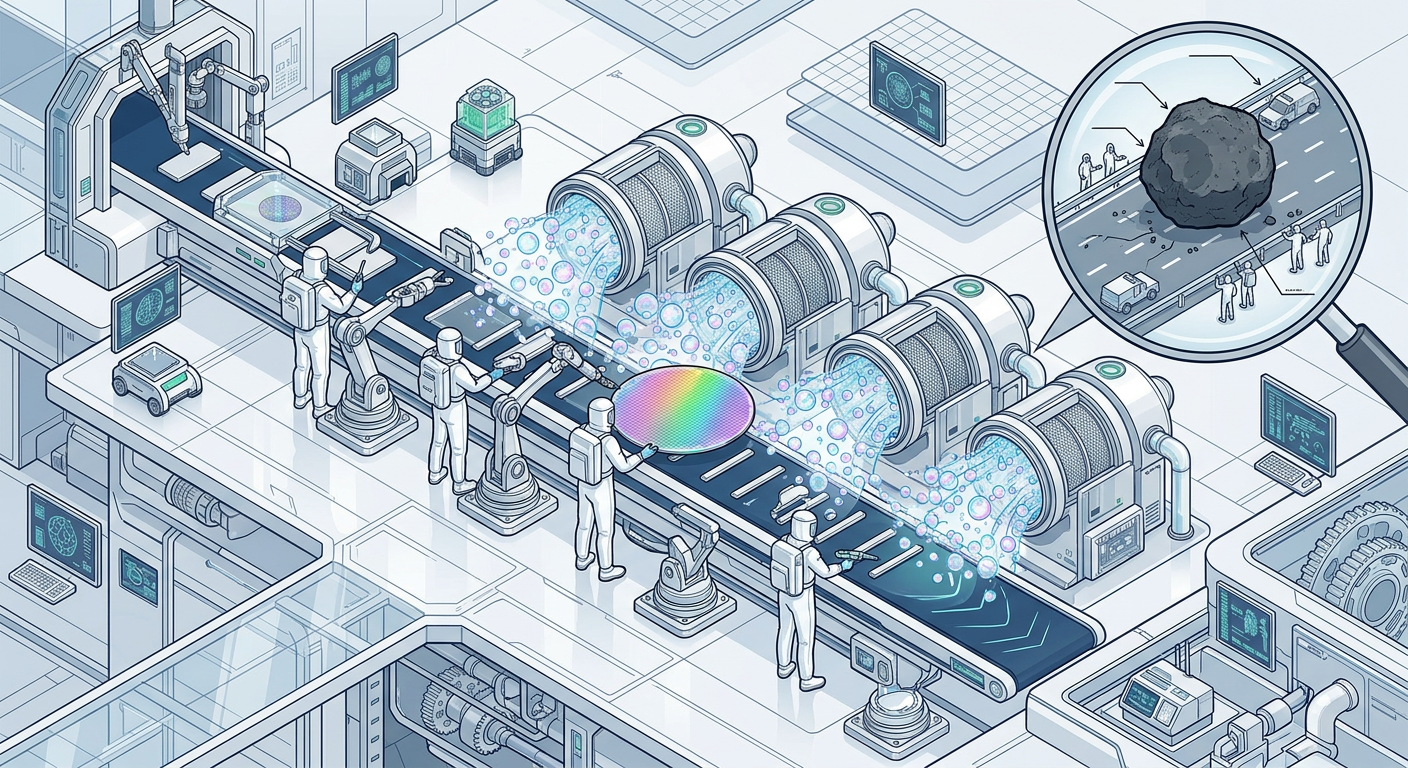
A chip fab is the cleanest place humans have ever built. At the scale of a modern transistor, a speck of dust is a boulder on the highway, and every wafer is washed, filtered, and handled thousands of times on its way to becoming a chip. Entegris sells the filters, the ultrapure chemicals, and the specialized containers that make that possible — the soap and the Tupperware of the chip industry — paid per wafer, whoever's logo ends up on the finished product.
The pairing: Entegris (ENTG) — Watch
The business is fine: second-quarter revenue of $883 million beat estimates, earnings beat by a dime, and this quarter is guided to $905–935 million. Stifel started coverage Thursday with a Buy and a $200 target.
So why Watch and not Buy? The ticket price. At Thursday's close of $162.19, Entegris costs about 36 times next year's expected earnings — 81 times trailing — against the S&P's 21, for a business whose trailing-year revenue grew about 3%. The stock is up some 86% this year; this is the Curtiss-Wright and Lam Research shape — a wonderful aisle, priced for the boom. The entrance: the October 29th report converting TSMC's record wafer starts into a raised forecast of its own, or a markdown toward the mid-$130s, where the multiple compresses toward 30. The kill: an AI-capex retrench — the Oracle creak we've watched since September — marking down wafer volumes across the whole industry.
Before You Go
The week's biggest moment comes Wednesday at 8:30 AM: the September inflation report. Forecasters expect the headline near 3.6%–3.7%, pushed up almost entirely by energy — this is what a Gulf war does to a price index — while core holds near 2.4%. That gap is the whole argument. The Fed meets October 27th and 28th; after the soft jobs report, market odds of a hike fell to roughly 17%, yet the September minutes showed most officials still penciling one more in. A hot core number puts the hike back on the table and re-marks everything on this page that borrows or trades at a premium; a cool one leaves the long end arguing about supply. Thursday adds producer prices and retail sales — the first full read on the trade-down shopper since the holiday fire drill. And Friday morning, Delta opened airline earnings with the split our Copa and AAR calls are built around: revenue up 16%, premium cabins up 18%, corporate travel strong — and fuel up 60% a gallon doing the squeezing. Demand is holding. Fuel is the villain.
That's the watchlist: the junkyard that gets busier the more the banks confess, the hospital on the other side of the insurer's grocery bill, and the soap seller to the cleanest rooms on Earth — at an entrance we'll name but not chase. One theme, as always: the best opportunities stand one step behind the headline.
Found this helpful? Share it with others.
Written by Behind the Markets