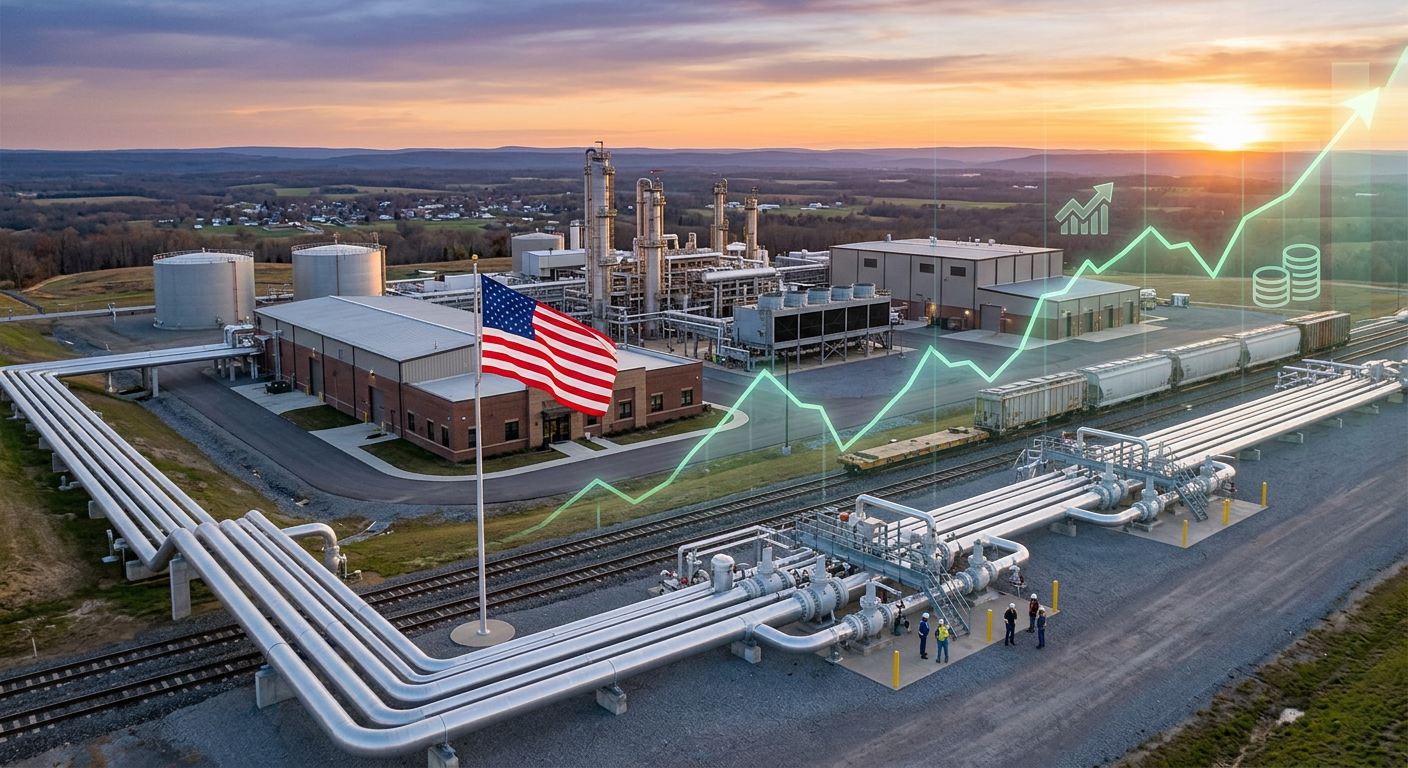
The Quietest Megatrade in the Market: U.S. LNG Is Becoming an Export Machine
A quick note from Behind the Markets
Everyone's trading AI headlines.
Meanwhile, a real-world buildout is happening in plain sight — and it's the kind of story retail investors can actually get ahead of.
U.S. LNG is turning into a long-duration export machine.
And the best part? It's not a "hot money" trade.
It's infrastructure.
1) The U.S. is already the top exporter — and capacity is set to surge again
The Energy Information Administration says the U.S. is already the largest LNG exporter in the world with 15.4 Bcf/d of liquefaction capacity.
They also flag planned additions of 13.9 Bcf/d between 2025 and 2029 — enough to more than double U.S. capacity.
Zoom out and it's even clearer: North America's export capacity could rise from 11.4 Bcf/d at the beginning of 2024 to 28.7 Bcf/d by 2029 — accounting for over half of all expected global additions through the end of the decade.
This is not a "one quarter" story.
It's a multi-year wave of steel-in-the-ground spending.
And the company sitting at the center of it has already built the moat.
Company: Cheniere Energy (SYM: LNG) Largest U.S. LNG exporter; operates the Sabine Pass and Corpus Christi terminals on the Gulf Coast
Cheniere isn't a hopeful developer with a permit and a press release. It's the established king — operating roughly 45 million tonnes per annum of LNG capacity across two massive Gulf Coast terminals, with more trains under construction. And here's what makes it a real business instead of a commodity bet: the bulk of its capacity is locked into long-term, take-or-pay contracts where customers pay fixed fees whether they lift the gas or not.
The numbers reflect that durability. Full-year 2025 revenue came in at $19.5 billion, with earnings up 63%. Cheniere is expanding Sabine Pass, just signed a major construction contract with Bechtel, and continues to buy back stock and pay a growing dividend.
LNG is currently trading around $266, with an average analyst target near $302. The stock isn't cheap on headline multiples — but you're paying for the most contracted, most proven export platform in the country, in the middle of a buildout that runs through 2029 and beyond.
When the world wants American gas for the next decade, this is the company already shipping it.
Bottom line: LNG is a long-duration capex cycle. That means years of contracted demand for equipment, engineering, pipelines, and services — not just for the terminal owners.
2) The second-order trade: the bottleneck is pipelines, not molecules
Everyone talks about gas supply.
But the hard part is moving gas to the coast on time.
EIA explicitly notes that to supply these terminals, new pipeline projects will be built — and that pipeline construction delays are a key risk.
That's your roadmap.
When a mega-project slips, the market blames "energy." But the actual winners and losers are in the plumbing: pipe and compression, permitting specialists, right-of-way and construction services, niche materials and coatings.
And yes, the boring midstream names with fee-based cash flows.
There's one that owns the single most important gas highway in the country.
Company: Williams Companies (SYM: WMB)
Natural gas infrastructure giant; operates the Transco pipeline carrying ~15% of U.S. gas
Williams owns Transco — a 10,000-mile interstate pipeline running from south Texas to New York City that moves roughly 15% of the nation's natural gas. That asset is effectively irreplaceable; you cannot get a new pipeline of that scale permitted and built today. As LNG terminals along the Gulf Coast ramp up, the gas to feed them has to flow through systems like Williams'.
The business is firing on all cylinders. Q1 2026 GAAP net income rose 25% to $864 million. Williams has 13 pipeline projects underway with a deep backlog, raised its dividend to $2.10 annualized (yielding around 2.8%), and management is openly tying its growth to surging gas demand from both LNG exports and AI data centers.
WMB is currently trading around $76, near its 52-week high, with analyst targets ranging up to $98. It's returned roughly 35% over the past year. This is the fee-based, contracted, toll-road side of the energy trade — the one that gets paid on volume, not on the price of gas.
The molecules get the headlines. The pipes get the cash flow.
Bottom line: If you only look at LNG terminal developers, you're late. The better asymmetric trade is the infrastructure chokepoints that have to get built.
3) Why this matters for geopolitics: LNG is the West's supply-chain weapon
In a world where energy is a strategic weapon, LNG is a supply-chain shield.
Europe learned the hard way.
Asia is watching.
And the U.S. is about to sell "energy security" the way it sells defense hardware.
That means demand isn't just "market demand." It's policy demand. Which tends to be stickier.
You can see it in the contracts already being signed: 20-year purchase agreements with the national oil companies of the UAE, Saudi Arabia, and major European buyers — deals measured in decades, not quarters. That's not a trader betting on next month's spot price. That's a government locking in supply for a generation.
If you want exposure to the whole theme — producers, midstream, and the natural gas value chain — rather than betting on a single terminal, there's a clean basket.
ETF: First Trust Natural Gas ETF (SYM: FCG)
Equity ETF tracking mid- and large-cap U.S. natural gas producers and midstream companies
FCG holds the companies across the natural gas chain — exploration and production names plus midstream operators that derive a substantial portion of revenue from gas. It's a way to own the broad buildout without having to pick which terminal, which pipeline, or which producer comes out ahead.
FCG is currently trading around $30, with a 52-week range of roughly $21 to $33 and an expense ratio of 0.60%. As policy demand for American gas hardens into multi-decade contracts, the producers filling those contracts — and the midstream firms moving the gas — sit inside this fund.
When energy becomes statecraft, the buildout stops being cyclical and starts being structural. That's a longer runway than Wall Street's models usually price.
Bottom line: LNG is becoming part of the geopolitical toolkit. That's why the buildout is bigger than Wall Street's short-term models.
Before You Go
When the story is obvious, the trade is crowded.
Right now, the LNG headline trade is getting attention.
But the infrastructure trade is still under-owned.
That's where independent investors can get paid.
Found this helpful? Share it with others.
Written by Behind the Markets