Morning Watchlist: Tuesday Edition
A quick note from Behind the Markets
Last week belonged to the central bankers — a Fed hike Wednesday, a Tokyo hike Friday. This week belongs to two presidents. On Thursday, President Trump hosts Xi Jinping in Washington, with tariffs, critical minerals, and artificial intelligence all on the table. Treasury Secretary Scott Bessent called the weekend's preliminary talks with Beijing's top economic negotiator "very successful" and floated a formal U.S.–China dialogue on AI.
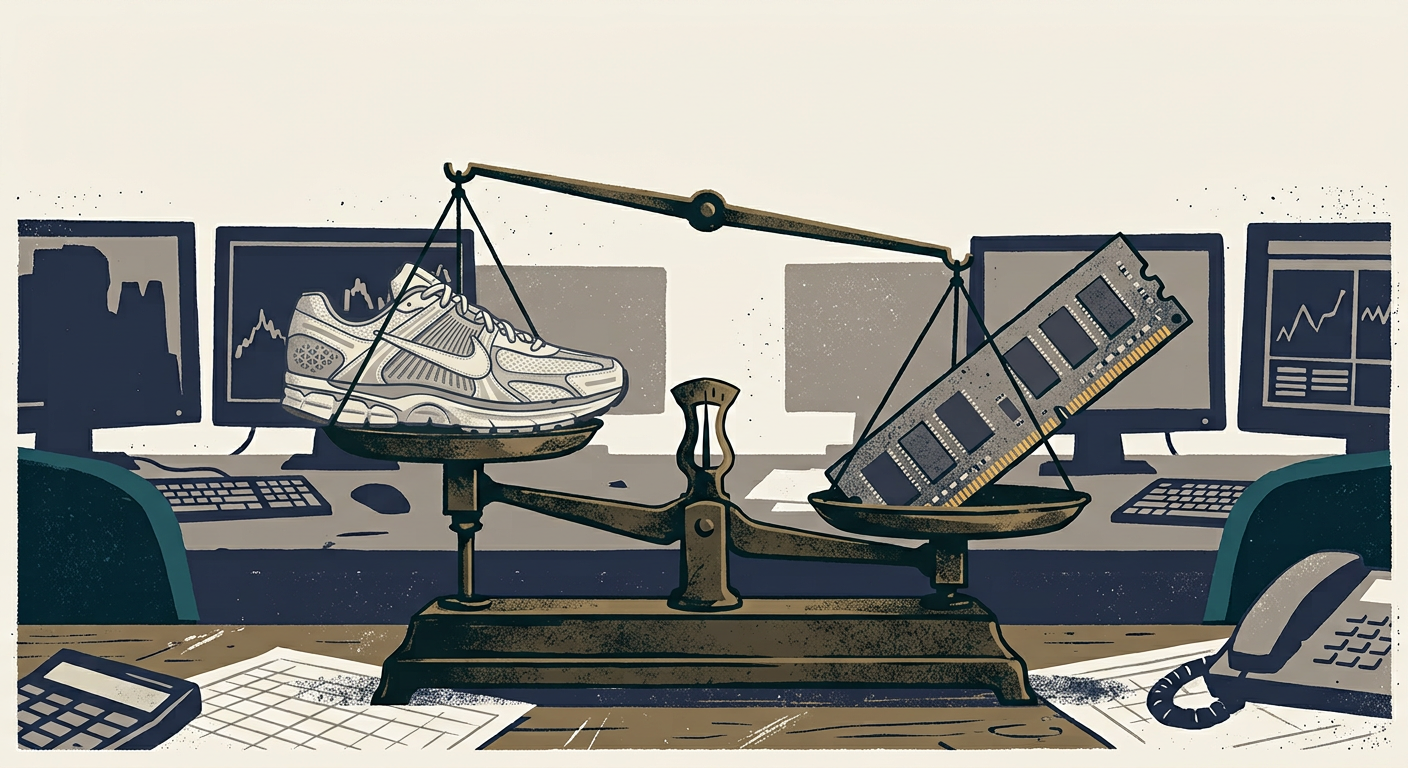
While the crowd handicaps the summit, an index committee already made the trade of the week: as of Monday's open, the S&P 100 — the bluest-chip list in America — dropped Nike after 18 years and added SanDisk, a memory-chip maker.
It traded sneakers for silicon. We'll take both sides of that swap this morning. Three stories. Three pairings. Let's get into it.
1) The Deliverable Already on the Barge
Start with what the summit crowd is trading. Every headline about critical minerals whipsaws the rare-earth stocks — up on export curbs, down on thaw hopes, sometimes both in the same week. Even the dinner guest list — Nvidia's Jensen Huang, OpenAI's Sam Altman, former Apple chief Tim Cook — is a bet on what might be agreed Thursday.
We'd rather own what's already been delivered. As part of last year's trade agreement, China pledged to buy 25 million tons of U.S. soybeans a year through 2028. Ahead of the summit, Beijing has been paying up in public: nearly 13 million tons booked this season — past the halfway mark — including more than a million tons in one week this month. Chicago soybean futures have climbed to their highest levels since 2023 — right as the combines roll into harvest.
So who wins when all that grain has to physically move from the Midwest to the water?
The pairing: The Andersons (ANDE) — Buy
The Andersons has been standing between American farmers and their buyers since 1947: grain elevators and merchandising across the eastern corn belt, a plant-nutrient business, and a renewables arm that just posted record results on strong ethanol exports. The elevator is the cash register of the farm belt — whatever two presidents agree to, the bushels ring through somebody's scale on the way to the river.
The numbers: a $2.3 billion company that earned $5.17 a share over the past year, more than double the year before. At Friday's close of $69.59, that's about 12 times next year's expected earnings. The S&P 500: about 21 times. The analyst consensus is Strong Buy with an average target of $88.33, and the stock actually slipped 3.4% Friday even as the beans rallied — a small gift, as far as we can tell.
Honest flags: the stock has already run about 85% off its 52-week low, merchandising earns pennies per bushel, and the buying behind this story is political — if Thursday sours, it can stop as fast as it started. That's the risk we're paid to take at 12 times.
2) Five Times. Maybe Seven.
Now the other side of Monday's index swap. On Friday the Philadelphia Semiconductor Index jumped 2.78% — led not by AI logic chips, but by memory. SanDisk soared nearly 11% ahead of its S&P 100 promotion. Western Digital gained 4%. Micron — our September 15th Buy — rose almost 4% more, above our flag.
The Wall Street Journal's headline said it plainly: memory stocks are surging because the shortage is expected to worsen. Intel's CEO put a number on the pain this month — memory prices have risen to "5 to 7 times their previous levels" as manufacturers shovel capacity toward servers and high-bandwidth memory — and TrendForce sees another double-digit DRAM price rise this quarter. We've said it since September 3rd: the memory bill is the AI boom's quietest tax.
SK Hynix alone is building $38 billion of new memory plants, and every one of those clean rooms has to be filled with machines. We already own the inspection line through Onto Innovation. Who sells the other unavoidable tool?
The pairing: Axcelis Technologies (ACLS) — Watch
Axcelis makes ion implanters — with Applied Materials, essentially a duopoly. Before a chip can do anything, charged atoms must be planted into the silicon, row by row. The implanter is the seed drill of the chip farm: nobody harvests until somebody plants. And DRAM fabs are heavy users.
The setup: a $3.4 billion company at $109.32, about 44% below its 52-week high after the electric-vehicle chip slump crushed its power business. Second-quarter revenue and earnings beat, guidance went up, and management expects memory demand to grow strongly into 2027 — it's building a new facility in Pyeongtaek, Korea, memory's home turf.
So why Watch and not Buy? The order book hasn't inflected — bookings have been flat for three straight quarters, and management calls memory "slightly lumpy" until the new clean rooms open. And China was 46% of last quarter's revenue, which puts Thursday's summit on half the income statement. Our entrance: memory showing up in the bookings line, or a pullback toward the low $90s. The kill: a summit blow-up that hits the China business, or the EV slump deepening.
3) The Day Nike Got Cut From the Team
And now the seat SanDisk took. Nike leaves the S&P 100 — the market's hundred bluest chips — after 18 years. (It stays in the S&P 500: a demotion, not an expulsion.) From its 2021 peak, Nike has lost roughly $200 billion of market value — a 78% fall — and it closed Friday at $35.51, one penny above its 52-week low.
It's a famous restaurant losing its Michelin star: the food didn't change that night, but every guidebook reprints without it and the tour buses reroute.
We've circled this wreck all quarter. On August 27th we flagged Dick's Sporting Goods and wrote that the tell on the industry's promotion wave was Nike's next report. On August 30th we told you to watch Lululemon's knife rather than catch it — it kept falling, and waiting cost nothing. Nike's next report now has a date — Thursday, October 1st — and a desperate price tag.
The pairing: Nike (NKE) — Watch
Here's what the desperation buys you: a 4.6% dividend yield — from Nike — and a stock at about 17 times last year's earnings. But look closer. Nike's forward P/E is about 21 — higher than the trailing 17. That inversion only happens when Wall Street expects profits to keep shrinking. Cheap against the past, full price against the forecast.
The forecast has reasons: revenue fell 2% last fiscal year, Greater China sales have declined eight straight quarters — down 17% in the latest — and the direct-to-consumer bet went backwards while Hoka, On, Anta and Li Ning kept taking share. Forbes argues the index exit "may mark capitulation" — and forced selling does create honest counterparties, as we wrote about The Trade Desk. But capitulation is a condition, not a catalyst. Our entrance: the October 1st report showing inventories clean, gross margins stabilizing, and China's decline moderating — evidence this is cycle-broken, not brand-broken. The kill: another guide-down or a fresh China leg lower. Until the swoosh proves it can hold a floor, we watch the greatest brand in sports the way we watched Lululemon: with our hands in our pockets.
Before You Go
That's the watchlist: the grain scale ringing up Beijing's down payment, the seed drill of the memory-chip farm, and the fallen blue chip with a report-card date. One theme, as always: the best opportunities stand one step behind the headline.
A few notes off Monday morning's tape. Oil slipped — WTI near $98, Brent near $101 — as Saudi pipeline repairs pushed exports past 4 million barrels a day; with Iran's president at the UN Tuesday and Trump willing to meet him, the "cheerful loss" risk on our energy shelf (Magnolia, Darling, SLB, Excelerate) is live — Copa remains the designated winner if diplomacy sticks. The Trade Desk began Monday outside the S&P 500; our September 13th rule stands — no entrance unless a washout printed and holds, and Monday's close is your grading sheet. Bitcoin jumped 5% Monday morning toward $84,400 on a short squeeze — Coinbase rides that tape, but our Sell was about the shrinking business underneath; it stands, for holders. And AutoZone reports this morning; Sunday's LKQ pairing is listening.
Found this helpful? Share it with others.
Written by Behind the Markets