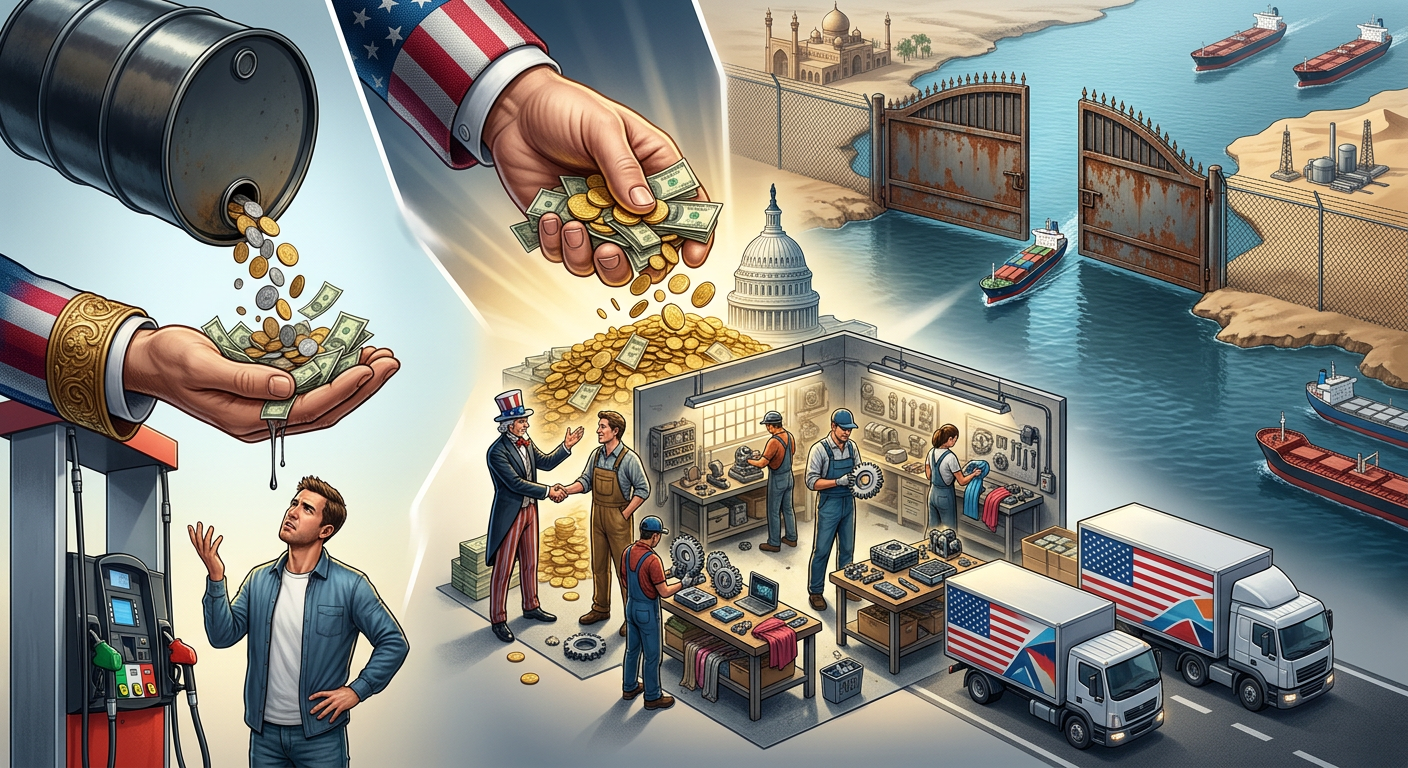
The Strait Is Leaking, Oil Is a Tax, and Washington Is Funding the Choke Points
A quick note from Behind the Markets
Good morning.
Wall Street keeps telling you the market is "resilient."
Translation: the biggest players are still making money… so they want you to ignore the stress in everything else.
Today's reality is simpler: oil is acting like a tax, the Strait of Hormuz is still half-closed, and small companies that actually make things are about to get paid because Washington finally wants domestic supply chains.
1) The Strait of Hormuz is "leaking" oil — and that's why prices aren't acting as crazy as the situation is
If you're watching a war, a choke point, and a supply shock… and wondering why oil isn't already at $150 — here's your answer.
CNN reports JPMorgan estimates visible traffic through the Strait of Hormuz is down to 15% of pre-war levels.
But the same analysis points to "clandestine flows" — roughly 2.1 million barrels per day transiting during the last two weeks of May, with pre-conflict flows around 15.6 million barrels per day. Tankers are reportedly dodging the blockade by turning off transponders to avoid detection. Maritime intelligence firm Vortexa says 65.2% of outbound laden vessels transited "dark" in May.
In plain English: the market found a messy, expensive, semi-illegal workaround.
That's the part the headlines miss. The world is adapting. But it's adapting at a cost: more risk premium baked into every barrel, more "ghost shipping" and shadow logistics, and more room for sudden accidents, miscalculations, or enforcement that shuts the workaround overnight.
And that's why you're seeing this weird pricing regime: oil can stay in the $90–$110 zone without "breaking"… until it breaks.
Because when you're running a global supply chain on the equivalent of gray-market plumbing, the system is stable right up until the minute it isn't.
Meanwhile, somebody is getting paid handsomely for every one of those longer, riskier voyages.
Company: Frontline (SYM: FRO)
World's largest publicly traded crude tanker operator — VLCCs, Suezmax, and Aframax vessels
When oil has to travel farther, dodge blockades, and pay war-risk premiums, tanker owners collect the bill. Frontline operates roughly 80 vessels, including 41 very large crude carriers — and the Hormuz disruption has sent charter rates to levels nobody modeled a year ago. VLCC daily rates spiked past $400,000 at the peak of the crisis.
The earnings followed. Frontline reported record adjusted Q1 2026 profit with revenue of $714 million — up sharply from $432 million the prior quarter — and declared a $1.55 per share dividend for the quarter alone. The forward yield, if elevated rates hold, runs into the high single digits or beyond.
FRO is currently trading around $36, with analyst targets in the $41–$45 range. Fair warning: this is a cyclical, volatile business, and a durable ceasefire that fully reopens the Strait would compress rates fast — two analysts downgraded in late May on exactly that risk. But as long as the Strait stays "leaking" instead of open, the longer routes and risk premiums keep flowing straight to Frontline's bottom line.
Bottom line: The Strait isn't "open or closed." It's partially closed with leaks — and that means oil volatility is a feature, not a bug. Your portfolio should be built for that reality.
2) Oil wobbled, stocks sank — and investors are still pretending this is "just geopolitics"
The New York Times reported oil prices fluctuated and equity markets pulled back after a wave of U.S.–Iran strikes strained a two-month cease-fire.
The piece notes Brent slipped about 0.4% to around $91 and WTI fell about 0.6% to roughly $88.
Wall Street will say: "Oil is down today. So we're fine."
That's not how this works.
The real damage from a $90+ oil regime isn't one-day price direction. It's the second-order effect: higher transport costs, higher input costs, margin compression for anyone without pricing power, and consumer demand getting quietly taxed.
And the market's reaction tells you something else. NYT notes S&P 500 futures were pointing to a drop of about 0.8%.
When investors start selling the index on war + energy stress, you're not in a "stock picker's playground." You're in a macro tape.
So who keeps earning when energy stays elevated for a year? The companies that charge a toll on every barrel and molecule — no matter what the price is.
Company: Enterprise Products Partners (SYM: EPD)
Fee-based midstream energy giant — pipelines, processing, storage, and export terminals
Enterprise doesn't drill. It doesn't bet on oil prices. It owns the pipes, processing plants, and export docks that energy has to move through — and it charges fees based on volume, not price. Think of it as the tollbooth on the energy highway.
That model shows up in the numbers. Q1 2026 net income rose 7.4% year over year to $1.48 billion. The partnership is building $5.3 billion in major capital projects — including Permian processing plants and export terminal expansions — and just raised its growth capex budget. Leverage sits at a conservative 3.2x.
EPD is currently trading around $38 and pays a quarterly distribution of $0.55 per unit — an annual yield of roughly 5.9%. It has raised that distribution for 27 consecutive years, through oil crashes, pandemics, and rate cycles.
When oil is a tax on the economy, EPD is the toll collector that gets paid regardless. That's the kind of business you want when "geopolitics" stops being a headline and starts being a regime.
Bottom line: In an energy-driven world, the question isn't "is oil up today?" The question is: who can keep earning when energy stays elevated for a year.
3) The underfollowed defense trade isn't prime contractors — it's critical materials and the companies that can actually deliver
Retail investors always get pushed toward the obvious names.
Big defense primes. Big ETFs. Big headlines.
But the real bottlenecks aren't always in the final assembly.
They're in specialized inputs.
Company: Elmet Technologies / The Elmet Group (SYM: ELMT)
Sole U.S.-owned, vertically integrated tungsten and molybdenum manufacturer
Elmet announced Tuesday it secured $4.3 million in strategic funding through a U.S. government contract award to expand domestic manufacturing capabilities for molybdenum-based products and refractory metal components used in critical defense programs.
The release highlights investments in precision machining, production automation, additive manufacturing, finishing, and inspection systems — aimed at increasing throughput and improving precision components for mission-critical interceptor systems.
Here's why this tiny contract matters more than its dollar figure. Elmet is the only U.S.-owned and operated, vertically integrated tungsten and molybdenum manufacturer in the country — nearly 400 employees across facilities in Maine, Ohio, and Michigan. Those metals go into interceptors, hypersonics, and defense platforms that cannot legally or practically source from China. The company IPO'd earlier this year, raising $125.5 million, and reported Q1 revenue growth of nearly 21% with accelerating demand in aerospace, defense, and government markets.
The stock is currently trading around $17, down from recent highs — small, volatile, and thinly covered. That's exactly the profile. This is a speculative small-cap, so size any position accordingly.
Here's the bigger setup:
In a world where wars are real again, "domestic capacity" stops being a political slogan and becomes an industrial policy.
And industrial policy doesn't just fund the primes. It funds specialty metals, machining and inspection, subcomponents that can't be swapped at the last minute, and suppliers that can pass audits and deliver on time.
That's where small and mid-caps can get explosive — because they're under-owned, under-covered, and suddenly indispensable.
Bottom line: Don't just buy the prime. Follow the choke points in the supply chain — especially critical materials and precision manufacturing.
4) Tomorrow's market is about "who needs money" — not who has the best story
One more contrarian point.
In a high-rate, high-volatility world, the market doesn't punish bad products first.
It punishes bad balance sheets.
When oil stays elevated, inflation stays sticky. When inflation stays sticky, the Fed stays restrictive. And when the Fed stays restrictive, small caps stop being a "value" bucket and become a "financing" bucket.
So here's the filter I'm using right now: Who can self-fund growth? Who has real free cash flow — not adjusted EBITDA? Who has maturities coming due in the next 24 months? Who is one capital raise away from losing control?
Wall Street wants you to chase the big narrative.
Retail wins by doing the boring work: avoiding funding traps.
If you want that filter applied systematically across the whole market, there's an ETF built on exactly these criteria.
ETF: iShares MSCI USA Quality Factor ETF (SYM: QUAL)
Large- and mid-cap ETF screening for high return on equity, stable earnings, and low debt
QUAL's index does three things: it selects for high return on equity, stable earnings growth, and low debt-to-equity — sector by sector, so you're not just buying a tech fund in disguise. In other words, it owns the companies that don't need permission from the bond market.
QUAL is currently trading around $213, near the top of its 52-week range of $175 to $218, with a rock-bottom 0.15% expense ratio. It holds the market's most profitable, least-leveraged large companies — the ones that fund their own growth, survive credit squeezes, and pick up market share when weaker competitors start cutting.
It won't be the most exciting line in your portfolio. It will be the one still standing when the financing bucket gets emptied out.
Bottom line: The best stock in your portfolio is the one that doesn't need permission from the bond market.
Before You Go
Markets are turning into a game of bottlenecks.
Energy bottlenecks. Supply-chain bottlenecks. Financing bottlenecks.
If you train yourself to look for choke points — instead of hype — you'll see the next winners before Wall Street can package them into a product.
Found this helpful? Share it with others.
Written by Behind the Markets