Dear Reader,
I was talking to a buddy of mine this weekend who owns a very large business.
And I got to thinking about something I've observed over 35 years in this business.
Entrepreneurs are the worst investors I have ever seen in my life.
I know that sounds crazy.
You'd think they'd be the best.
But in my lived experience, they take the cake.
The Old Wall Street Wives' Tales
When I started on Wall Street, they used to say doctors were the worst investors.
Overconfident — and trained to fight for the outcome until the very end.
Great when you're saving a patient.
Terrible when you need to cut your losses and get out.
They used to say dentists were bad because of isolation.
No one to bounce ideas off of.
They said engineers suffered from analysis paralysis.
They said lawyers had confirmation bias — when a stock drops, they defend it, because they're smart enough to convince themselves everyone else is wrong.
But look, those are really personality types, not professional ones.
You'll find all of those in every profession.
In my own personal experience, the worst of all of them has been entrepreneurs.
And here's why it's so counterintuitive.
Why Entrepreneurs Should Be Great Investors — and Aren't
Being an entrepreneur has made me a better investor.
Being an investor has made me a better entrepreneur.
The skills are almost identical.
And yet most entrepreneurs I know look at stocks like little pieces of intangible paper instead of what they actually are — pieces of businesses.
When you're running your own company, the only thing that matters is cash.
Survive and advance.
Survive and advance.
Survive and advance.
That's it.
Can I generate more cash than I spend this month?
This quarter?
This year?
That's the whole game.
The Right Way to Look at a Stock
When you're buying a business — public or private — the question is the same.
How much cash can I pull out of this thing?
And what's the likelihood that it keeps coming?
If it's a private business, you take that cash and put it in your pocket.
If it's a public business, the company pays it out as dividends or buys stock back.
That's it.
That's the whole framework.
What you're really looking for when you buy a stock is a bond coupon.
A stream of cash payments that you're buying at a price today.
The question is: how much is it worth to own that stream?
Take Republic Services — the garbage company.
Bill Gates' largest personal position outside of Microsoft.
They basically have a monopoly in the areas they operate.
Very little competition.
The free cash flow they generate is about as reliable as a bond coupon.
All you have to ask yourself is: over the next ten years, if this company generates X in year one, Y in year two, and so on — what is that entire stream of cash worth to me today?
That's the value of the stock.
How to Diagnose a Business
When I'm analyzing a company, I look at the income statement and find which of three buckets is causing problems.
Cost of goods — it costs too much to make what they're selling.
Operating expenses — too much overhead, salaries, rent.
Non-operating problems — debt, interest, balance sheet issues.
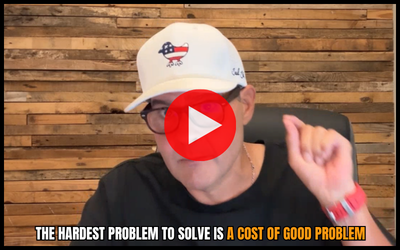
Pro tip: the hardest problem to fix is always the cost of goods problem.
If for every dollar of revenue it costs you ninety cents to generate it, you're left with razor-thin margins on everything else.
That's a terminal diagnosis.
Operating expense problems are more like surgery — painful, but fixable.
You cut costs, you restructure, you come out the other side.
But a cost of goods problem?
That's the one that kills companies.
And sitting inside the cost of goods of almost every business in America is the same line item: energy.
URGENT: Fellow Investor, Please View ASAP
I recently released a report on a secret story big oil has desperately been trying to cover up. One that could lead to gains of 1000% or more for early investors.
The catalyst is coming... but the smart money is already moving and I want to make sure you see this before the biggest opportunities are gone.
This report will only take a moment of your time, but it could have a dramatic impact on your personal wealth.
Entrepreneurs understand this instinctively when they look at their own business.
The mystery to me is why they don't apply the same thinking when they look at stocks.
The Bottom Line
When you find a company like Microsoft, Alphabet, Visa, Mastercard, or Republic Services — businesses with durable competitive advantages, reliable free cash flow, and the ability to grow that cash over time — you've found something worth owning.
The same thing you'd look for if you were buying a private business.
It's not complicated.
But you'd be amazed how many brilliant people — especially entrepreneurs — make it harder than it needs to be.
Have a wonderful Monday.
I'll see you tomorrow.
"The Buck Stops Here,"

Found this helpful? Share it with others.
Written by Dylan Jovine