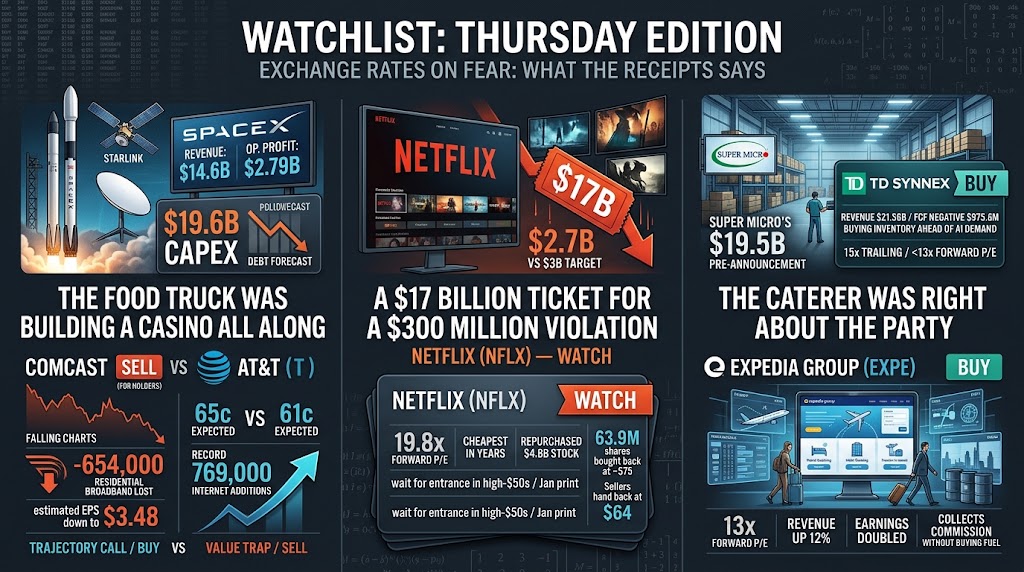
Morning Watchlist: Thursday Edition
A quick note from Behind the Markets
The market spent this week setting exchange rates on fear.
Netflix missed an advertising target by $300 million and was billed $17 billion. United Airlines grew revenue 17% — a record — and got marked down over the fuel bill. Two weeks ago, the carriers lost $39 billion of value over an $8 billion spectrum purchase.
Then, Tuesday night, the books began to open. When the receipts argue with the fear, we side with the receipts.
Four stories this morning. Four pairings.
Let's get into it.
1) The Food Truck Was Building a Casino All Along
Two weeks ago we said the market sold the phone companies because a food truck bought the parking spot — and that the food truck was mostly busy building a casino. Tuesday night, SpaceX opened its books and proved it.
Revenue of $14.6 billion, up 161%. Its first operating profit as a public company — $2.79 billion. But look inside. The AI segment did $7.56 billion — nearly triple last quarter — now bigger than Starlink's entire connectivity business at $5.25 billion. And the invasion itself undershot: Starlink added 1.6 million consumer subscribers against the 2.29 million expected. The bill keeps arriving too — $19.6 billion of capital spending in one quarter, with S&P Global projecting SpaceX's debt swelling toward $350 billion by 2029.
On Wednesday morning, AT&T — our Buy from this week — passed its own exam: 65 cents against the 61 expected, a revenue beat, a record 769,000 internet additions, and a raised full-year earnings guide. Both our carriers stand. But 769,000 internet customers don't appear out of thin air. Somebody is donating them.
The pairing: Comcast (CMCSA) — Sell
This one is for readers who already hold it. Comcast is the somewhere that AT&T's record quarter is happening to. Fiber, fixed wireless, and Starlink all pull from the same bathtub — and this year Comcast stopped publishing the water level, ending its regular subscriber disclosures. When a restaurant takes down its health-inspection grade, you don't assume the kitchen got cleaner.
What we still know: 654,000 residential broadband subscribers lost last year, 232,000 more so far this year, and the CFO told a Goldman conference the third quarter won't improve on last year's. Fiber overlap with Comcast's footprint is growing 4–5% a year — gigabit offers at $30 to $40 a month he calls "irrational pricing" — and KeyBanc, which just downgraded the stock, sees losses re-accelerating to 665,000 next year. Earnings estimates are falling with them: $4.10 last year, about $3.48 expected this year.
Yes, it's cheap — about $22.36, roughly 6 times earnings with a 5.9% yield, near its 52-week low. The dividend is covered twice over; this is a trajectory call, not a dividend-crisis call. But we'd rather own the networks taking the customers at 10 times than the one donating them at 6. Wrong if the planned NBCUniversal-and-Sky spinoff re-rates the pieces (bulls see $31 to $37), or the losses genuinely inflect better. Until then, cheap on a melting denominator is how value traps dress.
2) A $17 Billion Ticket for a $300 Million Violation
Tuesday night, Netflix beat on operating margin — 34.6% against the 33.2% forecast — grew revenue about 12%, and repurchased $4.8 billion of its own stock, the largest buyback quarter in its history. The stock fell about 6% after hours, from $68.69 toward $64.50 — roughly $17 billion of market value, gone.
The violation: a cut to the 2026 advertising target, to about $2.7 billion from roughly $3 billion, plus fourth-quarter income guided to $2.79 billion against the $3.07 billion expected. Revenue growth, at 11.8%, was the slowest in nearly three years.
The market charged $17 billion for a $300 million miss — a 57-to-1 exchange rate on fear. And the detail we keep turning over: Netflix bought those 63.9 million shares at an average near $75. Tuesday's sellers handed the stock back at $64 and change. One of those two groups is wrong.
The pairing: Netflix (NFLX) — Watch
So why not buy the ticket? Price, still. At about 19.8 times next year's expected earnings, Netflix is the cheapest it has been in years — its five-year average is 32.6 — but that's still nearly the S&P 500's 21 for a business whose growth just downshifted. When the multiple needs the growth to hold and the growth is the thing in question, you name an entrance. The entrance: a markdown into the high-$50s that pays for the deceleration, or the January print showing the ad business re-accelerating. The kill: revenue growth sliding through 10% — then the discount to its own history was a warning, not a sale.
3) The Caterer Was Right About the Party
While the market argued about fear, Super Micro handed it a receipt. Late Tuesday, the AI server maker pre-announced preliminary quarterly revenue of about $19.5 billion — roughly $4 billion above its own guidance — and the stock surged 13% Wednesday morning. Micron, SanDisk, and SK Hynix rose premarket with it, and Seoul's bruised chipmakers steadied.
Hold the two Octobers side by side. The financing panic — CoreWeave's 15% bonds, the Kospi circuit breaker — is about how the build-out is paid for. Tuesday's pre-announcement is about whether anyone still wants the machines. Four billion dollars of surprise demand says yes. We sold the borrowed checkbook. We own the cash registers.
The pairing: TD SYNNEX (SNX) — Buy
A repeat, on purpose. We bought TD SYNNEX on September 7th at about $263 — the beer distributor of corporate tech, whose Hyve unit builds AI servers for hyperscalers. Then the market billed it: after a record late-September quarter ($21.56 billion of revenue, up 37.7%, guidance above consensus), the stock was marked down because free cash flow ran negative $975.6 million — cash spent buying inventory ahead of AI demand.
The caterer bought the groceries before the party, and the market billed him for the grocery run. Tuesday night, the party RSVP'd $4 billion more guests. At $246.75 as of the October 16th close — our latest verified print, 6% below the September flag — the $19.7 billion company trades at 15 times trailing earnings and under 13 times forward. The S&P 500: 21. The risks are unchanged — pennies-per-dollar distribution margins, Hyve customer concentration — and the kill is cash conversion failing again at the next print.
4) Record Demand, Eaten by the Rent
Finally, the quietest big number of the week. United Airlines grew September-quarter revenue 17.4% to $17.88 billion — a record — and guided fourth-quarter revenue up more than 20%. CNBC's headline said it plainly: travelers keep booking despite higher fares.
And the stock slid anyway. United's adjusted $2.54 missed the $2.59 expected — its first miss after four straight beats — because fuel expense rose 62%, and management warned Wall Street's fourth-quarter fuel math was about a dollar a share too optimistic. Our United Watch got half its answer: demand is holding, the fuel bill hasn't crested. Still Watch.
So follow the money one step. Fares are up, planes are full, and somebody in this aisle collects on every booking without ever buying a gallon of jet fuel.
The pairing: Expedia Group (EXPE) — Buy
Expedia is the realtor in a town where house prices just jumped: she doesn't pay the mortgage, she collects the commission. The booking platform takes its cut of a market where demand is setting records and fares — the thing commissions are calculated on — keep rising. Trailing revenue grew 12%, earnings nearly doubled, and at $300.76 as of Tuesday's close, the $36 billion company (large-cap, but the pairing earns the exception) trades at about 13 times next year's expected earnings. The S&P 500: 21. Thirty-eight analysts rate it Buy, with the average target near $336.
The honest flags: the stock is up more than 60% off its 52-week low — we're not early — and it reports November 4th, so the proof has a date. The risks: a squeezed consumer finally trimming trips rather than trading down, and AI assistants someday booking travel directly, cutting out the agent's window. The kill: gross bookings growth stalling at the November print. Until then, the airlines pay the fuel bill. The agent cashes the commission.
Before You Go
That's the watchlist: the rocket's casino confirmed and cable left holding the bill, a $17 billion ticket for a $300 million violation, the caterer vindicated by $4 billion of RSVPs, and record travel demand that pays the agent before the airline. One theme, as always: fear has been trading at terrible exchange rates — sell it, don't buy it.
One more Wednesday grade: Lithia, our September Buy, passed its exam with record revenue of $9.95 billion, earnings per share up 54%, and a dividend raise. Verizon rides the same SpaceX receipt as AT&T; both stand.
Today, two more named entrances take their exams: Valero, against Washington's five-program campaign on fuel prices, and FirstCash at the pawn counter — with Alaska Air reporting as well.
Found this helpful? Share it with others.
Written by Behind The Markets