Morning Watchlist: Friday Edition
A quick note from Behind the Markets
We're closing out the week, and on Wednesday night the market got the hour it had been waiting for all month. Tesla, Meta, IBM, Texas Instruments, and Lam Research all reported within about an hour of the close.
All five beat.
And Thursday morning, futures opened red anyway — the chip aisle marked down again, oil at a five-month high after drones reached inside Saudi Arabia.
Reading the five report cards side by side, the beats weren't the news. The shopping lists were. The market spent the night arguing about the bills. We went looking for the cash registers.
Three stories this morning. Three pairings.
Let's get into it.
1) Meta Wrote a $145 Billion Shopping List
Start with the loudest numbers. Meta earned $3.83 a share against the $3.45 expected, on $64.6 billion of revenue — up 26%, the highest quarter in its history — raised this quarter's revenue guide to $73 to $76 billion, and announced a 2-for-1 stock split. The quarter was an A.
But the number that matters to this newsletter was on the spending line: Meta projected $135 to $145 billion of capital spending on AI infrastructure. One company. One year.
A data center, as we said when Amazon took its warrant from 3M, is mostly a building full of wiring — plus power systems, liquid cooling, and racks of integrated compute. Meta doesn't manufacture any of that. Somebody does.
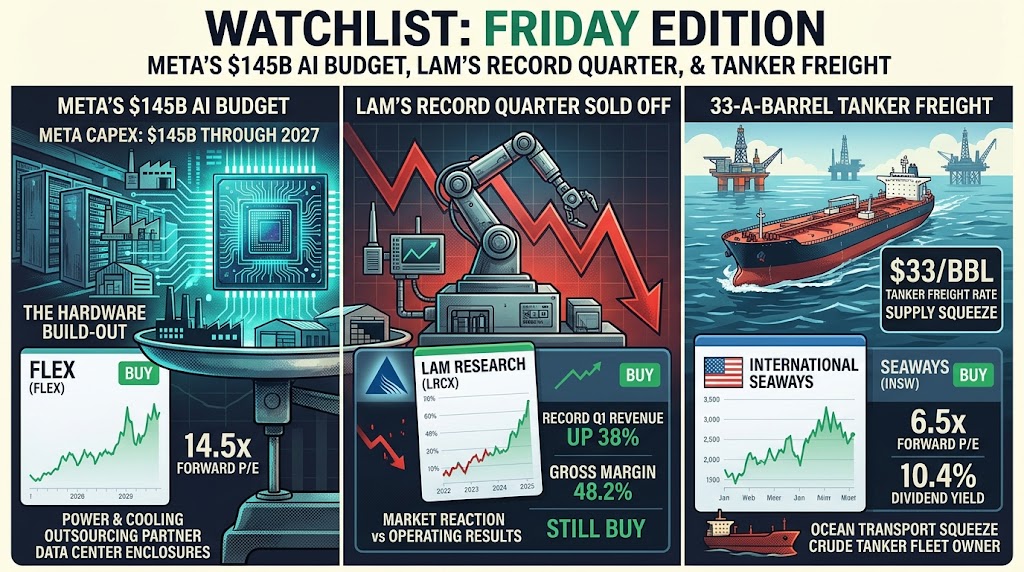
Two weeks ago, somebody got appraised. Flex — the contract manufacturer — is spinning off Axiom, its AI data-center unit, and a buyer group led by General Catalyst paid $2 billion for preferred stock at a $37.5 billion enterprise value. Axiom did $6.6 billion of revenue last fiscal year, grew 35% last quarter, is guided to grow 65% to 75% this year, and just closed a $4.4 billion purchase of EPC Power to go deeper into exactly the aisle Meta's shopping list funds.
Now the arithmetic the market hasn't done. The whole of Flex — Axiom plus the global manufacturing business wrapped around it — sells for roughly $33 billion.
The pairing: Flex (FLEX) — Buy
It's a house with a guest cottage — and the appraiser just valued the cottage above the asking price of the entire property. (The $37.5 billion is an enterprise value, so it carries debt. The gap is still the point.)
Why so cheap? October's AI-financing panic sold everything attached to the build-out, and Flex caught extra sellers over deal mechanics: the EPC purchase went on the credit line, the new preferred pays 10% until the spin-off, and existing holders wear the dilution. The stock has fallen from a $166.86 high to $92.80 at the October 16 close — our latest verified print, with more recent quotes drifting toward $87. Three weeks ago it cost 24 times next year's expected earnings; the same estimates put the marked-down price under 19 times. The S&P 500: 21. Goldman's target is $145.
The honest risks: Axiom's growth hangs on a few hyperscalers whose spending can change quickly — Flex's own filings say so — the spin-off may slip or die, and the legacy business earns thin margins. The exams are dated: earnings next Wednesday, then the November 10 Investor Day, where Axiom's standalone margin path is the number to watch. The kill: a hyperscaler capex cut, or the spin-off repriced below its appraisal.
2) Tesla Beat. The Market Read the 2027 Budget Instead.
Tesla earned 48 cents against the 45 expected, on $28.05 billion of revenue — also a beat, with automotive gross margin, excluding regulatory credits, at 18.1%, above projections. Driving subscriptions grew 67% to 1.74 million, the robotaxi fleet has logged 2 million unsupervised miles, and Optimus production has started at Fremont.
And the stock barely moved, because the argument skipped past the quarter to the budget: lower spending this year, then heavier spending in 2027 and 2028 — on Optimus, on the Cybercab, and on Terafab, Tesla's own chip plant.
Add it to the pile. Three weeks ago Micron named $25 billion and four new fabs. Now Tesla wants to build its own. The town keeps announcing bakeries — and an hour later, the oven maker reported.
Lam Research printed record everything: revenue of $8.22 billion, up 54%, its first operating margin above 40%, record free cash flow. It guided this quarter higher still — $8.6 billion and $2.33 a share — and the CFO said revenue would have been higher if supply constraints hadn't pushed shipments into March. Then the industry number: chip-equipment spending in the mid-$150 billions this year, and a preliminary 2027 view above $200 billion.
The stock fell anyway — from Wednesday's $260.81 close toward $243 after hours. A company that beat estimates, punished for missing the $2.28 "whisper number" with its $2.19. Thursday morning, the chip aisle opened red again.
The pairing: Lam Research (LRCX) — Buy
A flip, on schedule. We flagged Lam as a Watch on October 2nd at $328.51 and named two entrances: its own report converting Micron's capex into a raised guide, or a pullback toward $300. Both just printed — the report came a week early and converted, and the price went through $300 without stopping, about 25% below our flag.
Annualize the new guide — $2.33 a quarter — and the marked-down price is about 26 times that pace, down from 35 times forward earnings when we refused to chase it. Not a bargain-bin ticket; it's a toll road priced for traffic. But the traffic forecast just went above $200 billion, and the ticket got a quarter cheaper on a record quarter.
The honest risks: China was 35% of revenue and falls sharply this quarter; whisper-miss selloffs can run further than logic; export controls can rewrite a quarter overnight; and memory's oldest talent is building one fab too many. The kill: that $200 billion number getting cut — by Lam or by anyone else.
3) The Ocean Started Charging $33 a Barrel
On Wednesday, Saudi defenses intercepted a Houthi drone over the Shaybah oilfield — the falling debris killed two contractors — and hours later an attack at Dammam's airport killed one more. The State Department ordered non-emergency employees out of Saudi Arabia. Brent pushed above $110 and WTI near $99, five-month highs, with the kingdom's East-West pipeline still halted since October 5 and Kpler counting at least 18 attacks on vessels in two weeks.
Now the quiet number underneath. Shipbroker Poten & Partners puts the Middle East-to-Asia supertanker rate at $1.3 million a day — 43 times January's $30,000. Per barrel, ocean freight has gone from $1.73 to almost $33. Shipping is now 27% of the delivered cost of crude, up from 3%.
The pairing: International Seaways (INSW) — Buy
A flip from last quarter. We flagged International Seaways on August 20th at $99.54 with a rule: buy the pullback, not the peak. The pullback never came — Wednesday it closed at $111.15, only 12% above our flag while the daily rate multiplied. What changed is the bookings math. Tanker owners book voyages weeks and months ahead, so the fleet is still working off old prices: Frontline's record quarter averaged $152,700 a day — about a tenth of today's spot rate. It's a landlord with leases expiring into a housing shortage. The old rents are in the books. Every renewal reprices.
International Seaways is the mid-cap version of that landlord: a $5.5 billion fleet of crude and product tankers, trading at about 7 times earnings — roughly 6.5 times forward — with an 11.4% trailing dividend yield. The S&P 500: 21 times.
The honest risks, plainly: the kill is peace. Iran's seven-day ceasefire offer is still on the table, and a signature collapses war premiums faster than they built. Washington's five programs aimed at fuel prices could become six, aimed at shipping. And the dividend floats with the rates — a payout, not a promise. If spot rates halve, we bought the toll booth at the top, and we'll say so.
Before You Go
That's the watchlist: a guest cottage appraised above the whole house, record ovens marked down 25%, and an ocean that now charges $33 a barrel. One theme, as always: everyone else is reading the bills. We'd rather own the cash registers.
The rest of the exams, quickly. IBM beat and rose about 3.5% after hours; Texas Instruments beat on every line and got sold anyway after a 64% year — the bar, not the business. Crown Castle, our October 13th Watch, raised its 2026 guide on a $275 million customer settlement, but the DISH wireless bankruptcy still hangs over the tower book, with tower companies pressing a $7.6 billion claim. The entrance hasn't printed; still Watch. Thursday's exams — Valero, FirstCash, Alaska Air — were graded after our press time; Saturday's review runs the full card. One calendar note for this morning: reports say Anthropic's IPO paperwork could be filed as soon as today — the marquee ticket we've been tracking at Nasdaq, Goldman, and Evercore.
Found this helpful? Share it with others.
Written by Behind The Markets