Morning Watchlist: Wednesday Edition
A quick note from Behind the Markets
The Fed decides this afternoon at 2:00 Eastern, with a quarter-point hike almost fully priced in. But on Monday, the bond market didn't wait for permission. The 10-year Treasury yield touched 5% — the first time it has crossed that line since October 2023.
Five percent is not just a number on a chart. It's the price of money for the whole economy: every mortgage, every corporate loan, every deal that pencils or doesn't. When that price crosses a threshold it hasn't seen in three years, somebody's business model breaks — and somebody else's phone starts ringing.
This morning we're following the phones. Three stories. Three pairings. Let's get into it.
1) Five Percent Money and the Man Who Warned You
Monday gave us the milestone and the confession in the same session.
The milestone: the 10-year hit 5.01% before easing back, with the 30-year near 5.33% — levels last seen when "Barbie" was in theaters. The confession: Bank of America CEO Brian Moynihan told a Barclays conference that his investment-banking fees are on track to fall at least 10% this quarter. BofA dropped 5.1% to $59.47. Goldman fell 4%. JPMorgan and Wells slipped with them.
Put the two together and you get the real story. At 5% money, deals die. Companies that need to refinance cheap 2021-era debt into this market can't make the math work. The big banks starve on both ends — no IPO fees, no merger fees, nervous trading desks.
But one corner of Wall Street is built for exactly this weather.
The pairing: Houlihan Lokey (HLI) — Buy
Houlihan Lokey is the quiet mid-cap advisor that ranks No. 1 in the world in two very different leagues: the most M&A deals by count — 458 last calendar year — and No. 1 in restructuring, the business of untangling companies that borrowed more than 5% money will forgive. A tow truck company in an ice storm: nobody thinks about it in July, and then one cold week it's the busiest fleet in town.
The market is pricing the July version. Because the deal drought hit Houlihan too — last quarter's revenue slipped to $511 million on delayed transactions — the stock trades at $137.82, roughly 35% below its 52-week high, at about 18 times forward earnings against the S&P 500's 21. This from a firm that just posted record annual revenue of $2.6 billion, grew adjusted earnings 20%, and pays a 2% dividend while you wait. Management's own words: they expect "robust restructuring activity due to contracting monetary policies and credit market instabilities."
The same 5% that starves the deal desk feeds the workout desk.
The honest risk: restructuring is only about a fifth of Houlihan's revenue, so if the deal freeze deepens faster than the distress cycle ramps, the counterweight can't fully carry the firm — and mandates take quarters, not weeks, to become fees. A fast Fed pivot that revives cheap money would drain the pipeline too, though it would revive the M&A side in exchange.
2) The AI Race Just Picked a Stadium
On Sunday, Bloomberg reported that Anthropic — yes, the company whose CEO's essay knocked the chip complex over last week — has chosen Nasdaq for its much-anticipated IPO, targeting a debut as soon as October. The valuation being discussed: around $2 trillion.
That's Nasdaq's second heavyweight win over the New York Stock Exchange in a row, after SpaceX listed there this summer at a $1.75 trillion valuation and joined the Nasdaq-100 in July. Nasdaq even shortened its seasoning rules so giant new listings can qualify for its indexes after just 15 trading days. OpenAI, meanwhile, has signaled it will stay private for now.
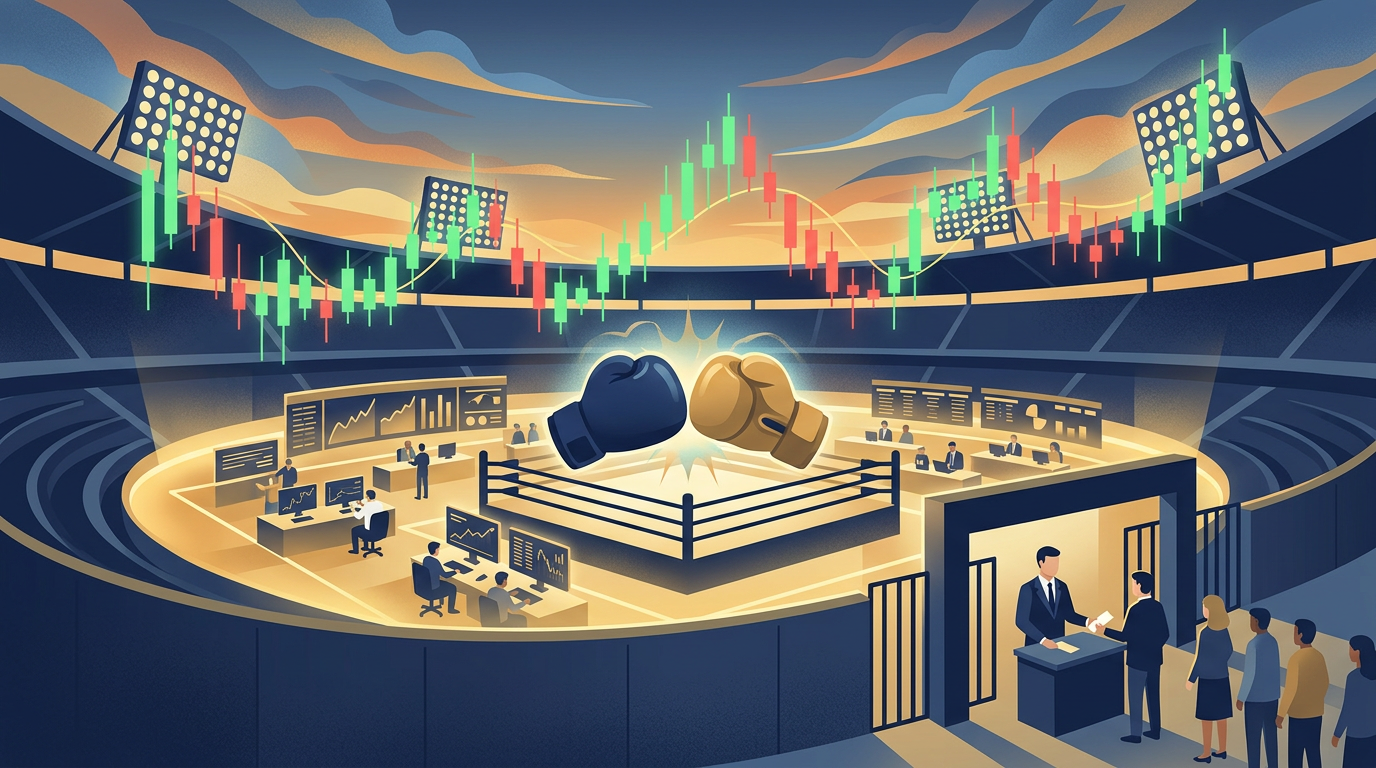
Here's what we keep coming back to. We have no idea whether Anthropic at $2 trillion will be a good stock. Neither does anybody else. But we don't have to know — because whoever wins the AI race, the fight keeps selling tickets, and one company owns the stadium.
The pairing: Nasdaq, Inc. (NDAQ) — Buy
Nasdaq collects three ways on every marquee listing: the listing itself, the trading that follows, and — the quiet one — index and data revenue, because every giant that joins the Nasdaq-100 makes the index franchise more valuable to every fund that licenses it. The flywheel is already visible: second-quarter net revenue rose 15% to $1.5 billion, powered by the SpaceX debut and data demand, and earnings per share over the past year grew about 32%.
At $91.57, the stock costs about 21 times forward earnings — the market multiple, for a business growing revenue 14% and earnings 30%-plus, with seventeen analysts at consensus Buy and an average target near $110. We own the volatility tollbooth in this sector already through CME, our August 26th call; this is the listings tollbooth. The risks, plainly: a hawkish Fed this afternoon could slam the IPO window and delay the whole parade, an at-market multiple leaves no bargain cushion, and NYSE will fight for every mega-listing from here.
3) On Monday, Everybody Bought Locks
While the chip stocks bled, one aisle of the market had its best day in months. CrowdStrike and Zscaler jumped about 12% apiece on Monday, Palo Alto Networks 11%. The logic: if the AI-safety crowd is right that powerful models are getting harder to control, the world is about to spend a fortune defending itself from AI-powered attacks. CrowdStrike's CEO George Kurtz put it bluntly — the labs "will keep advancing their technology regardless"; his job is making that safer.
We think the logic is sound. It's the prices we can't hold. CrowdStrike and Palo Alto had each roughly doubled this year before Monday's pop — and we've spent all quarter refusing exactly this shape, from Tenable to Okta. When a theory gets proven on a Monday, the famous names are already priced for it by Tuesday.
But the theory lifts the whole industry. So we went looking for the cheapest seat in the sold-out theater.
The pairing: Check Point Software (CHKP) — Buy
Check Point is one of the oldest names in cybersecurity — the Israeli firewall pioneer that now protects networks, clouds, and email for organizations worldwide, and was just named a leader in Gartner's 2026 rankings for hybrid firewalls. It rose 5% Monday with the group, to $138.50. And here's the punchline: it trades at about 13 times next year's expected earnings. CrowdStrike costs many multiples of that. The S&P 500: 21 times.
Why so cheap? Growth. Check Point grows revenue around 6% a year — the steady balcony seat, not the front row — while the momentum names grow 25%. But it earned over $1 billion last year on $2.7 billion of revenue — profits up 25% — and 38 analysts still call it a Buy. If Monday's theory is right — if AI risk becomes a durable security-budget line — the tide reaches the balcony too, and you paid face value for the same concert. The kill switch: if that 6% growth fades toward zero as the platform giants poach its customers, the cheap multiple was a warning label, not a discount.
Before You Go
That's the watchlist. A bond market that crossed 5% and the workout shop that gets busy at that price, a $2 trillion listing headed for one exchange's stadium, and the face-value ticket to Monday's cybersecurity stampede. One theme this morning: when the price of money and the price of fear both spike, buy the businesses that get paid to handle them.
And keep one eye on the clock: August retail sales landed this morning at 8:30, the Fed decision comes at 2:00 with Chair Warsh's press conference at 2:30, Lennar reports after the close — we flagged it Sunday, watch the print, don't front-run it — and the Bank of Japan goes Friday.
Found this helpful? Share it with others.
Written by Behind the Markets