Morning Watchlist: Wednesday Edition
A quick note from Behind the Markets
Thirty minutes before this issue reached your inbox, the government released July's inflation report — the number we told you on Monday would referee the fight between a Fed talking about rate hikes and a labor market that just lost 23,000 jobs. Whatever the first reaction says, remember Monday's rule: the first market reaction is not the final economic signal.
Because underneath the inflation theater, the quieter machinery keeps turning — and that's today's issue. Wall Street still treats regulation as a risk to be discounted and infrastructure as a story to be bought after the stock has already moved. That's backwards. Europe's AI rules are now forcing companies to prove what their systems do. Germany is putting public credit behind the physical energy network. Specialty-drug demand is rewarding the distributors that execute. And a tiny defense supplier just showed what happens when detection — not destruction — becomes the product.
The overlooked winners are not always the companies with the loudest technology. They're the ones that make the new system auditable, financeable, and usable.
1) AI Compliance Just Became a Budget Line
As of August 2, the European Union's AI Act transparency requirements are no longer a policy debate — they're an operating requirement, with the EU's AI Office and national authorities now actively enforcing them. The rules cover disclosures around AI-generated and manipulated content among other transparency obligations, and the Commission has published guidance interpreting Article 50 for providers and deployers. If you sell AI into Europe, this is now a line item, not a memo.
That changes the investment map. Every enterprise deploying AI now needs identity controls, model inventories, audit trails, disclosure workflows, human review, and a way to prove a system behaved as promised. The obvious winners are the big cloud platforms, who will bundle compliance tooling the way they bundle everything. The less obvious opportunity sits in the boring layer underneath: governance software, data lineage, cybersecurity, testing, document retention, and specialized compliance services.
Two cautions before anyone buys the theme. First, do not confuse a regulation headline with a guaranteed software boom. Buyers may consolidate vendors, shove the work into existing security budgets, or simply delay low-risk AI experiments — Europe has a long history of compliance regimes that enriched lawyers more than software companies. Second — and this is why there's no ticker in this section today — nearly every public name in the governance, identity, and security-software aisle reported earnings within the past two weeks, and this earnings season has been a slaughterhouse for software vendors whose guidance wobbled. Criteo fell 28% in a day. Fiserv fell 10%. I am not going to hand you a compliance-software ticker without putting its fresh print through the full process first. The screen to run yourself in the meantime: does the vendor sell into a mandatory workflow, does it integrate with systems of record, and can it show measurable reduction in legal or operational risk? A chatbot demo is not a moat. A defensible audit trail can be.
Bottom line: AI regulation is becoming an enterprise software spend category. Follow the companies that make compliance repeatable, not the ones that merely add "AI" to a slide deck — and in this tape, verify the earnings print before you touch anything.
2) The Grid Trade Is Bigger Than Data Centers
Two announcements, eight days apart, tell you where Europe's real energy money is going — and neither one is about picking a winning generation technology.
First, the financing. Germany's state development bank KfW launched new energy-supply credit instruments on August 3 as part of the Germany Fund — programs supporting electricity-distribution expansion, networked heating and cooling, storage, and related infrastructure. Per the bank's announcement, the investment loan can finance up to 100% of eligible costs for projects up to €100 million, with a syndicated-loan program providing risk-sharing for larger ones. When a AAA-rated sovereign lender starts underwriting distribution wires at 100% of cost, the constraint on grid buildout stops being capital and becomes equipment and labor.
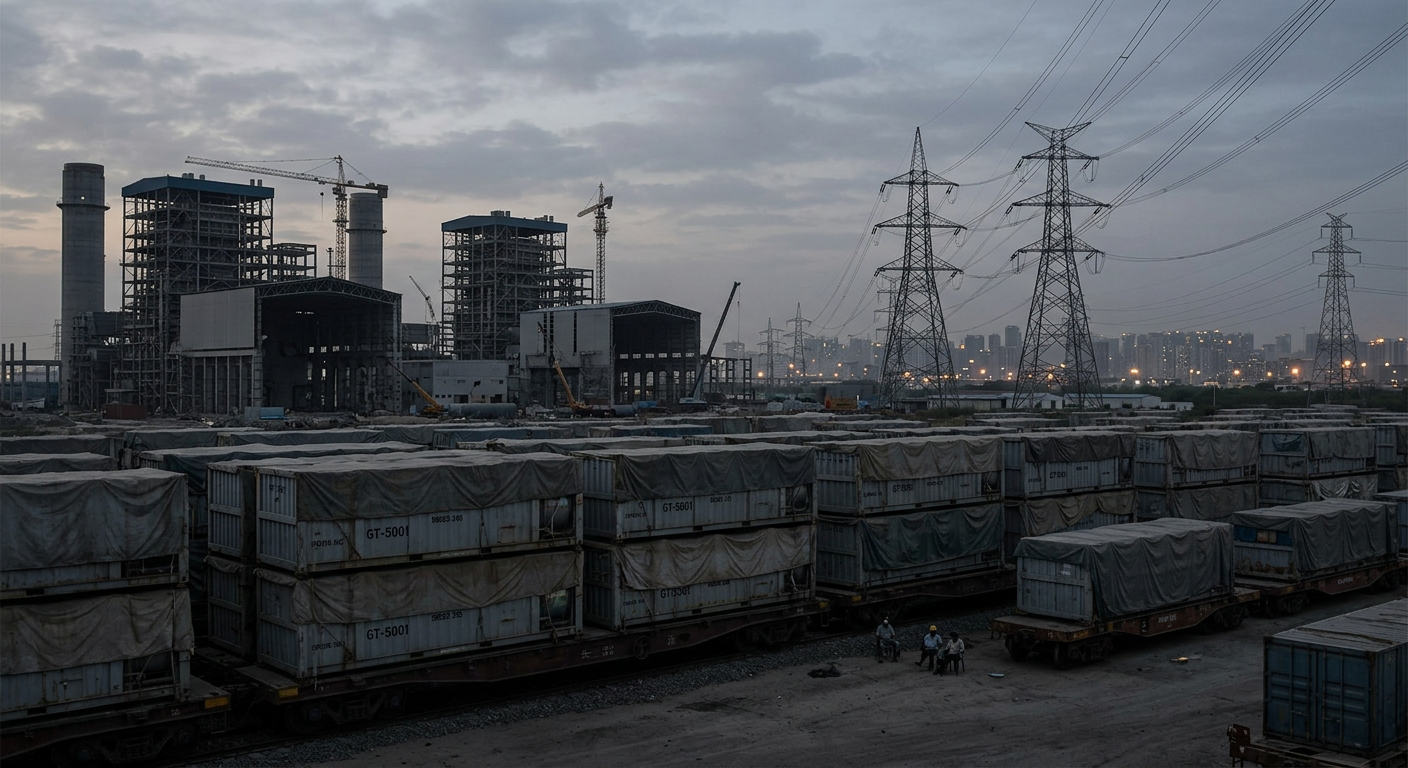
Which brings us to the equipment — and the single most spectacular industrial tape in the world right now. Siemens Energy, Europe's grid-and-turbine champion, reported its fiscal third quarter days ago: record orders of €17.9 billion, an all-time-high total backlog of €162 billion, revenue up 18.5%, and profit before special items more than tripled. The gas-turbine backlog is approaching 70 gigawatts — with customers now waiting up to four years for delivery and, in an almost unheard-of move, paying upfront reservation fees just to hold a production slot. The Grid Technologies division — transformers and switchgear — booked orders up 27.6% with a 1.48 book-to-bill and a €51 billion backlog of its own, and the company is expanding transformer and switchgear capacity by roughly 50% by 2030, including a ~$1 billion U.S. manufacturing buildout. Management now sizes the sustained annual gas-turbine market at 110–120 gigawatts — half of it American — and says the business is supply-constrained, not demand-constrained.
Read that backlog the way we read Powell's and TTM's last week: it's the strongest possible confirmation that the electrification supercycle is real — and it's a reminder of the two-sided test. A four-year delivery queue is magnificent revenue visibility right up until a customer cancels, a capacity expansion overshoots, or execution slips; Siemens Energy's own wind division spent years teaching investors that lesson, and the stock has already pulled back double digits from its spring highs even amid record orders. (For U.S. readers: Siemens Energy trades in Frankfurt, with thinly-traded OTC ADRs — it's the read-through here, not a formal pick. We featured the American ways to own this bottleneck — switchgear, PCBs, fiber — over the past week.)
Bottom line: The energy transition is becoming a financing and equipment cycle. When the state banks the wires and the equipment maker charges you a fee just to get in line, the toll collectors are the suppliers — regardless of which generation technology wins the argument.
3) Specialty Drugs Are Winning. Who Collects the Toll?
Cardinal Health reported fiscal fourth-quarter results Tuesday morning, and the print is a clean read-through on where healthcare's economics are migrating.
The headline: revenue of $63.7 billion rose 6% but missed the Street's estimate — and the stock didn't care, because everything beneath the top line was excellent. GAAP operating earnings jumped 70%. Full-year non-GAAP EPS grew 37% to $11.26. Management guided fiscal 2027 EPS to $12.40–$12.60, growth of 13–15%, above its own long-term algorithm — and the board approved a $5 billion increase to the buyback, taking total authorization to $6.4 billion. The driver is specialty pharmaceuticals, where Cardinal's revenues have been compounding at 20%-plus toward a $50 billion-a-year run rate.
That revenue-miss-profit-beat split is the lesson. A drug distributor's top line is largely pass-through — what matters is gross profit dollars, mix, and working capital. Specialty drugs are expensive, complex, and operationally unforgiving: cold-chain handling, patient support, reimbursement expertise, limited-distribution management. That infrastructure is genuinely hard to replace, which is why the distributor — a company that never discovers a molecule — keeps taking a growing toll on medicine's most expensive products.
Now the two-sided read, because the market has noticed all of this. Cardinal trades around $238 — a price that has roughly doubled-plus over a few years — and at the midpoint of new guidance that's about 19 times forward earnings for a distributor that historically traded at 10–12 times. The multiple assumes the specialty mix-shift keeps working and that Washington never successfully compresses specialty-drug economics — a live policy risk this piece has flagged before (recall the IRA Medicare drug-pricing headwind that hit Albertsons' pharmacy guidance). Add the four-test reflex on that buyback headline: $6.4 billion is an authorization, and Cardinal's history of actual repurchases is what to watch in the coming 10-Qs. One more mechanical note: the print landed Tuesday morning, so event risk is cleared — but the easy re-rating from "boring generic distributor" to "specialty toll collector" has largely happened. You're no longer early. You'd be paying for execution.
Bottom line: The specialty-drug boom is also a supply-chain trade, and Cardinal just proved the earnings engine again. Follow who controls access and execution — then be honest that a 19x multiple already assumes the toll booth stays open.
4) This Tiny Defense Supplier Is Selling Detection, Not Missiles
The Stock: 908 Devices (NASDAQ: MASS)
908 Devices makes handheld chemical-analysis tools — mass spectrometry and spectroscopy shrunk into devices that soldiers, border agents, first responders, and drug-enforcement teams use to identify unknown substances in the field, in minutes. Fentanyl and novel narcotics at a checkpoint. Chemical warfare agents on a battlefield. Hazmat at an industrial accident. Small dollar value per device; enormous cost of being wrong.
Tuesday morning's second-quarter report showed the model working. Revenue of $16.1 million grew 23%. The installed base grew 23% to 4,101 devices. Recurring revenue — service, calibration, software — ran at 31% of sales. The adjusted EBITDA loss narrowed by more than half, to just $1.9 million. Management raised the low end of full-year guidance to $68–70 million, representing 21–25% growth, and the pipeline is visibly international: more than 35 VipIR chemical-identification units shipped in the quarter including 18 to a major South Asian law-enforcement agency, plus a $6 million order from an Asia-Pacific corrections agency landed after quarter-end. The balance sheet is the quiet strength: $101.5 million of cash and zero debt — real staying power for a company with a ~$335 million market cap — even after spending $13.5 million in the quarter to acquire NIRLAB, a Swiss maker of AI-powered narcotics-detection tools. Management's stated path: adjusted-EBITDA crossover this year.
Some honest questions to keep in mind for the company: Does recurring revenue expand? It's growing, but 31% of sales means this is still mostly a hardware-placement story — the flywheel is promising, not proven. Does the company reach breakeven before needing capital? $101.5 million against a $1.9 million quarterly adjusted-EBITDA burn says yes with enormous room — though note the GAAP net loss was a much larger $11.9 million, so read the reconciliation, not just the adjusted line. Are placements durable adoption or one-time program funding? Genuinely unresolved — government and law-enforcement budgets drive lumpy, grant-dependent orders, and a South Asia agency's 18 units this quarter tells you little about next quarter.
And the market-structure cautions: the stock trades near the top of its 52-week range ($5.03–$9.34) after roughly a 50%-plus run over the past year; analyst coverage is thin (a handful of firms, targets clustered around $11, with one recent downgrade to Hold and one fresh Buy initiation — a genuine split); and a company director sold 20,000 shares on August 5 with an intent-to-sell filing for more. None of that is disqualifying for a small-cap that's executing — but it means position sizing for a $335 million company whose stock has already been discovered by somebody. Small-cap defense is attractive precisely because the market can miss the supplier beneath the prime. It is dangerous for the same reason.
Bottom line: Defense spending is not only about weapons. Field detection is becoming a recurring niche with a fortress small-cap balance sheet behind it — buy it, if you buy it, as a multi-year adoption story at micro-cap sizing, not as a momentum trade near its highs.
Before You Go
The market is still rewarding the biggest story: AI, energy, specialty medicine, defense. The independent edge is finding the necessary layer underneath each one.
Regulation creates audit work — mandatory, budgeted, boring. Grid expansion creates equipment demand — so intense that the equipment maker now charges a fee just to stand in line. Specialty drugs create logistics complexity — and the toll collector just raised guidance and its buyback in the same morning. Defense procurement creates field-testing requirements — and the company selling the detectors is sitting on $100 million of cash with no debt.
That's where the real economics live. Ask who must buy, who can be replaced, who gets paid before the headline fades, and who has the balance sheet to survive a delay. The crowd buys the theme. You should underwrite the bottleneck.
Found this helpful? Share it with others.
Written by Behind the Markets