Morning Watchlist: Tuesday Edition
A quick note from Behind the Markets
Tuesday's market wants to celebrate a soft landing and another AI week — and after Friday, who can blame it? The economy reported losing jobs and stocks finished their best week since April anyway.
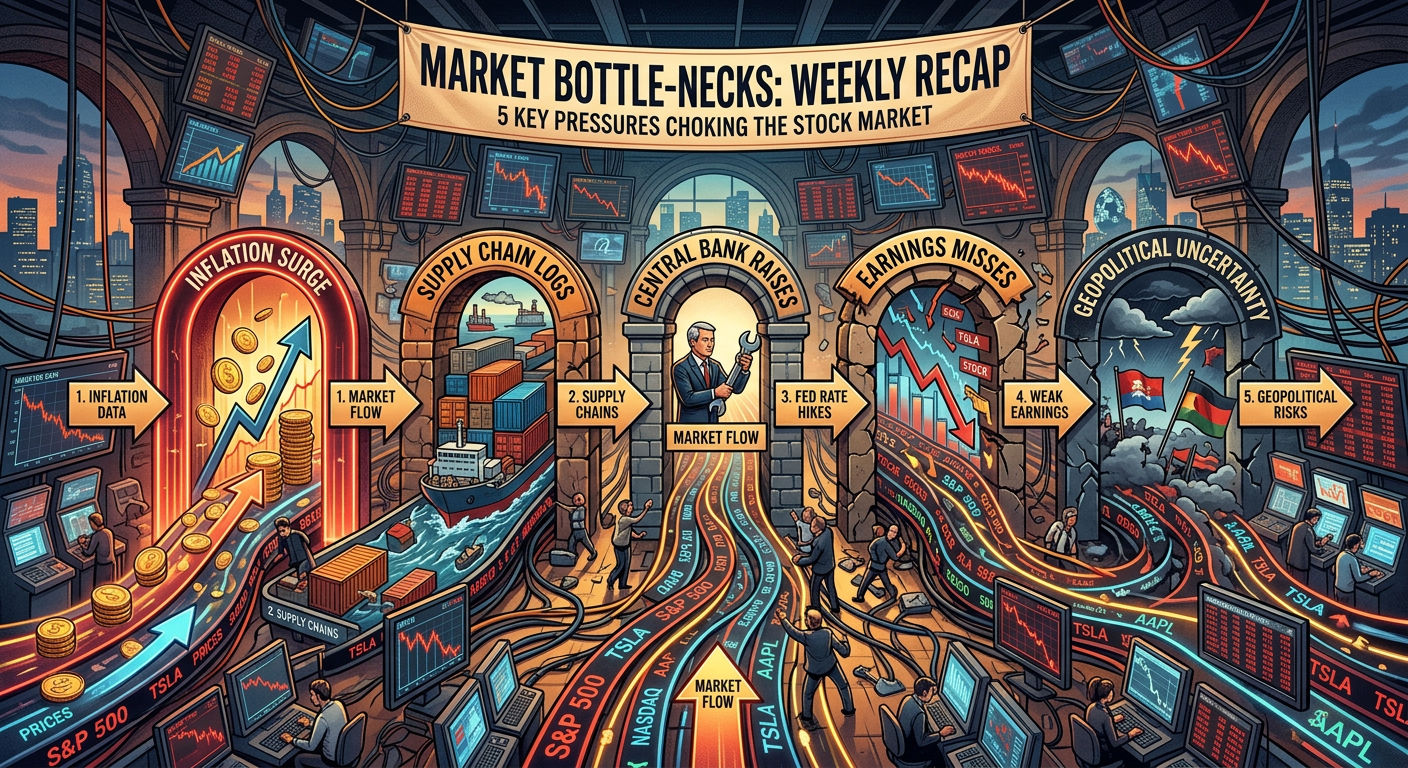
But several potential chokepoints are emerging.
Washington is rewriting the contest between banks and stablecoins — with the decisive vote now parked five weeks away.
A shipping choke point is making energy a logistics trade, with tanker traffic through the world's most important strait running at a tenth of normal.
Commercial real estate debt is facing hard maturities that don't care about press releases.
And two software vendors just lost a quarter of their market value in a single week for the same underlying reason: the money kept flowing through their industries, and less of it stuck to them.
Wall Street will package these as separate sectors. They're the same question: who owns the bottleneck, and who absorbs the cost?
1) Stablecoins Are Coming for the Deposit Franchise
On Saturday, Senate Majority Leader John Thune filed to set up a procedural vote on the Digital Asset Market Clarity Act — the crypto industry's long-sought federal rulebook — for when the Senate returns in mid-September. The bill would draw the line between digital commodities and securities, divide oversight between the CFTC and SEC, and give banks explicit authority for a long list of digital-asset activities. It needs 60 votes: every Republican plus at least eight Democrats.
Two honest cautions: This filing came after the Senate missed its own window — leadership promised a vote before the August recess and couldn't deliver it, so September's three-week sprint before midterm season is the whole game. Senator Thom Tillis put it bluntly: with the delay, the odds "drop precipitously." Second, the stablecoin yield-and-rewards question is explicitly one of the unresolved issues negotiators are still fighting over, alongside ethics provisions. Nothing here is settled.
Which is exactly why the underlying fight matters more than the bill's odds. The real dispute is not ideological. It's about funding. Banks have lobbied ferociously against language that would let crypto firms offer yield-like rewards on customer stablecoin holdings — because a digital dollar that pays you is a savings account without a bank attached. The draft text tries to split the difference: no interest merely for holding a payment stablecoin, but rewards tied to bona fide transactions and services are permitted. Banks want to stop token issuers from competing for deposits. Crypto firms want digital dollars useful, not just compliant. That fight survives whatever happens in September.
The investment map is two-sided: clear rules benefit custody, compliance, settlement, and exchange infrastructure — but if stablecoins become a better cash substitute, bank funding costs and net-interest margins eventually feel it. The winners will be firms that monetize the rails without needing either side's total victory.
The Stock (handle with care): Fiserv — SYM: FISV
Here's the company sitting at the exact center of this fight — and it comes with the biggest warning label of the week.
Fiserv is the plumbing of American banking: core processing and payments technology for roughly 10,000 financial institutions and six million merchant locations moving 90 billion transactions a year. Most of the community banks and credit unions whose deposit franchises stablecoins threaten? They run on Fiserv. And Fiserv's answer to the threat is the most interesting rails play in the space: FIUSD, its own bank-grade stablecoin platform — built on Circle and Paxos infrastructure, interoperable with PayPal's PYUSD, delivered through the systems its bank clients already use, and explicitly designed to keep dollar deposits inside the regulated banking system while adding blockchain settlement. The company is also developing deposit tokens, a more capital-friendly structure for banks. In other words: whichever way the CLARITY fight breaks, Fiserv is selling shovels to the defenders.
Now the warning label, and it's a big one. Fiserv reported second-quarter results last Thursday and it was ugly. Adjusted revenue fell 4% to $4.96 billion, adjusted EPS of $1.84 missed and fell 26% year over year, and management cut full-year guidance — again — to organic revenue of −1% to flat and EPS of $7.20–$7.40. The stock plunged roughly 10% to around $48, pennies from its 52-week low, down nearly 60% in a year and roughly two-thirds from its all-time high above $140. The banking segment shrank 8%, core account counts are down 3%, Argentina is a persistent macro headwind, and the company's president departed unexpectedly in July — management turmoil in the middle of a turnaround.
So why name it at all? Because the math has become remarkable: at ~$48 against $7.20–$7.40 of guided earnings, you're paying about 6.5 times earnings for critical infrastructure with $1.1 billion of quarterly free cash flow (112% conversion) and a strategic asset (FIUSD) the market is currently valuing at zero. That's the kind of price you only get when everything is going wrong at once.
But hear the discipline clearly: this is a falling knife until it stops falling. Three guidance disappointments in a year means management has lost the benefit of the doubt; the next print has to do the talking. The print is public (event risk cleared), the valuation is the opportunity, and the burden of proof is entirely on the company. This goes on the watchlist as the cheapest seat at the deposit-competition fight — with position sizing for a stock that has repeatedly shown it can gap down double digits on its own news.
Bottom line: The stablecoin trade is a deposit-competition trade. Follow the plumbing, not the political slogans — and when the plumbing goes on clearance sale, understand exactly why before you reach for it.
2) Your Oil Hedge Is Really a Shipping Hedge
The Strait of Hormuz is still operating at a trickle — and now we can quantify the trickle: 8 to 15 vessels a day crossed the strait early this month, per ship-tracking data, against roughly 130 daily transits before the conflict. That's the largest energy disruption in recorded history, entering its sixth month.
The weekend's headlines captured the whiplash perfectly. Iran said Sunday that a deal with Oman defining new shipping lanes was in its "final stages" — inbound vessels through Iranian waters, loaded outbound tankers through Omani waters. Then Tehran published its conditions: an end to the war, the lifting of the U.S. counterblockade, sanctions relief, frozen assets released, and war reparations. President Trump told Axios the U.S. is "only semi-negotiating." Oil, which had fallen more than 7% last week on deal optimism, reversed hard — Brent traded from about $84.40 in the early Monday session to nearly $86 by mid-morning, with WTI pushing above $80.
One piece of history the market keeps forgetting: a Hormuz deal has already collapsed once. The June 17 memorandum of understanding to reopen the strait fell apart within days over exactly the question on the table now — which routes vessels could use and who controls them. As one analyst put it Monday, even if an agreement is announced, "these understandings can prove fragile."
That gap between agreement and actual cargo movement is the trade. Energy investors reach first for producers, but a shipping disruption pays the companies that move, store, insure, blend, or reroute molecules. Tanker rates, marine insurance, port capacity, inventory ownership, and regional product spreads matter more than the headline barrel.
Every pure-play on this disruption — tanker owners above all — is now a coin flip on a diplomatic headline. A signed reopening deal could crush tanker rates and those stocks in an afternoon; a collapse could spike them. When your thesis can be vaporized by a single press conference in Muscat, in either direction, that's not an investment — that's a wager on news timing. The durable version of this trade is the second-order screen: companies with hedges, local supply, and pricing power absorb a route shock; businesses that buy spot and sell fixed cannot. Run your holdings through that filter this week instead.
Bottom line: Don't buy energy on the headline. This is a supply-chain problem wearing an oil-market costume — and right now, even the toll collectors are binary bets.
3) CRE Lending Is Back. The Maturity Wall Did Not Leave.
Trepp's August review found $5.49 billion of private-label CMBS hard maturities across 130 loan pieces, roughly double July's total. Office represented $1.81 billion — about a third of the cohort — and all current delinquency in the group was in office. Trepp also flagged $3.04 billion of these loans carrying debt yields below 8%, the zone where refinancing math stops working.
The number that matters is not the current delinquency rate. It's the loan that is technically performing while failing the next lender's underwriting test. Trepp counts $76.6 billion of CMBS hard maturities in 2026. Office and retail borrowers can remain current right up to the day the extension options run out.
The wider context sharpens the point. CMBS delinquency reached 7.5% earlier this year with the special servicing rate near 11% — and office delinquency has printed record highs above 12%. Across all lender types, the Mortgage Bankers Association counts roughly $875 billion of commercial mortgages maturing in 2026. Even Trepp's own research director frames this year as — hopefully — "the peak," with normalization beginning in 2027. Peaks are where the bodies surface.
That makes "banks are lending again" an incomplete signal. New originations can rise while old loans get modified, extended, or pushed into special servicing. The cleaner opportunities are the businesses paid for occupancy, leasing, operations, and workout expertise — the fee-earners of the workout cycle — rather than lenders chasing volume into the wall. No name today: the leasing-and-services giants that fit this screen reported earnings in the past two weeks, and I won't feature them until I've put their prints through the full process. That's a Thursday project, not a Tuesday shortcut.
Bottom line: CRE stress is moving from a rate story to a maturity story. The calendar, not the press release, decides who gets refinanced.
4) Retail Media Can Grow While the Vendor Gets Weaker
Criteo's second quarter is the cleanest specimen yet of a risk hiding inside the retail-media boom — and the market just graded it in public: the stock crashed 28% in a day, to around $16, pennies off its 52-week low.
Media spend through Criteo's platform rose 9% at constant currency to $1.1 billion. Retail-media spend specifically grew over 30%. The company beat the Street's revenue and EPS estimates. And the stock lost more than a quarter of its value anyway — because total revenue still fell 11% to $428 million, retail-media revenue fell 21%, and management cut full-year guidance to a 10–12% decline in contribution ex-TAC.
The mechanics matter. A $21 million headwind came from scope changes with two specific retail-media clients — big customers renegotiating what they pay Criteo for, which is a polite way of saying the platform's largest partners clawed back economics. Excluding that, the underlying client base grew 20%. The market's verdict: the exclusion doesn't count. When your growth depends on nobody large renegotiating, the renegotiations are the business model risk. More money can flow through an ecosystem while the vendor loses pricing power — that's not a paradox, it's a take-rate story.
The details deserve your attention beyond this one company. Gross margin slipped to about 52% from 54%. Free cash flow was negative in the quarter even as the company spent $61 million on buybacks in the first half — a buyback is not automatically shareholder-friendly when the business is funding a transition with a shrinking top line. There's a brand-new CFO as of this week. And for the AI optimists: Criteo's OpenAI partnership now spans 2,000+ brands with ChatGPT traffic converting at 1.5–2x normal referral rates — genuinely interesting — and management itself says it won't meaningfully affect 2026. Even the good news is a 2027 story.
The lesson generalizes to every "AI beneficiary" in your portfolio: ask whether the contract structure, data ownership, and measurement layer leave the supplier with a durable share of the value — or whether the platforms and largest clients can reprice the relationship whenever they like. Friday's tape showed the same split: software names with clean guides soared; vendors with take-rate questions got destroyed.
Bottom line: AI and retail-media spending can grow without making every intermediary stronger. Follow take rates, client concentration, and cash conversion — the market is now repricing these violently, in both directions, on every earnings call.
5) Rare Earths Are a Government-Backed Margin Trade
MP Materials' latest quarter is the reminder that critical minerals are no longer a pure commodity bet — and it contains one number almost everyone will misread.
The results themselves were strong: revenue of $108.5 million, up 89% from a year ago, driven by NdPr oxide and metal sales of $94.4 million on volumes up 127%. Adjusted EBITDA swung $41 million to positive $28.5 million. The net loss narrowed to $20.3 million, and on an adjusted basis the company essentially broke even — better than the Street expected. The Texas magnet business generated $16.5 million of revenue at better-than-40% margins, magnets were delivered to GM for in-car qualification, first commercial deliveries remain on schedule for the fourth quarter, and the company signed a nine-figure gadolinium supply deal with a U.S. aerospace customer.
Now the number to read carefully. MP recorded $17.6 million of U.S. government price-protection income this quarter — $110.9 million cumulatively since the Pentagon arrangement began. That deal sets a $110-per-kilogram floor under NdPr prices through 2035. Here's what most coverage missed: the support payment was $42.3 million in the first quarter, $17.6 million in the second, and management guides to roughly $10 per kilogram in the third. The subsidy is shrinking — because market prices are rising toward the floor. That's the mechanism working exactly as designed: the floor carries the company when prices are weak and fades as the market strengthens. Anyone dismissing MP as "a company that only earns government checks" is reading a chart that's already moving the other way. Anyone assuming the checks are permanent margin is making the opposite mistake.
The honest open question is the one the strategic framing skips: whether the magnet ramp becomes an economically durable business at commercial scale. Financial de-risking is not industrial de-risking — separating heavy rare earths reliably, converting oxides to metals, and manufacturing magnets to spec at thousands-of-tonnes scale is the hard part, and it's all still ahead. The company spent $307.7 million on capex in the first half and cash has drawn down to $1.45 billion from $1.83 billion doing it. This one printed last Thursday, so the numbers are public; the stock has had an enormous policy-driven run, so treat it as a story to understand rather than a dip to chase.
The underfollowed opportunity may sit in the equipment, separation, testing, recycling, and specialty-material suppliers that earn from the buildout without carrying full mining-and-processing risk — a screen worth building this quarter as the heavy-rare-earth circuits come online across the industry.
Bottom line: Critical-minerals policy can create a floor, but only operating economics create a moat. MP's own income statement now shows the floor receding as the market takes over — which is precisely what success is supposed to look like, and precisely when execution risk takes center stage.
Before You Go
Markets look calm when the headline moves in one direction. The harder truth is that the costs are always being pushed somewhere.
Stablecoins push on bank funding — and the company that runs the banks' plumbing just went on sale for six and a half times earnings, for reasons that have nothing to do with stablecoins. Hormuz pushes on logistics — at eight to fifteen ships a day where 130 used to sail. CMBS maturities push on property values — $76.6 billion of them this year, on a calendar no press release can amend. Retail media pushes on vendor bargaining power — ask Criteo's shareholders, who are 28% lighter. Rare-earth policy pushes on the line between national security and shareholder returns — and at MP, the government's share of the margin is already handing the job back to the market.
The crowd buys the label. You should underwrite who gets paid, who gets squeezed, and who has enough balance-sheet strength to wait.
Found this helpful? Share it with others.
Written by Behind the Markets