Key Bullet Points:
- Alphabet (GOOGL) cut its share buyback program to zero — ending a program that returned $346 billion to shareholders over the past five years — and acquired a $40 billion stake in rival AI company Anthropic, betting that owning its competitor matters more than rewarding the investors who already own Google
- Brent crude surged past $95 a barrel for the first time in six weeks — up more than 30% from pre-conflict levels near $72 — after President Trump threatened to "bomb and destroy one bridge or power plant" every time Iran attacks a ship in the Strait of Hormuz
- Secretary of State Marco Rubio said Iran is "not serious" about reaching a peace deal, while the U.S. military completed its 11th consecutive night of strikes, air raid sirens sounded in Bahrain, and Saudi Arabia warned citizens to take cover
- Tesla (TSLA) and Alphabet both report Q2 earnings after Wednesday's close — with Tesla at 177x forward earnings and short bets up 33%, and Alphabet needing Google Cloud to deliver 70% year-over-year growth to justify scrapping shareholder returns entirely
- SpaceX (SPCX) announced its first-ever public earnings date — August 4 — then slipped on Wednesday, while the Dow rose 0.3%, the S&P 500 edged up 0.2%, and the Nasdaq dipped 0.1% as the market held its breath ahead of the two most important reports of the quarter
Alphabet Just Told Its Shareholders: AI Matters More Than You Do
In the most aggressive strategic pivot in Big Tech history, Alphabet eliminated its share buyback program entirely on Wednesday — slashing repurchases to zero after spending $346 billion returning cash to shareholders over the past five years.
Where is the money going? To Anthropic.
Alphabet disclosed a $40 billion stake in the AI company that has been positioning itself as Google's most dangerous competitor. The same Anthropic that has been poaching Google's top AI researchers. The same Anthropic whose Claude model has been steadily closing the gap with Google's Gemini. Alphabet's answer to the competitive threat was not to outbuild it — but to buy a massive piece of it.
The move came hours before Alphabet was set to report its Q2 2026 earnings after Wednesday's close, with Wall Street expecting earnings per share of $2.89 on revenue of $116.84 billion, representing approximately 21% year-over-year growth. But the numbers almost don't matter anymore. What matters is whether Google Cloud can deliver 70% year-over-year growth — the threshold analysts say is necessary to justify abandoning shareholder returns in favor of an AI infrastructure buildout now projected to exceed $190 billion through 2028.
To fund this transformation, Alphabet raised $84.75 billion in a stock offering earlier this month, with $10 billion of that placed privately with Berkshire Hathaway. Warren Buffett is now directly financing Google's bet that artificial intelligence will restructure the entire technology industry — and that Alphabet needs to own both sides of the competition to survive.
For shareholders, the message is blunt: Alphabet believes the AI arms race is more important than your dividends, your buybacks, and your near-term returns. The stock gained just 0.35% on Wednesday ahead of the earnings release. The market hasn't decided yet whether this is visionary or reckless.
Oil at $95: The War Premium That Won't Stop Growing
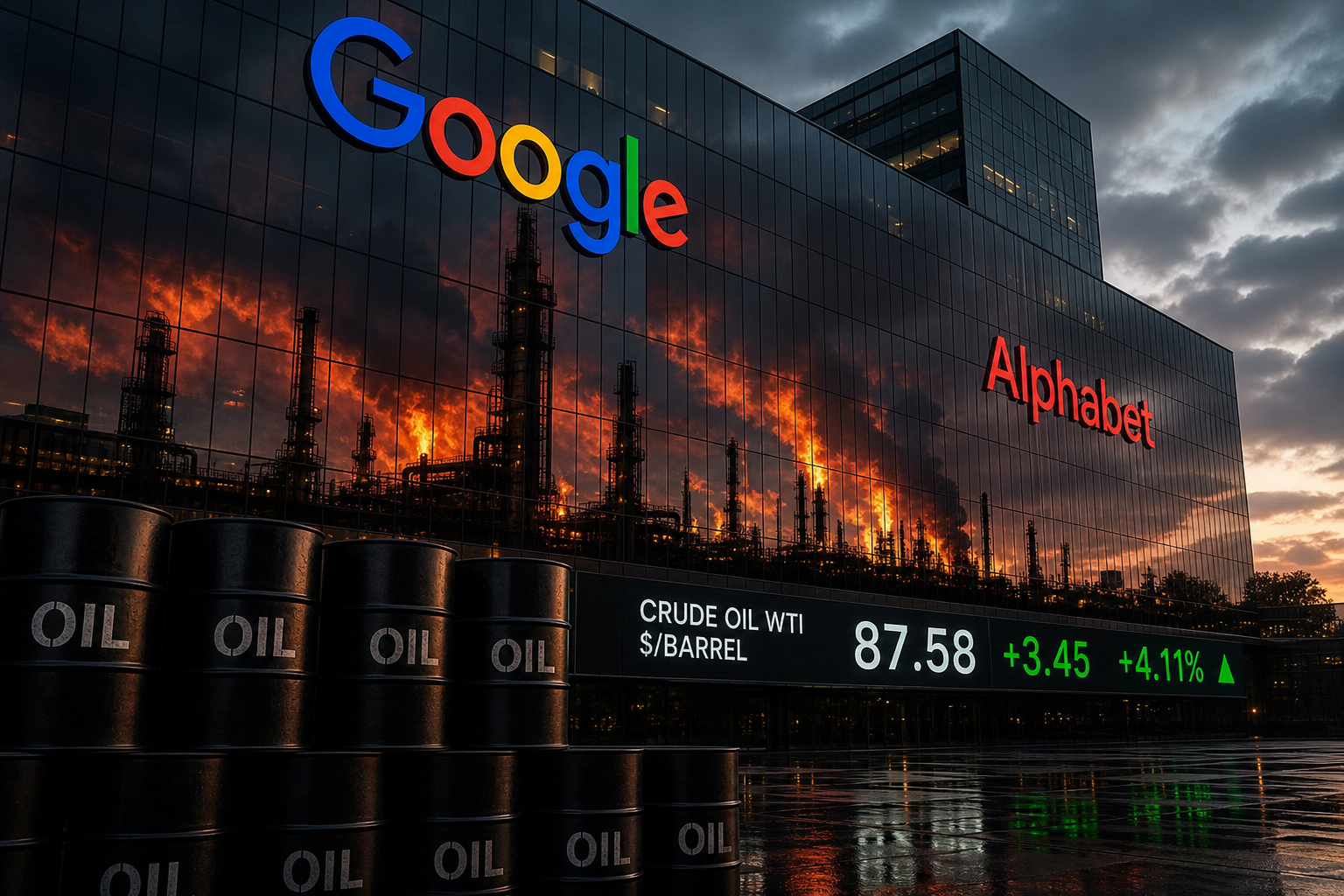
Brent crude surged past $95 a barrel on Wednesday — hitting $95.47 intraday, the highest level in six weeks — before settling at approximately $94. West Texas Intermediate climbed above $88.
The numbers tell a story of relentless escalation. Three weeks ago, before the U.S.-Iran conflict intensified, Brent was trading near $72. It has now risen more than 30%. When oil crosses $90, it begins to function as a tax on every consumer and every company in the economy. At $95, it becomes an active threat to the earnings growth that has been holding this market together.
The immediate catalyst was President Trump's most explicit infrastructure threat yet. In a Wednesday morning statement, Trump declared that the United States would "bomb and destroy one bridge or power plant" every time Iran attacks a ship in the Strait of Hormuz. The threat transforms the conflict from a military campaign into an economic war — targeting the civilian infrastructure that keeps Iranian society functioning.
Secretary of State Marco Rubio reinforced the escalation, telling reporters that Iran is "not serious" about reaching a deal to end the fighting. The U.S. military confirmed it had completed its 11th consecutive night of strikes against Iran. Air raid sirens sounded in Bahrain. Saudi Arabia issued warnings for citizens to seek shelter.
Meanwhile, the Houthi naval blockade of Saudi Arabia — declared Monday — remains in effect, threatening to choke the world's largest oil export corridor from a second direction. Oil analysts at several major banks have begun raising their price targets, with some suggesting Brent could reach $120 if the Strait of Hormuz becomes functionally impassable.
At $95 and climbing, the market is pricing in a conflict that is getting worse, not better.
Tesla's 177x Moment of Truth
Tesla entered Wednesday's close as the most expensive stock in the Magnificent Seven — trading at 177 times forward earnings — with short bets against the company surging 33% in recent weeks.
Wall Street expects Q2 revenue of $26.4 billion and earnings per share of $0.53-$0.54. The car numbers should be strong — Tesla already reported record Q2 deliveries of 480,126 vehicles. But as with Alphabet, the headline numbers are secondary. Investors want to hear about robotaxis, Optimus, and whether Tesla's massive AI spending — which has pushed the company into negative free cash flow — is generating measurable progress or burning capital.
The stock is down roughly 14% year to date. Short sellers have been building positions aggressively, reading the technical weakness as a sign that the valuation has finally outrun the narrative. If Tesla delivers a beat-and-raise quarter with concrete autonomous driving milestones, the shorts get squeezed. If the results reveal that the AI spending is accelerating faster than the revenue it generates, the 177x multiple becomes indefensible.
Between Tesla and Alphabet, Wednesday evening's after-hours session will set the tone for the rest of earnings season — and potentially the rest of the summer.
The Market Held Its Breath
The broader market barely moved on Wednesday as investors positioned for the two most important reports of the quarter. The Dow rose 0.3%, the S&P 500 edged up 0.2%, and the Nasdaq dipped 0.1%. The Russell 2000 fell 0.7%, reflecting the growing divergence between mega-cap tech and everything else.
Semiconductor stocks pulled back after Tuesday's 5.36% surge in the SOX index, cooling a rally that had been driven more by short-covering than conviction. The chip sector remains in a bear market, down more than 20% from its June 2 peak, and the bounce's survival depends entirely on what Alphabet says about AI spending tonight.
SpaceX announced it will release its first-ever quarterly earnings on August 4 — a historic moment for the company that went public just six weeks ago. The stock slipped on Wednesday after Tuesday's 3% rebound from record lows. At roughly $123, SpaceX trades 45% below its all-time high of $225.64, and investors are hungry for actual financial data to justify a valuation that was built on narrative alone.
The stage is set. Two reports. $95 oil. A war with no end in sight. And a market that has been rising on the assumption that corporate earnings can outrun geopolitical chaos. Tonight, that assumption gets tested.
Found this helpful? Share it with others.