Key Bullet Points:
- Tesla (TSLA) crashed roughly 14% on Thursday — its worst single-day plunge of the year — after reporting adjusted earnings per share of just $0.33 versus the $0.53 Wall Street expected, a stunning 39% miss driven by surging AI and robotaxi spending that pushed free cash flow to negative $1.1 billion
- Brent crude blasted through $100 a barrel for the first time since late May — hitting $101.47 intraday — after Yemen's Houthis bombed two Saudi oil tankers in the Red Sea and the Strait of Hormuz remained effectively closed, with oil now up more than 30% this month alone
- Alphabet (GOOGL) sank nearly 7% despite reporting revenue of $119.8 billion — a 24% year-over-year beat — after raising its full-year capital expenditure forecast to $195–$205 billion and spending a record $44.9 billion in a single quarter, while its headline $9.11 EPS included $6–$7 in one-time unrealized gains from its Anthropic and SpaceX stakes
- The Dow plunged more than 550 points, the Nasdaq tumbled over 2.5%, and SpaceX fell to a new post-IPO low below $115 — down 49% from its all-time high — as short sellers booked $15.5 billion in paper profits and the company's August 4 first-ever earnings report loomed
- The U.S. military confirmed a 12th consecutive night of strikes against Iran — including the first use of B-1 long-range bombers in weeks — while the House voted to limit the president's war authority and Iran threatened retaliation for Trump's vow to destroy bridges and power plants
The Most Expensive Stock in the Magnificent Seven Just Got 14% Cheaper in a Single Day
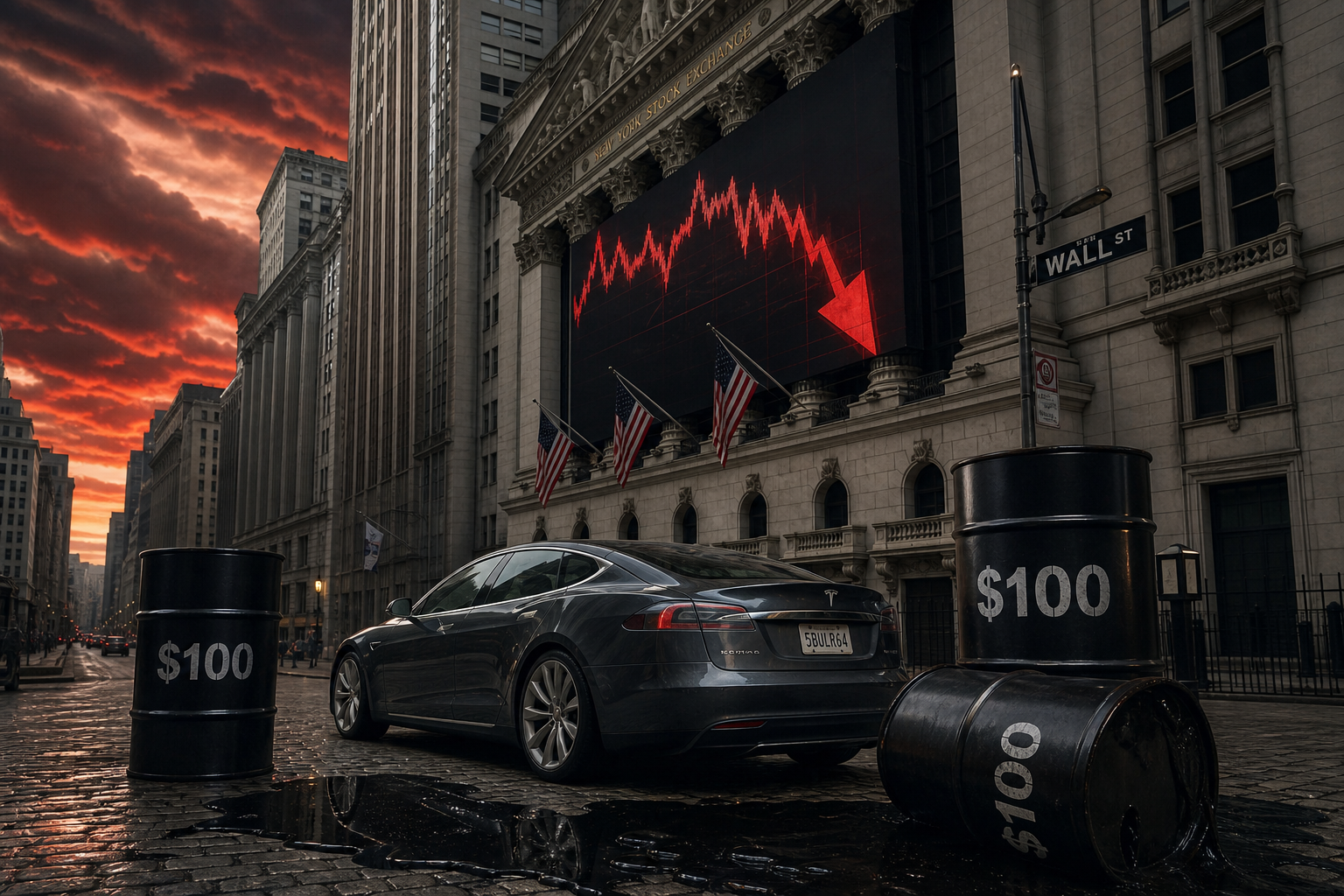
Tesla entered Wednesday's earnings call trading at 177 times forward earnings — the most expensive valuation of any stock in the Magnificent Seven. By Thursday afternoon, the market had rendered its verdict: that multiple was indefensible.
The electric vehicle maker reported second-quarter revenue of $28.24 billion, beating estimates of $26.4 billion and growing 26% year-over-year. Record deliveries of 480,126 vehicles proved the car business is not the problem. The problem is everything else Elon Musk wants Tesla to become.
Adjusted earnings per share came in at just $0.33 — a staggering 39% miss against the $0.53 consensus. Free cash flow turned negative at minus $1.1 billion, compared to positive $146 million a year ago. Capital expenditures surged 142% year-over-year, and Tesla raised its full-year capex guidance above $25 billion as it pours money into AI computing capacity, robotaxi infrastructure, Optimus robot production lines, battery manufacturing, and semiconductor facilities.
The stock opened Thursday at $341 and kept falling, hitting a low of $318.55 before trading around $321 — a roughly 14% wipeout from Wednesday's close of $374.01 on volume exceeding 78 million shares. Analysts immediately began slashing price targets, and the short sellers who had increased their bearish bets by 33% heading into earnings were spectacularly vindicated.
The message from the market was clear: record car sales are not enough to justify a $1 trillion-plus valuation when the company is burning cash faster than it can sell vehicles. Tesla needs its AI bets — robotaxis, Optimus, Full Self-Driving — to start generating revenue, not just consuming capital. Until that happens, 177 times forward earnings was never a number. It was a prayer.
Oil Crosses $100: The Threshold No One Wanted to See
Brent crude blasted through the $100-per-barrel mark on Thursday for the first time since late May, hitting $101.47 intraday before closing near $101. West Texas Intermediate surged above $92. Oil prices have now risen more than 30% this month alone.
The immediate trigger was an attack by Yemen's Houthis on two Saudi oil tankers in the Red Sea — opening a dangerous new front in a conflict that has already disrupted the world's most critical shipping lanes. The Strait of Hormuz, through which roughly 20% of the world's oil flows daily, remained effectively closed after Iran's sustained attacks on commercial vessels. Now the Red Sea route — the alternative corridor that global shipping has relied upon — is under threat as well.
The U.S. military confirmed Thursday morning that it had conducted a 12th consecutive night of strikes against Iran, deploying B-1 long-range bombers for the first time in weeks. Iran reported that two rescue vessels were damaged in U.S. strikes in the southern province of Hormozgan, directly on the Strait of Hormuz. The House of Representatives voted to limit the president's authority to wage war against Tehran — a move that has zero chance of becoming law but signals growing unease in Congress.
Iran, meanwhile, threatened an "eye-for-an-eye" response to President Trump's Wednesday vow to "bomb and destroy one bridge or power plant" for every Iranian attack on a ship in the Strait. Kuwait intercepted drones. Air raid sirens continued sounding across the Gulf.
At $100 oil and climbing, this is no longer a geopolitical risk premium. It is a supply crisis in the making. Analysts at several major banks are now openly discussing $120 Brent as a realistic scenario if the Strait remains closed through the summer. At that level, oil becomes an active drag on consumer spending, corporate margins, and the economic growth that this entire stock market rally has been built upon.
Alphabet's $200 Billion Problem
Alphabet delivered one of the strongest revenue quarters in its history — $119.8 billion, up 24% year-over-year, with Google Cloud surging 82% to $24.8 billion and Search growing 17%. Cloud backlog swelled to $514 billion. By any traditional measure, this was a blowout.
The market didn't care.
Alphabet's stock sank nearly 7% on Thursday, dragging the Dow down roughly 136 points by itself, after the company raised its full-year capital expenditure forecast to $195–$205 billion — up from the already staggering $180–$190 billion guidance it gave three months ago. The company spent a record $44.9 billion in a single quarter on AI infrastructure. That number has roughly doubled in twelve months.
The headline earnings per share figure of $9.11 — up 294% year-over-year — looked incredible until investors realized that $6 to $7 of it came from unrealized gains on Alphabet's stakes in Anthropic and SpaceX. Strip those out, and adjusted earnings of $2.85 per share actually missed the $2.89 consensus.
This is the same company that just killed its $346 billion buyback program and redirected all of its capital into AI infrastructure and a $40 billion Anthropic acquisition. Google Cloud's 82% growth exceeded the 70% threshold analysts said would validate the strategy. But the market has decided that $200 billion in annual capex is too much spending, no matter how fast the cloud is growing.
A Market That Is Starting to Crack
Thursday's selloff extended across the board. The Dow plunged more than 550 points. The S&P 500 fell roughly 1.5%. The Nasdaq tumbled over 2.5%, dragged lower by Tesla's collapse and Alphabet's post-earnings slide.
SpaceX fell to a new post-IPO low below $115 — now down 49% from its all-time high of $225.64. Short sellers have booked $15.5 billion in paper profits betting against the company, and the stock trades 15% below its $135 IPO price with a lock-up expiry approaching on August 6 that could unleash additional selling pressure. The company's first-ever public earnings report on August 4 now represents both its best hope for a rebound and a potential catalyst for further decline.
The combination of $100 oil, collapsing Big Tech earnings multiples, and an escalating Middle East war is creating the kind of environment where markets can move violently in either direction. Tesla and Alphabet together represent roughly $3 trillion in market capitalization, and both just told investors the same thing: we are going to spend massively on AI, and you are going to have to trust us.
The market's answer on Thursday was emphatic: trust is earned, not assumed — and right now, the receipts don't match the promises.
Found this helpful? Share it with others.