Key Points:
- Amazon announced a multiyear, multibillion-dollar agreement with Corning to supply the optical fiber, cable, and connectivity solutions powering its data centers
- Corning shares surged as much as 9% on the news, with the stock trading above $189 — up more than 280% from its 52-week low of $49
- The deal creates 1,000 new manufacturing jobs in North Carolina and follows a similar $6 billion agreement Corning signed with Meta earlier this year
- Corning's Optical Communications segment grew 36% year-over-year last quarter to $1.85 billion, making it one of the fastest-growing divisions in the AI supply chain
- While investors chase GPU makers, Corning has quietly become the essential infrastructure layer connecting every AI data center on the planet
The Invisible Backbone of the AI Boom
Everyone knows Nvidia makes the chips. Everyone knows Microsoft and Google build the models. But who makes the physical connections that hold the entire AI revolution together?
Corning does. And Amazon just wrote them a very large check to prove it.
On Monday, Amazon announced a multiyear, multibillion-dollar agreement with Corning to supply the optical fiber, cable, and connectivity solutions that power Amazon Web Services' expanding data center infrastructure across the United States. The deal sent Corning shares surging as much as 9% in premarket trading, pushing the stock above $189.
It's not the flashiest headline in a market obsessed with trillion-dollar GPU orders and celebrity AI chatbots. But it might be one of the most important signals about where the AI trade goes next.
What the Deal Actually Means
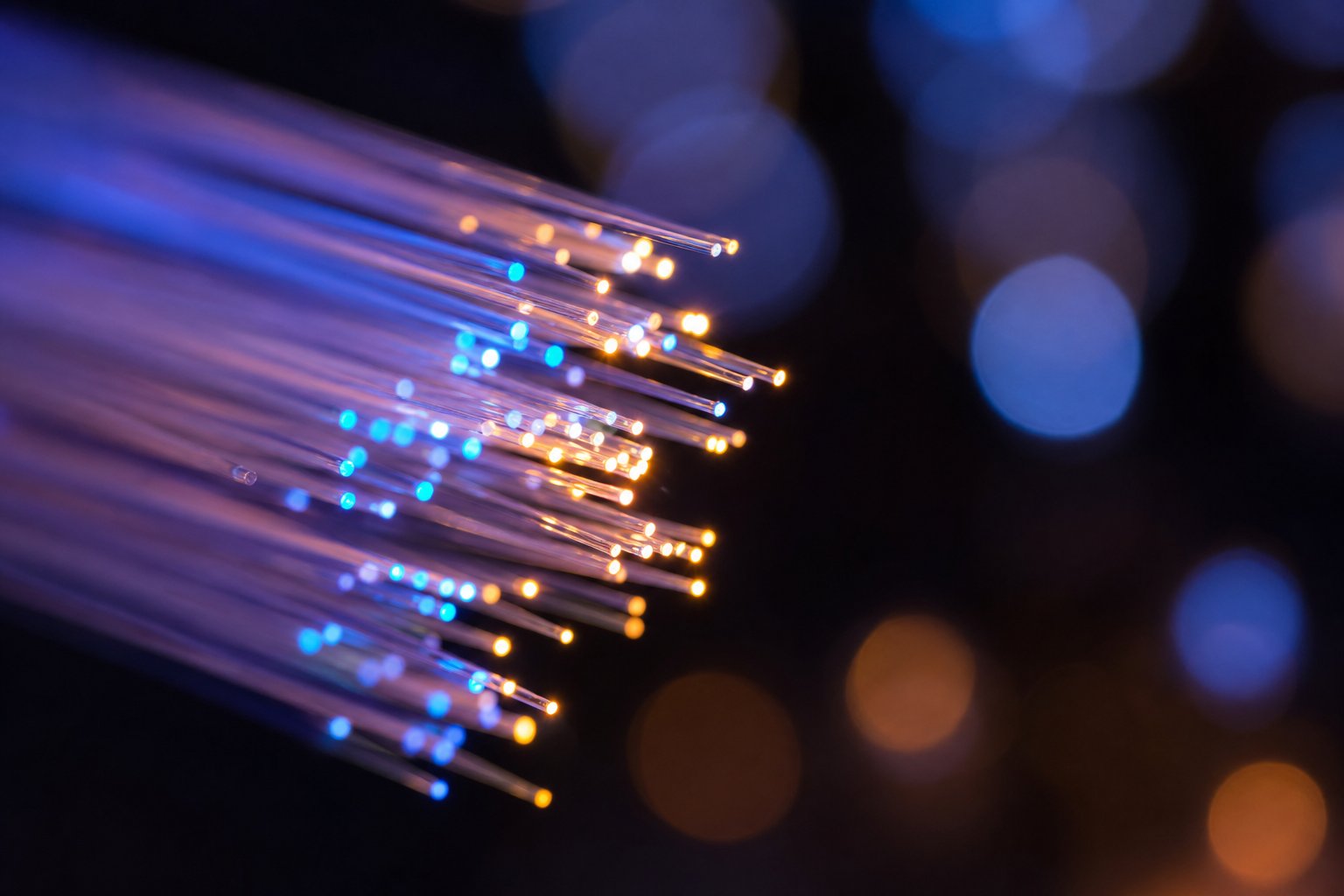
The Amazon agreement isn't just a purchase order — it's a strategic commitment to Corning as the primary supplier of the physical plumbing that connects AI data centers. Optical fiber is to data centers what roads are to cities: invisible, unglamorous, and absolutely essential.
Under the deal, Corning will expand its manufacturing facilities across North Carolina, creating 1,000 new highly skilled manufacturing jobs and supporting hundreds of additional construction positions. Amazon will also partner with Corning on a workforce development program through Catawba Valley Community College to train fiber optic technicians — a tacit admission that the industry is already struggling to find enough skilled workers to build the AI infrastructure it needs.
Amazon has now invested more than $20 billion in North Carolina alone, creating over 26,000 jobs across the state. The Corning deal represents the latest — and one of the largest — moves in a broader strategy to bring critical AI supply chains back onshore.
The Pattern Is Unmistakable
Here's what should catch investors' attention: this is the second massive fiber optics deal Corning has landed from a hyperscale tech giant in 2026.
Earlier this year, Meta signed a multiyear agreement with Corning worth up to $6 billion to supply optical fiber, cable, and connectivity solutions for its own AI infrastructure. That deal was announced alongside Corning's Q1 earnings, during which the company also disclosed a third large hyperscale contract it hasn't yet named publicly.
Three deals of this magnitude in the span of months isn't a coincidence. It's a pattern. The hyperscalers — Amazon, Meta, Google, Microsoft — are all scrambling to lock in fiber optic supply as they build out the physical networks needed to support exponentially growing AI workloads. And Corning is the dominant supplier.
The Numbers Behind the Surge
Corning's Q1 2026 results, reported in late April, tell the story clearly. Total revenue grew 18% year-over-year to $4.35 billion, marking the company's eighth consecutive quarter of sales growth. Earnings per share rose 30% to $0.70, beating consensus estimates.
But the standout was the Optical Communications segment. Sales jumped 36% year-over-year to $1.85 billion — accelerating from 24% growth in Q4 2025 to 36% in Q1 2026. In a world where most companies are trying to slow the rate of deceleration, Corning is actually speeding up.
The company's Springboard strategic plan now targets $6.5 billion in incremental annualized sales by the end of 2026, with management extending the plan through 2030 as demand from AI data centers and fiber-to-the-home deployments continues to surprise to the upside.
From $49 to $190 — The Quiet Four-Bagger
What makes Corning's run remarkable is how little attention it's received compared to the AI names everyone knows.
Twelve months ago, Corning was trading near $49. Today it's above $189 — a gain of roughly 285%. The stock briefly topped $211 earlier this year before pulling back 9% in late April when Q2 revenue guidance of $4.6 billion came in about $50 million below the most aggressive analyst estimates. Even that pullback has since reversed.
At $163 billion in market cap and 85 times earnings, Corning is no longer cheap. But the valuation reflects a company that has transformed from a sleepy industrial glass maker into a critical supplier for the most capital-intensive technology buildout in human history.
Why This Matters Beyond Corning
The Amazon deal highlights a broader reality about the AI trade that many investors are still missing: the boom isn't just about chips and software. Every new data center needs miles of optical fiber. Every connection between GPU clusters requires Corning's cable. Every expansion of cloud capacity means more orders for the glass and connectivity solutions that only a handful of companies on the planet can produce at scale.
While the semiconductor stocks grabbed headlines last week — Broadcom crashing 18%, CrowdStrike dropping 11% — Corning quietly kept climbing. It's a reminder that in a market obsessed with the most visible layer of the AI stack, the real money might be hiding one layer below the surface.
In the fiber optic cables that nobody sees but everybody needs.
Must Read Spotlight: I paid $5,000 to hear Elon say this
I recently paid $5,000 to be in a room with Elon Musk in Los Angeles. And what he said in that room, confirmed everything my 15+ years in the tech industry had been telling me. I believe what Elon is launching right now — a project 27 years in the making — could be his biggest move yet. If you buy just one stock in 2026, I urge you to make it the one I'm giving away for free here.
Found this helpful? Share it with others.