Key Bullet Points:
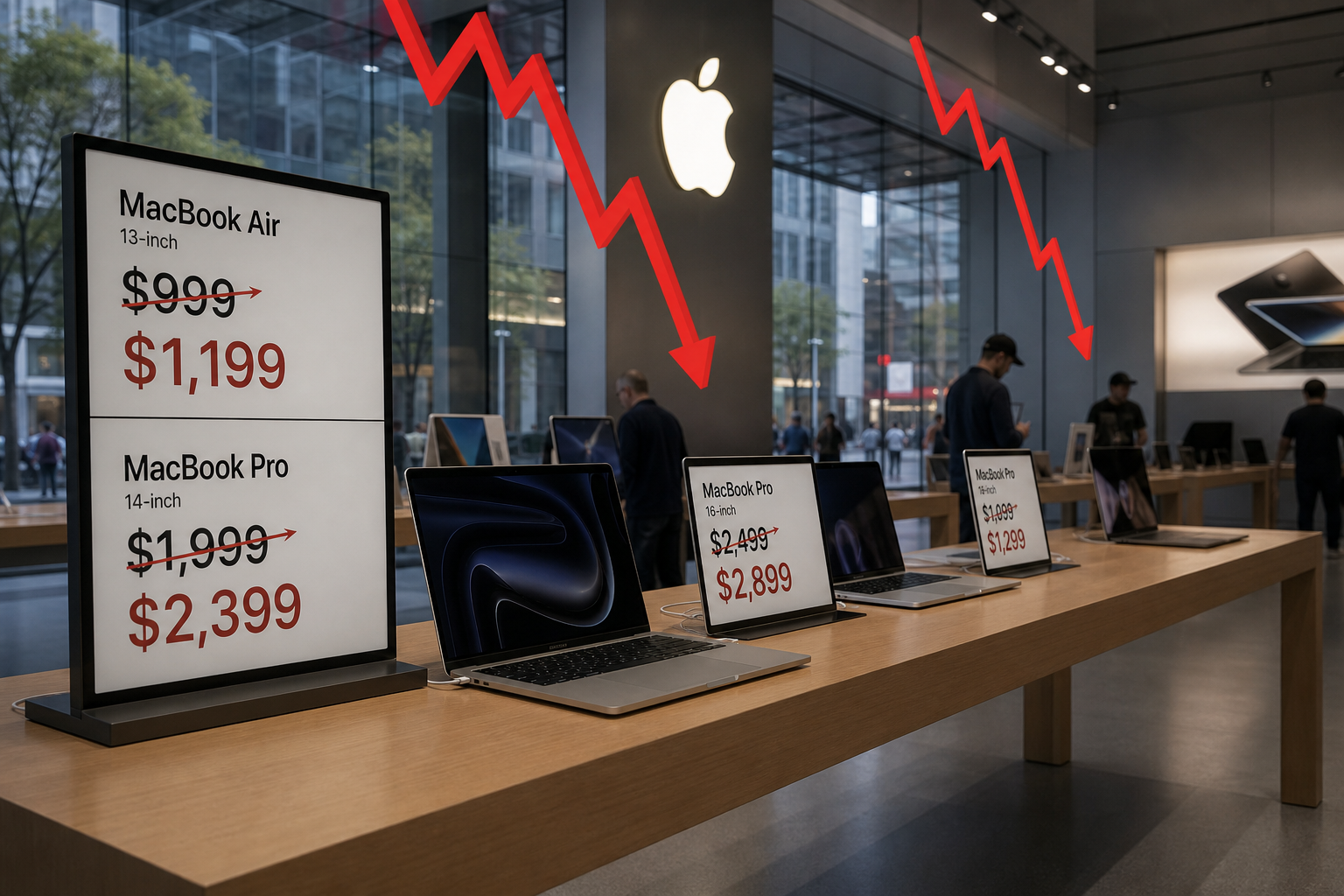
- Apple announced Thursday it is raising prices on MacBooks and iPads by 17% to 25% — MacBook Air up $200, MacBook Pro up $300, iPad Air up $150, iPad Pro up $200 — in what the company called "the most rapid and significant increase in component prices" it has ever experienced, warning that more hikes are coming including for the iPhone
- Apple stock plunged more than 6% on the news, its worst single-day decline in over a year, as Wall Street panicked over the threat of "demand destruction" — the fear that consumers will simply stop buying devices they can no longer afford
- The culprit is what the industry has dubbed "RAMageddon" — prices for dynamic random-access memory have surged as much as 98% in the first half of 2026 and are projected to rise another 58% to 63% in the coming quarter, driven by an insatiable AI data center buildout that is devouring the world's supply of memory chips
- CEO Tim Cook, who told The Wall Street Journal last week that the situation had "become unsustainable," is now facing his final major crisis before handing the reins — with Counterpoint Research estimating the upcoming iPhone 18 Pro could cost $200 more than its predecessor, potentially pricing out millions of consumers
- Research firm IDC now forecasts the global smartphone market will experience its largest annual decline in history — nearly 14% — while the PC market is expected to shrink 11.3%, as consumers worldwide balk at higher prices driven not by innovation but by a chip shortage created by artificial intelligence
The Price Tag the World's Richest Company Couldn't Absorb
For years, Apple has been the master of pricing power.
When competitors raised prices, Apple held the line. When component costs surged during the pandemic, Apple absorbed them. When supply chains broke down, Apple's legendary procurement machine kept products on shelves at the same prices consumers had come to expect.
On Thursday, that era ended.
Apple announced sweeping price increases across its MacBook and iPad lineups — the company's first significant consumer-facing price hikes driven by component costs in recent memory. The MacBook Air with 512GB of storage jumped from $1,099 to $1,299. The MacBook Pro with 1TB of storage surged from $1,699 to $1,999. The MacBook Neo climbed from $599 to $699. The iPad Air with 128GB rose from $599 to $749. The iPad Pro WiFi 256GB leapt from $999 to $1,199.
These aren't subtle adjustments. They represent increases of 17% to 25% across Apple's most popular computing products. And the company made clear this is only the beginning.
"The consumer electronics sector is confronting an unprecedented challenge," Apple said in a statement that briefly crashed its own online store as pricing updated. "We have never encountered a component price surge of this magnitude so rapidly. We have arrived at a juncture where price increases on several products are unavoidable."
Wall Street's Verdict: Worst Day in a Year
The market's reaction was swift and brutal. Apple shares plunged more than 6%, their steepest single-session decline since February and the worst day for the stock in over a year.
The selling wasn't driven by the price increases themselves — it was driven by what they represent. D.A. Davidson analyst Gil Luria called the hikes "quite substantial" and warned they appeared to go "beyond the increased cost of memory," suggesting Apple may be padding margins or preparing for even higher costs ahead.
The real fear on Wall Street has a name: demand destruction. When Apple raises the price of a MacBook Air by $200, some consumers will simply not buy it. When the iPad Pro crosses the $1,200 threshold, casual users will stick with their old devices. And when the iPhone 18 Pro — expected to launch in September — arrives with a rumored $200 premium over its predecessor, potentially starting at $1,299, the global smartphone market could see its worst year ever.
"The market is worried about the potential demand destruction that could come as a result of these higher prices," said one Wall Street analyst. And the data supports those fears: IDC now forecasts the smartphone sector will see its largest annual decline in history — nearly 14% — while the PC market is expected to shrink 11.3%.
RAMageddon: The AI Shortage That Changed Everything
The villain behind Apple's price crisis isn't Apple itself — it's artificial intelligence.
The term "RAMageddon" has swept through the semiconductor industry to describe an unprecedented reality: the world's supply of memory chips is being consumed by AI data centers at a pace that no one predicted even a year ago. Companies like Microsoft, Google, Amazon, and Meta are signing long-term contracts with memory manufacturers, locking up production capacity that would otherwise flow to consumer electronics.
The numbers are staggering. According to TrendForce, prices for DRAM — the type of memory used in virtually every modern computing device — surged as much as 98% in the first half of 2026. And it's not slowing down: projections call for an additional 58% to 63% increase in the coming quarter.
Counterpoint Research paints an even grimmer picture, noting that memory and storage prices have quadrupled over the past three quarters as manufacturers pivot production toward high-bandwidth memory for AI servers, leaving consumer-grade chips in increasingly short supply.
This is the dark irony of the AI boom. The same technological revolution that promises to transform how we work and live is simultaneously making the devices we use every day significantly more expensive. Micron Technology — whose memory chips power everything from iPhones to AI servers — just reported revenue growth of 346% and guided next quarter to $50 billion. Memory chipmakers have never been more profitable. And consumers have never been more squeezed.
The iPhone 18 Pro: A $1,299 Smartphone?
The most consequential price hike hasn't happened yet.
Counterpoint Research's Tarun Pathak estimates that the increased component costs could add approximately $200 to the price of each iPhone. If Apple follows through, the iPhone 18 Pro — historically priced at $1,099 for the base model — could debut in September at $1,299.
That price point would push Apple's flagship phone into true luxury territory, potentially alienating the millions of mainstream consumers who stretch their budgets for the latest iPhone. In emerging markets where Apple has been aggressively growing its user base, a $200 increase could be devastating.
Cook himself telegraphed the move last week in a rare interview with The Wall Street Journal. "Regrettably, price increases are unavoidable," he said. "We are striving to alleviate the substantial cost increases being passed on to us, and we've been attempting to protect our customers from these hikes, but the situation has become unsustainable."
Can Apple Weather the Storm?
Despite the selloff, not everyone on Wall Street is panicking.
Some analysts argue that Apple's brand loyalty and ecosystem lock-in make it uniquely positioned to pass costs along without catastrophic demand loss. Apple users don't just buy products — they buy into an ecosystem of services, apps, and integrations that makes switching prohibitively painful.
CNBC noted that Thursday's decline, while dramatic, represents "a bump in the road — but one that the tech giant is well-equipped to handle." The company still sits on mountains of cash and generates billions in high-margin services revenue that cushions hardware volatility.
But the bull case has limits. Apple can't raise prices indefinitely in a world where consumers have finite budgets. And with the memory shortage expected to extend beyond 2027, the cost pressure isn't going away anytime soon.
For the world's most valuable consumer electronics company, RAMageddon isn't a one-time event — it's the new normal. And Thursday's 6% plunge may be just the beginning of a painful recalibration for investors who assumed Apple was immune to the forces reshaping the semiconductor industry.
The question isn't whether Apple can survive RAMageddon. Of course it can. The question is whether its stock can maintain a premium valuation while its products become less accessible to the consumers who made it the most profitable company on Earth.
Found this helpful? Share it with others.