Key Bullet Points:
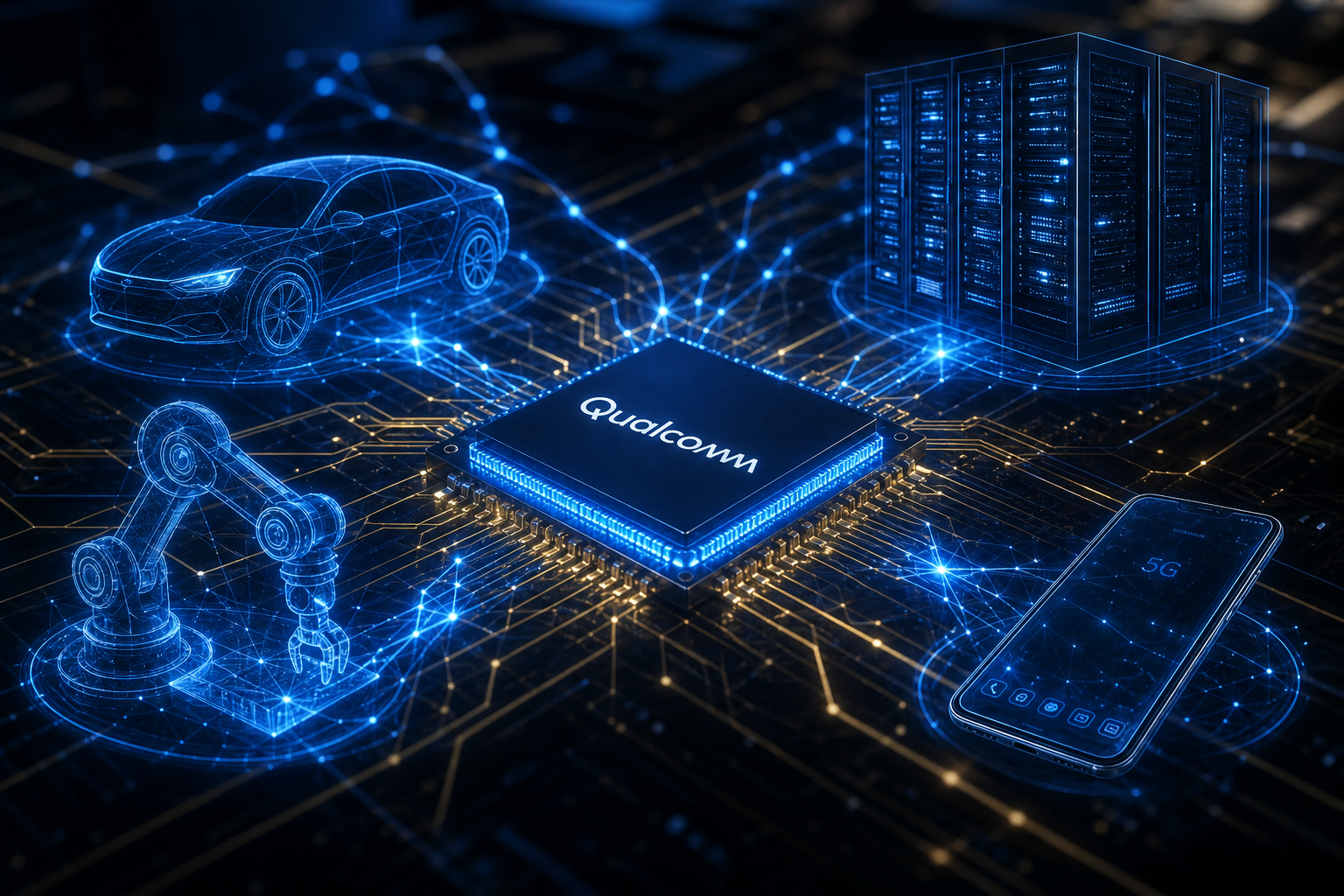
- Qualcomm unveiled a stunning strategic transformation at its 2026 Investor Day, nearly doubling its fiscal 2029 non-handset revenue target from $22 billion to $40 billion — powered by a massive push into AI data centers, autonomous vehicles, and industrial robotics that promises to remake the company from the ground up
- The stock surged more than 8% Thursday as investors absorbed the scope of the pivot — Qualcomm now targets $15 billion in data center AI infrastructure revenue by 2029, $10 billion from automotive, and more than $14 billion from IoT and industrial applications, while smartphones shrink to just one-third of its total chip revenue
- JPMorgan raised its price target on the stock by 66% — from $160 to $265 — calling Qualcomm's data center strategy a "three-pillar" approach built on custom silicon for hyperscalers, merchant CPUs, and AI accelerators that could generate $3 billion in revenue as early as fiscal 2027
- Qualcomm revealed an expanded automotive design-win pipeline of $65 billion, signaling that the world's biggest automakers are already betting billions on Qualcomm's chips for next-generation connectivity, infotainment, and advanced driver assistance systems
- The transformation comes at a critical moment for the semiconductor industry — as Nvidia dominates AI training and Micron reaps the memory boom, Qualcomm is quietly positioning itself as the company that brings AI to the edge, powering everything from self-driving cars to factory robots to the AI agents running on your phone
The Company Everyone Underestimated
For most investors, Qualcomm is "the phone chip company."
It's the firm that powers the wireless modems and processors inside hundreds of millions of Android smartphones. It's the company that collects licensing royalties on virtually every wireless device sold on Earth. It's a solid, profitable business — but not exactly the kind of story that makes portfolio managers lose sleep with FOMO.
On Wednesday evening, Qualcomm shattered that narrative entirely.
At its 2026 Investor Day — an event that lasted hours and featured detailed presentations from virtually every business unit — Qualcomm laid out a vision so ambitious that JPMorgan immediately raised its price target by 66%. The message was unmistakable: by fiscal 2029, Qualcomm will no longer be a phone chip company. It will be an AI infrastructure company that also happens to make phone chips.
The numbers tell the story. Qualcomm's new target for non-handset revenue is $40 billion by fiscal 2029 — roughly double its prior forecast of $22 billion. By that time, smartphones are expected to represent just one-third of its total chip revenue. The other two-thirds? AI data centers, autonomous vehicles, industrial robotics, and connected everything.
$15 Billion in Data Centers: The Shock Nobody Saw Coming
The biggest revelation was Qualcomm's data center ambitions.
The company announced it is targeting more than $15 billion in data center AI infrastructure revenue by fiscal 2029 — a segment that barely existed in its revenue mix a year ago. CFO Akash Palkhiwala told investors that the data center segment alone is projected to contribute $5 billion to fiscal 2027 earnings, with $1 billion of that coming from brand-new custom chip clients.
This isn't vaporware. According to JPMorgan analyst Samik Chatterjee, who described the strategy as a "three-pillar" approach, Qualcomm plans to enter the data center market through custom ASICs built for hyperscale customers — the Googles, Amazons, and Microsofts of the world — before layering on merchant CPU and AI accelerator products.
The accelerator push will be powered by Humain, Qualcomm's AI chip platform, which is designed to compete with Nvidia's data center GPUs on specific workloads, particularly inference — the process of running trained AI models in production.
Chatterjee's analysis projects Qualcomm could eventually target $35 billion in data center revenue by fiscal 2031 — a figure that would make it one of the largest data center chip companies in the world, alongside Nvidia, AMD, and Intel.
$10 Billion in Cars: The Automotive Goldmine
Qualcomm's second growth engine is hiding in plain sight — inside the dashboards and driver-assistance systems of the world's newest vehicles.
The company raised its automotive revenue target to $10 billion by fiscal 2029 and revealed that its automotive design-win pipeline has expanded to $65 billion — a massive war chest of committed business from automakers who have chosen Qualcomm's chips for their next-generation vehicles.
The automotive strategy spans four critical areas: connectivity (5G and satellite communications), infotainment (the screens and computers that power modern car interiors), advanced driver-assistance systems (ADAS, the technology that enables lane-keeping, adaptive cruise control, and eventually autonomous driving), and centralized compute (the "brain" that coordinates all vehicle systems).
This isn't a future bet — it's already generating meaningful revenue. And as vehicles become increasingly software-defined, requiring more computing power and connectivity, Qualcomm's chip content per vehicle is growing exponentially.
$14 Billion in IoT: When Everything Gets Smart
The third pillar of Qualcomm's transformation is the Internet of Things — and the numbers here may be the most surprising of all.
Qualcomm now targets more than $14 billion in IoT revenue by fiscal 2029, broken down into two segments: $8 billion from industrial, networking, and robotics applications, and $6 billion from personal AI and compute devices.
The industrial segment includes factory automation robots, 5G networking infrastructure, and edge computing devices that process AI workloads locally rather than in the cloud. The personal AI segment covers next-generation laptops, tablets, and wearables powered by Qualcomm's Snapdragon X Elite processors, which are increasingly competing with Apple's own silicon.
Why Wall Street Was Caught Off Guard
For years, the knock on Qualcomm was simple: it was too dependent on smartphones, and smartphones were a maturing market. That narrative suppressed the stock's valuation relative to "pure AI" plays like Nvidia.
Wednesday's Investor Day demolished that thesis. Qualcomm isn't just diversifying away from phones — it's building a multi-front assault on three of the largest technology markets in the world, each driven by the same secular trend: the proliferation of AI from the cloud to the edge.
The stock's 8% surge Thursday was just the opening salvo. JPMorgan's 66% price target increase — from $160 to $265 — suggests that Wall Street is only beginning to reprice Qualcomm for its new identity. And with the data center ramp expected to start generating meaningful revenue as early as 2027, the repricing may accelerate.
"Multiple large markets are reaching inflection points as AI compute becomes increasingly distributed across devices, edge and cloud over the next three to five years," Qualcomm said in its investor presentation — a line that reads less like corporate guidance and more like a manifesto.
The phone chip company just told the world it's done being a phone chip company. And the market is only starting to figure out what that means.
Found this helpful? Share it with others.